

The Holy Family with Saint John the Baptist

about 1500 · Glue size on canvas
Dimensions 71.1 x 50.8 cm
Collection: National Gallery, London
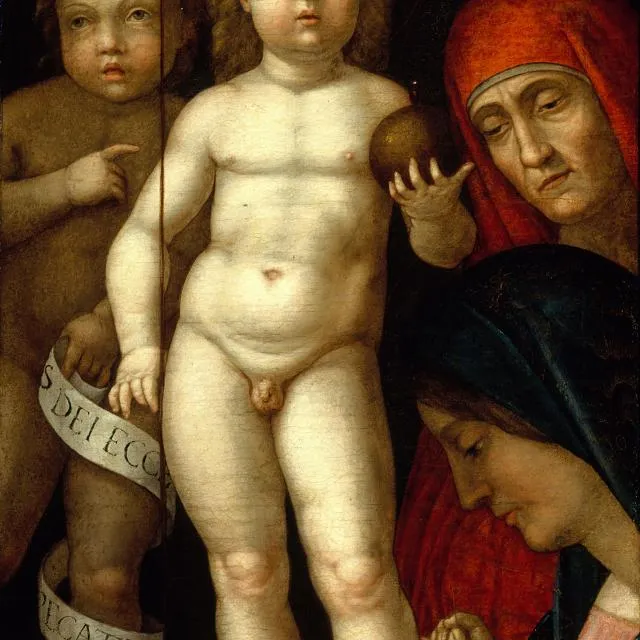
For many years, this picture was known as the ‘Imperator Mundi’ – the Ruler of the World. Christ is shown standing on the ledge of an oval structure, perhaps a well. He holds a crystal orb topped with jewels in his left hand and an olive branch in his right; he looks like a king or a Roman emperor. His very fine tunic clings to his body and we can see his little pot belly beneath it. One diagonal fold, running from his right leg to his left shoulder, recalls the folds of a Roman toga.Christ’s cousin, Saint John the Baptist, stands to his right. He looks out towards us, pointing at Christ, an indication of his role as his forerunner – the one who foretold the significance of Christ’s life and death. The scroll that unfurls around his leg was originally inscribed with the words he spoke about Christ as he baptised him: Ecce Agnus Dei (Latin for ‘Behold the Lamb of God’, John 1: 29). It was common for lambs and goats to be sacrificed to God; in the Christian tradition Christ took on the role and, by dying, redeemed the sin of humanity.The two toddlers dominate the scene: through their gestures, clothing and the objects they hold, Mantegna tells the whole story of Christian redemption through Christ. Christ’s parents, the Virgin Mary and Joseph, appear to have been squeezed in at the last minute, but Mary’s unusual position and gesture may also be significant. An engraving of the image dating to the early nineteenth century shows the Virgin holding an olive branch in her right hand; in the late nineteenth century this was removed by a restorer who replaced it with a book (thinking, perhaps, that since she’s looking down, she must originally have been reading).Once the picture joined our collection, technical analysis showed there was no evidence that she ever held a book and it was removed. By comparing this image with others by Mantegna (for example, the version in the Petit Palais, Paris) and one by his pupil Caroto, it seems more likely that the Virgin is sewing – both of these show her in a similar pose but with a needle. The Virgin shown sewing may be a reference to her humility.Another unusual aspect of this picture is the Virgin’s position: if the object is a well, then it looks as though Mantegna has placed the Virgin within it. This might be a reference to the fons signata (‘closed well’) which is described in Song of Solomon (4: 12), and which became a symbol of Mary’s sealed womb – and so her virginity.While small-scale images of the Virgin holding Christ in her arms were common and popular in Italian painting, similarly compact pictures showing the whole family or focusing on specific moments in Christ’s life, such as his circumcision, were new – one of Mantegna’s many innovations. Like many of Mantegna’s paintings in our collection, it is painted on canvas rather than panel (which was more common in this period). The paint surface is particularly worn and the canvas shows through in areas, giving it a slightly faded appearance.
51 collected·55 zoomed·0 comments
About this artwork
The Holy Family with Saint John the Baptist (about 1500) by Andrea Mantegna, Glue size on canvas, from the National Gallery, London collection.
About Andrea Mantegna
Andrea Mantegna (c. 1431 – September 13, 1506) was an Italian painter, a student of Roman archeology, and son-in-law of Jacopo Bellini. Like other artists of the time, Mantegna experimented with perspective, e.g. by lowering the horizon in order to create a sense of greater monumentality.
More by Andrea Mantegna
Comments (0)
No comments yet. Be the first to share your thoughts.