

The Juniata, Evening
1864 · oil on canvas
Dimensions overall: 50.8 x 76.2 cm (20 x 30 in.)
Collection: National Gallery of Art
Credit Gift of Max and Heidi Berry and Ann and Mark Kington/The Kington Foundation
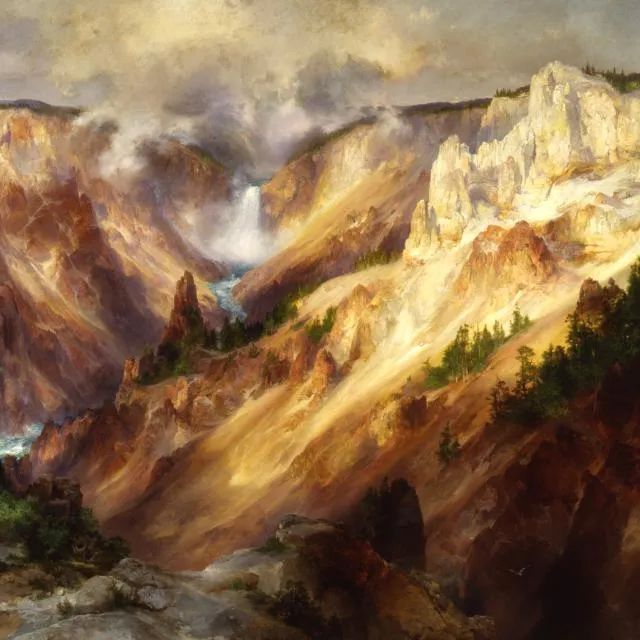
In the spring of 1871 Thomas Moran traveled to the American West for the first time. Immediately upon his return, he began producing the paintings that would change the course of his career. A gifted colorist, Moran was the first artist whose technical expertise matched the wonders of Yellowstone. In 1872 Congress purchased Moran's enormous canvas Grand Canyon of the Yellowstone and installed it in the Capitol. Soon Moran began signing his paintings with a creatively configured monogram incorporating three letters (TYM), reflecting his new fame as Thomas "Yellowstone" Moran.Moran's paintings of Yellowstone and later of the Grand Canyon and the Southwest were so revelatory in terms of wondrous geologic formations and astonishing color that they soon overshadowed all his previous work. Only recently have the remarkable eastern landscapes that Moran created before he journeyed west garnered the attention they deserve. One of the most beautiful and important of these works, The Juniata, Evening, has been acquired by the Gallery, thanks to the generosity of Max and Heidi Berry and Ann and Mark Kington/The Kington Foundation.Born in Bolton, England, raised in Philadelphia, Moran returned to his homeland in 1862 to study works by the artist he revered above all others—J.M.W. Turner. For several months he retraced Turner's path through England and France sketching the landscapes that had inspired the English master. Steeped in the writings of John Ruskin, Turner's early champion, Moran returned to Philadelphia and began producing a series of stunningly beautiful landscapes of the Pennsylvania countryside. Taking to heart Turner's example and Ruskin's advice (study nature carefully and reproduce her wonders accurately), Moran spent weeks sketching in the forests surrounding Philadelphia.In the summer of 1864 he ventured farther, traveling to central Pennsylvania where the Juniata River, a major tributary of the Susquehanna, flows through lush meadows and steep sandstone cliffs. Moran's painting of the valley is filled with closely observed detail: grazing sheep, farm dwellings, distant smoke, a lone traveler, and most remarkably, a foreground vignette of an artist (possibly a self-portrait) with a painting on his easel duplicating the scene before the viewer.Completed in September 1864, The Juniata, Evening was purchased—perhaps commissioned—by George Frederick Tyler, a Philadelphia banker and railroad executive. Moran signed and dated the painting in the lower left corner, placing the notation "Op 8" beneath his name. One year earlier he had begun numbering his studio paintings and recording key information about them on an "Opus List." Several pages of Moran's list survive including his notation for "Opus 8" The Juniata, Evening. Thus the completion date and first owner of the painting are known as well as the original purchase price: $200.
748 collected·670 zoomed·5 comments
About this artwork
The Juniata, Evening (1864) by Thomas Moran, oil on canvas, from the National Gallery of Art collection.
About Thomas Moran
Thomas Moran (February 12, 1837 – August 25, 1926) was an American painter and printmaker of the Hudson River School in New York whose work often featured the Rocky Mountains. Moran and his family, wife Mary Nimmo Moran and daughter Ruth, took residence in New York where he obtained work as an artist.
More by Thomas Moran
Comments (0)
No comments yet. Be the first to share your thoughts.