

The Nativity

1470-5 · Oil on poplar
Dimensions 124.4 x 122.6 cm
Collection: National Gallery, London
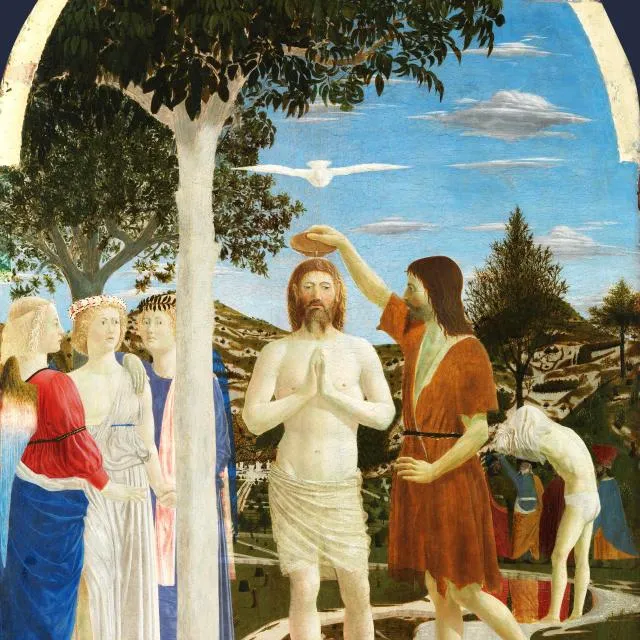
Piero made this picture – one of the very last he ever painted – for his family palace in his hometown of Sansepolcro, where it remained until the late nineteenth century. It is striking in its simplicity: he used mainly sandy brown and blue to unite the landscape and the groups of figures. This is only interrupted by the bright pink of Joseph’s robes and the green of trees and grasses that dot the largely bare earth and rocky mountainsides.As with the majority of Piero’s paintings, the figures are in mathematical proportion with each other and their surroundings; unlike The Baptism of Christ, for example, the image has no obvious geometry. Instead, the ramshackle and ruined brick lean-to that represents the stable in which Christ was born is at an awkward angle. Its slightly skewed position, combined with the setting of the holy figures on top of an exposed rocky outcrop, emphasises their precarious circumstances and their poverty. Piero brings the extraordinary circumstances of the birth of Christ directly into his own world by including a fortified town just like Sansepolcro in the valley below.Within this somewhat desolate and windblown setting, the Virgin Mary’s beauty and serenity as she meditates upon her son is all the more arresting. Her flawless pale complexion and fair hair – covered with a delicate, gauzy veil – follow Renaissance ideals of beauty. Humbly kneeling before him, she has offered her deep blue mantle – all she has – to protect his naked skin from the earth. She is depicted as both simple and majestic, her hair and neckline adorned with pearls. This image of the Virgin is inspired by the miraculous vision of Saint Bridget of Sweden, whose account of her experience was widely read in the fifteenth century and was popular in fifteenth-century paintings.Behind the Virgin are two shepherds, one pointing upwards, the other following the gesture with his gaze. Joseph, Mary’s husband, is seated on the donkey’s saddle in a pose drawn from a famous ancient statue known as the Spinario, in which a young boy pulls a thorn from his foot. A group of angels – whose loose, draped clothing make them look like classical sculpture – are playing lutes and singing, providing a heavenly soundtrack to this otherwise rustic scene. Even the donkey in the stable seems to be joining in, all recognising the incarnation of the divine in Christ.The picture was once thought to be unfinished; the underdrawing shows through in the shepherds' faces, for example. Technical examination, however, shows that traces of original finish – such as areas of highlighting – remain in these areas. It is likely the painting was damaged by restoration before it entered the National Gallery’s collection. Piero used oil paint here which means that, despite the poor condition, the colours appear more saturated than in his Baptism of Christ, which is painted in egg tempera.The picture might have served as the family’s private altarpiece – it is slightly too large to have been hung in a bedroom for private worship, as some small religious panels were. There may have been a chapel within the palace where it served as the focus of devotion. It may have been made as part of an ensemble: there might have been a lunette above or perhaps an image of the Virgin Annunciate.
62 collected·56 zoomed·0 comments
About this artwork
The Nativity (1470-5) by Piero della Francesca, oil on poplar, from the National Gallery, London collection.
More by Piero della Francesca
Comments (0)
No comments yet. Be the first to share your thoughts.