

The Painter's Daughters chasing a Butterfly

probably about 1756 · Oil on canvas
Dimensions 113.5 x 105 cm
Collection: National Gallery, London
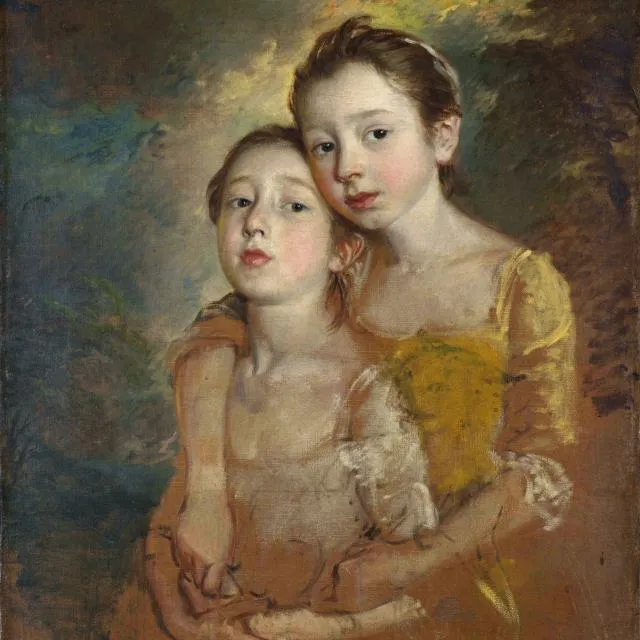
The two little girls in this unfinished portrait are Mary and Margaret, Gainsborough’s daughters by his wife Margaret Burr, and their only children to survive infancy. Both were born while Gainsborough was living and working in Sudbury in Suffolk, his own birthplace. Mary was baptised on 3 February 1750 and Margaret on 22 August 1751 – they were probably only 18 months apart in age.Mary and Margaret are running hand-in-hand through a dark landscape in pursuit of a cabbage white butterfly, which has landed momentarily on a tall thistle. Margaret reaches out her hand for the butterfly, while Mary clutches her looped-up muslin apron like a net. The children’s attempt to catch the elusive butterfly may be intended to suggest the fleeting nature of childhood. The wood in Gainsborough’s picture is dark and sombre.The Painter’s Daughters chasing a Butterfly is likely to have been painted in about 1756 while the family was living in Ipswich. Mary seems to be about six years old, and Margaret about four or five. The garden of the house Gainsborough rented adjoined that of a much larger house, occupied by his friend Revd Robert Hingeston, who was Master of Ipswich School. On 20 October 1759, before leaving Ipswich for Bath, Gainsborough put an advertisement in the local newspaper listing all of his household goods, some pictures and landscape drawings for sale. Unless this painting of his daughters was a gift from Gainsborough, it is likely that Hingeston bought the picture of the two little girls he must often have seen playing in their garden at this sale.Before this portrait, Gainsborough had probably never tried painting two full-length and almost life-sized figures. His earlier figures portrayed in the open air such as Mr and Mrs Andrews are quite small in scale and somewhat doll like. His daughters by contrast are shown much larger and in bold, entirely natural attitudes. Painting his own children allowed Gainsborough the freedom to experiment with handling paint, which gives this portrait its remarkable spontaneity and freshness. The pinkish-brown ground is left clearly showing through Margaret’s dress, her apron and her outstretched foot, while thick streaks of white suggest the movement of the fabric in the sunlight. The girls‘ faces are highly finished, but elsewhere Gainsborough’s brushwork is loose and expressive.Gainsborough is known to have painted six double portraits of his daughters, as well as separate portraits of each of them, between about 1756 and 1770. When Gainsborough painted the girls together he always showed them fondly holding hands, or protecting one another with an arm or half-embrace, as in The Painter’s Daughters with a Cat.As they grew up, Mary showed signs of mental instability and Margaret of eccentricity. Gainsborough’s fifth double portrait of his daughters as students of drawing (Worcester Art Museum, Massachusetts) reveals his hope they could be trained to draw well enough to earn money, but no work by either daughter is now known. After a brief unhappy marriage in 1780, Mary returned to her parents’ house. Margaret never married, and the sisters lived together the rest of their lives.
84 collected·100 zoomed·1 comments
About this artwork
The Painter's Daughters chasing a Butterfly (probably about 1756) by Thomas Gainsborough, oil on canvas, from the National Gallery, London collection.
About Thomas Gainsborough
homas Gainsborough RA FRSA (14 May 1727 (baptised) – 2 August 1788) was an English portrait and landscape painter, draughtsman, and printmaker.
More by Thomas Gainsborough
Comments (0)
No comments yet. Be the first to share your thoughts.