

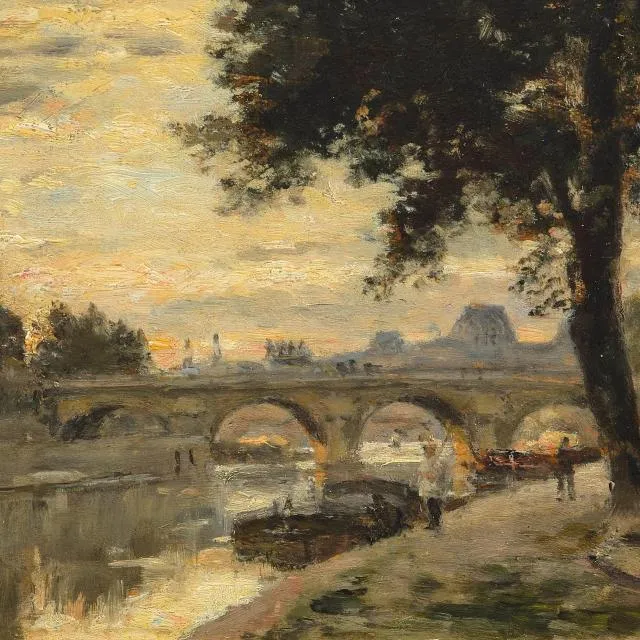
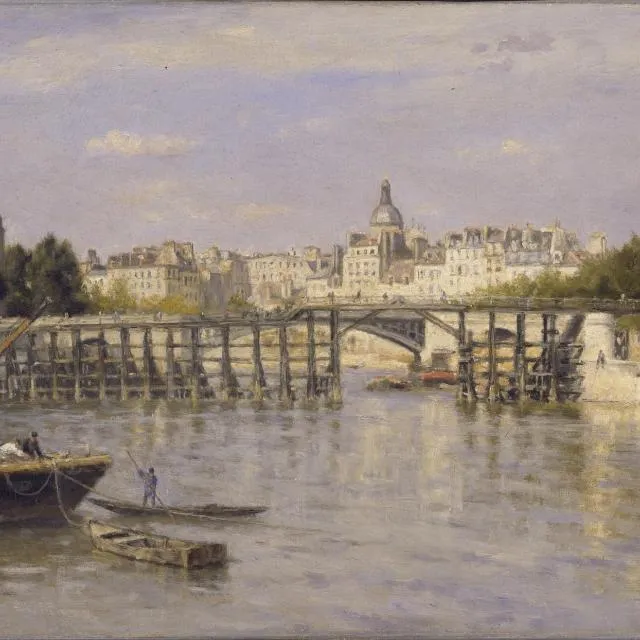
The Pont de la Tournelle, Paris

1862-4 · Oil on canvas
Dimensions 13.7 x 24.4 cm
Collection: National Gallery, London
Views of the river Seine in Paris, with its many quays and bridges, were a favourite subject for Stanislas-Victor-Edmond Lépine and form a substantial part of his work. He was especially drawn to the Pont de la Tournelle, whose backdrop included wide views of the river and some of the city’s oldest areas. Made of stone, the bridge connected the left bank of the river (at the quai Saint-Bernard) to the Ile Saint-Louis. ‘Tournelle’ refers to a square turret (tournelle) built at the end of the twelfth century. The arched bridge we see here was constructed in 1654, but was replaced in 1928 by the bridge that exists today.In this painting, we are looking west – perhaps from the Pont de Sully or from what is now the Square Barye on the easterly tip of the Ile Saint-Louis – across the full span of the bridge. The two towers, spire and apse of Notre-Dame Cathedral on the Ile de la Cité are just to the right. The tower in front of the Pont de la Tournelle is what remained of another bridge, the Pont de Constantine.On the horizon, just left of centre, you can see a tall structure. This is probably the Eiffel Tower, which had only recently been built for the 1889 World’s Fair. Its presence dates the picture to the final years of Lépine’s life (he died in 1892), almost 30 years later than it was previously believed to have been painted. The Eiffel Tower’s height made it a distinctive landmark, but Lépine typically avoided views of modern Paris, such as the wide boulevards that had been built by Baron Hausmann between 1853 and 1870. These new boulevards, together with scenes of crowds and leisure, particularly appealed to the Impressionists– as can be seen, for example, in Pissarro’s The Boulevard Montmartre at Night. Lépine, however, focused on areas and activities that were beginning to disappear and which lacked the visual excitement of contemporary life.Lépine sometimes worked on location, but large paintings were painted in his studio. These are also more detailed and have a smoother finish than this one. Although signed, this small picture is probably a sketch painted on site. Lépine limited the colours to shades of yellow, grey, brown and blue, with small highlights of white and red, as he has recorded the principal architectural features. Little is known about Lépine’s early training and he appears to be largely self taught. However, as a young man he spent some time studying with Corot. The emphasis in this sketch on atmosphere and muted tonal harmonies suggests Corot’s lasting influence.Lépine is a transitional figure who occupies a place between the Barbizon School and Impressionism. He participated in the first Impressionist exhibition in 1874, but not in later exhibitions by the group.
55 collected·35 zoomed·0 comments
About this artwork
The Pont de la Tournelle, Paris (1862-4) by Stanislas Lepine, oil on canvas, from the National Gallery, London collection.
About Stanislas Lepine
Stanislas Victor Edouard Lépine (October 3, 1835 – September 28, 1892) was a French painter who specialized in landscapes, especially views of the Seine. Lépine was born in Caen. An important influence in his artistic formation was Corot, whom he met in Normandy in 1859, becoming his student the following year.
More by Stanislas Lepine
Comments (0)
No comments yet. Be the first to share your thoughts.