

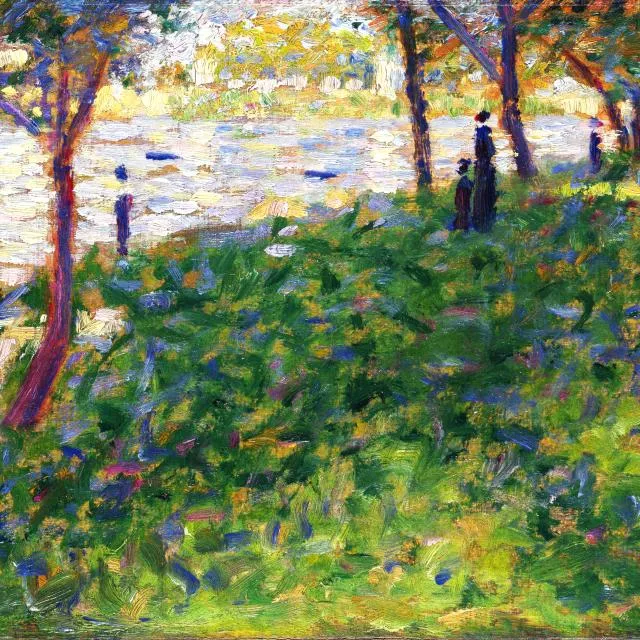
The Seine seen from La Grande Jatte

1888 · Oil on wood
Dimensions 15.7 x 25 cm
Collection: National Gallery, London
In the spring of 1888 Seurat, accompanied by his friend and fellow artist Charles Angrand, returned to the site shown in his monumental painting of 1884, A Sunday Afternoon on the Island of La Grande Jatte (The Art Institute of Chicago). Both the island itself and the views from it across the river Seine were a rich source of pictorial subjects for Seurat, and he produced over 100 small oil sketches of the area. He was clearly drawn to the location, in part because of the forms and structures it offered. The horizontals of the river, its banks and the skyline combined with the verticals of trees, sails and occasional standing figures provided a ready-made grid for his compositions, within which he could arrange particular motifs.This study, which was first owned by Angrand, formed the basis for a larger painting of 1888 The Seine from La Grande Jatte (Royal Museums of Fine Arts of Belgium, Brussels). It was very likely painted outdoors. We see in it the characteristic key components that appear in many of Seurat’s sketches, notably the horizontal formed by the distant river edge and embankment that runs across the full width of the picture, which is countered by the vertical tree trunk to the far right. Seurat has offset these by including the diagonal of the near riverbank, the green triangle of which cuts into what would otherwise be an almost unbroken band of blue water. He has also included a second tree trunk, the curved shape of which echoes the slight leftward lean of the sailboat.Seurat initially placed a large white-sailed yacht to the left of the picture, but then changed his mind and painted over it. The ghostly trace of the original is still visible. He also painted over the base of the tree. In the final painting, however, Seurat reinstated the yacht in the middle distance and introduced a single rower on a skiff. He also made the lower tree trunk much more solid and extended the area of land in the foreground.Most of Seurat’s small oil studies were painted on bare wooden panels, with the natural colour of the wood often visible beneath the brushstrokes. This panel, however, was first covered by a dense white primer, which gives the picture a distinct luminosity and enhances the brilliance of the colours. While Seurat’s earlier sketches were more Impressionist in technique – for example, The Morning Walk – here he has used a loose version of pointillism in which, with the exception of the sails, the paint is laid down in almost identically sized dabs of unmixed colour. A line of dots of blue and orange – themselves complementary colours – can just be seen along the upper edge of the picture. Although they do not continue around all four edges, these are the beginning of the coloured border that appears in the final painting. As with the changed position of the yacht, they are evidence of Seurat trying out ideas as he painted.
83 collected·112 zoomed·0 comments
About this artwork
The Seine seen from La Grande Jatte (1888) by Georges Seurat, oil on wood, from the National Gallery, London collection.
About Georges Seurat
Georges-Pierre Seurat (2 December 1859 – 29 March 1891) was a French post-Impressionist artist. He is best known for devising the painting techniques known as chromoluminarism as well as pointillism.
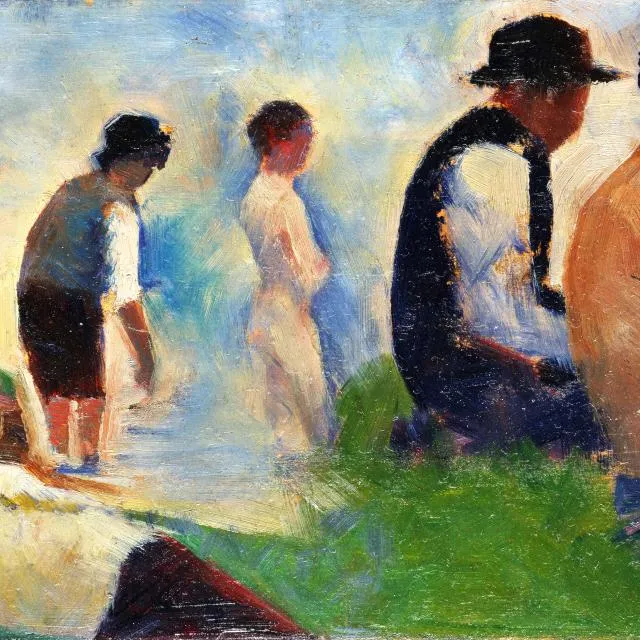
More by Georges Seurat
Comments (0)
No comments yet. Be the first to share your thoughts.