

The Trinity

1455-60 · Egg tempera, tempera grassa and oil on wood
Dimensions 185.5 x 91 cm
Collection: National Gallery, London
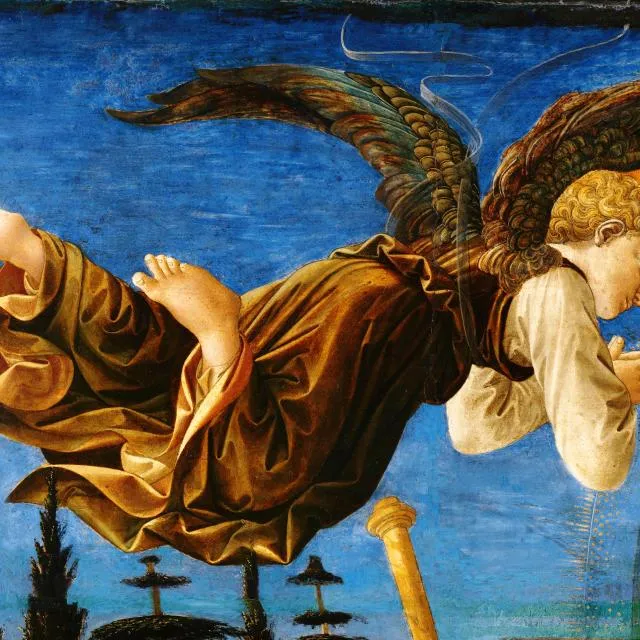
God the Father floats in mid-air, surrounded by red and blue cherubim and seraphim, holding up the Cross; Christ’s body hangs on it. The dove of the Holy Ghost hovers between them. This way of showing them is known as a ‘Throne of Grace Trinity’, and in medieval Christian theology signified God’s acceptance of Christ’s sacrifice.This oddly shaped painting was cut from a pala, an altarpiece with a single, unified surface. The Pistoia Santa Trinità Altarpiece was commissioned in 1456 by a confraternity of priests dedicated to the Trinity – hence the subject – but was cut into pieces, probably when the confraternity was suppressed, in the late eighteenth century.The painting was begun by Francesco Pesellino, and completed after his death by Fra Filippo Lippi. On Pesellino’s death the altarpiece was described as ‘half finished’ and we're not completely sure which bits were done by which artist. Presumably all the preparatory stages – the design, the underdrawing and the water-gilding, where gold leaf was applied using an animal glue mixed with water and then burnished – were done by Pesellino. Technical analysis shows that the whole composition was drawn in great detail before painting began; there’s even a surviving preparatory drawing of God from the Trinity (State Hermitage Museum, St Petersburg). All Pesellino’s figures were done in the same way, with a thin wash of paint over a strong drawing, and show a good grasp of form and structure.But parts of the Trinity are less convincing, and were perhaps left unfinished when Pesellino died. God’s hands are oddly boneless; Christ’s beard seems to have been added in at a late stage, and his body is painted in a single layer of paint and might not be finished. God’s hands and Christ’s body are blank in the St Petersburg study, but possibly for very different reasons. Pesellino could copy the body – a conventional pose – from an existing image of the Crucifixion, but he might have left the hands until he could do a study from life, mindful of the difficultly of showing hands bearing the weight of the Cross.Lippi and his workshop were responsible for things done in the final stages, such as the dots for the foliage on the trees, the detailing which disguises the juncture in the middle ground between the two types of landscape, and the mordant gilding. This was among the final stages in the execution of a panel painting, and involved applying gold leaf over the paint surface. Cleverly, in parts of the painting which were intended to catch the light – such as the left side of God’s tiara and the yellow lining of his robe – decoration was done in mordant gilding, while paint was used on the darker right side. This technique is also found in other works accepted by Lippi.Considering everything the painting has gone through, the individual parts are in quite good condition. Some of the colours have changed over time: the blue azurite of the Cherubim has darkened, as has the red vermilion used to paint the details of the seraphim’s wings. Parts of the mordant gilding has flaked off God’s tiara and the mandorla which surrounds him, and the dark area behind his head was originally a rich green.
62 collected·52 zoomed·0 comments
About this artwork
The Trinity (1455-60) by Francesco Pesellino, Egg tempera, tempera grassa and oil on wood, from the National Gallery, London collection.
More by Francesco Pesellino
Comments (0)
No comments yet. Be the first to share your thoughts.