

The Virgin and Child with the Magdalen and Saint John the Baptist

about 1490-1505 · Egg tempera on canvas
Dimensions 139.1 x 116.8 cm
Collection: National Gallery, London
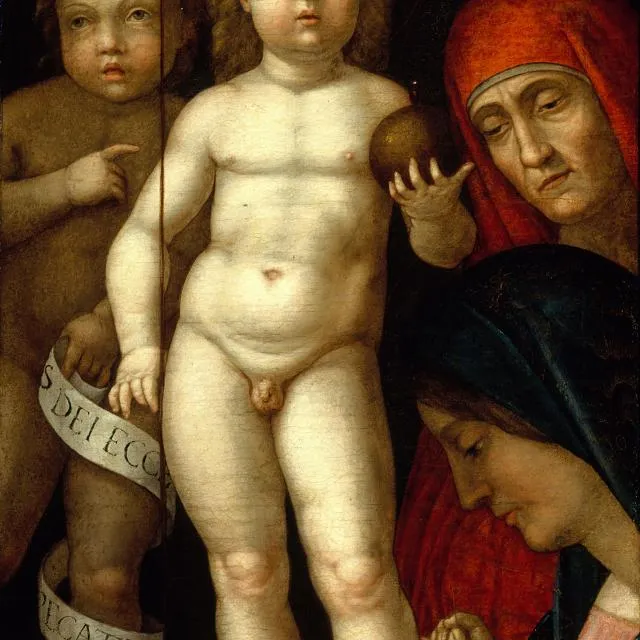
The Christ Child stands on the Virgin Mary’s lap, making a gesture of blessing. She is seated under a red canopy, between John the Baptist and Mary Magdalene. An unfurling scroll is inscribed with the words John spoke about Christ just before he baptised him: ‘Behold the Lamb of God, who takes away the sin of the world’ (John 1: 29).Mantegna has painted the figures as though they stand before us. John the Baptist’s skin is tanned, he has stubble around his jaw and his bones show through his skin – he is emaciated after his time in the wilderness prophesying the coming of Christ. He wears a simple tunic made from an animal hide, its rugged edge curling over around the neck and arms. Mary Magdalene looks up towards heaven and raises up a small pot, a reminder of the spices that she anointed Christ’s body with after his death. Her full, fair curls and the way the light hits her neck and chest make her look like a sculpted marble statue of an ancient goddess.Mantegna has adopted the contrapposto pose of classical sculpture, first revived in sculpture by Donatello (whose work Mantegna encountered in Padua). This asymmetrical pose, where the body curves gently as though the figure is swaying, makes them appear light and graceful. It is most obvious in the naked figure of Christ. The figures‘ draperies are a striking focus point – all three are wrapped in volumes of cloth which reveal the shape of their bodies. The knees and thighs of the Virgin and Mary Magdalene are revealed and concealed by the fabric, in the same way as ancient sculptures of goddesses. Mary Magdalene’s dress, with its multiple folds and pleats, especially recalls the arrangement of draperies of ancient statues. In this way the figures are imbued with the dignity and status of the art of antiquity, as well as appealing to the contemporary taste for these kinds of objects. The network of jagged lines created by these folds adds pattern and detail to the central part of the picture; the bright colours, the apples in the trees, and the plants and grasses springing from the rocky soil add vibrancy to the scene.These appealing details contrast with the sombre anchor of the scene, the Virgin Mary. Her solemn expression as she rests her head against that of her child is one of maternal tenderness, but also an indication of her grief to come. Along with John the Baptist’s cross and Mary Magdalene’s ointment, it is a reminder of the fate of her son: his crucifixion and death.This type of altarpiece, where the holy figures are shown together, occupying the same imaginary space, is known as a sacra conversazione. At the time, this format was relatively new in Venice, where it had been pioneered by Bartolomeo Vivarini and Marco Zoppo. It was developed to its fullest potential by Giovanni Bellini. We don’t know which church this altarpiece was made for, but as it is painted on canvas rather than wooden panel Mantegna could have produced it in his studio in Mantua, rolled it up and sent it to wherever it was required. It is first documented in Milan.The whole picture is contained within a black border, speckled with red – perhaps in imitation of a marble frame or window – which seems to have been cut down on three sides. Mantegna signed the inside of John’s scroll: ‘Andreas Mantinia C.P.F.’ The ‘F’ is for fecit, Latin for ‘made this’; the ‘C.P.’ may stand for ‘Comes Palatinus’, Count of the Palatine, a title given to Mantegna in 1469.
57 collected·40 zoomed·0 comments
About this artwork
The Virgin and Child with the Magdalen and Saint John the Baptist (about 1490-1505) by Andrea Mantegna, Egg tempera on canvas, from the National Gallery, London collection.
About Andrea Mantegna
Andrea Mantegna (c. 1431 – September 13, 1506) was an Italian painter, a student of Roman archeology, and son-in-law of Jacopo Bellini. Like other artists of the time, Mantegna experimented with perspective, e.g. by lowering the horizon in order to create a sense of greater monumentality.
More by Andrea Mantegna
Comments (0)
No comments yet. Be the first to share your thoughts.