

Time unveiling Truth
1733 · Oil on canvas
Dimensions 203 x 208 cm
Collection: National Gallery, London
Winged Father Time unveils Truth, who is dressed in white and rests her foot on a globe, symbolising the Earth from which she has sprung. With her left hand, Truth unmasks Deceit, while with her right she gestures to the four cardinal virtues: Prudence, holding a snake; Temperance, carrying a water jug; Justice, with sword and scales; and Fortitude, who rests her elbow on a courageous lion. Deceit’s second mask – a sign of her two-faced nature – lies beside her.Jean-François de Troy has juxtaposed Truth’s white drapery and bare feet with Deceit’s dark blue drapery and leather slippers, contrasting Truth’s purity with Deceit’s dark nature. The idea of Truth springing from the Earth is also found in Psalm 85: 11: ‘Truth shall spring out of the Earth.’ Truth was also believed to be more powerful than all earthly things, and to be above the baseness of the world.The monumental figures occupy the foreground of a landscape like actors on a stage set. They are organised in a balanced pyramidal arrangement with Time and Truth positioned at the top, perhaps to indicate that they will triumph. While all the figures look at Truth, she looks at us, drawing us into the image and guiding us around it by the interplay of glances and hand gestures. The inclusion of the domed temple on the right, which also appears in de Troy’s The Virgin Mary and Souls in Purgatory of 1710 (San Donato, Genoa), may be intended to suggest the classical origins of the subject.The classical motto, ‘Truth is the daughter of Time’, means that truth becomes apparent through the passage of Time. The idea was depicted in two books which explained how to represent symbolic subjects: Alciati’s Emblemata of 1531 and Ripa’s Iconologia of 1593. In France, the theme appeared during the seventeenth century and continued to be depicted into the eighteenth century. De Troy must have known of Poussin’s version of the subject, painted in 1641 for Cardinal Richelieu’s ‘Grand Cabinet’ in the Palais Cardinal, Paris, in which Time rescues Truth from Anger and Evil. The pose of de Troy’s Truth is derived from the figure of Truth in Gian Lorenzo Bernini’s unfinished sculpture Time and Truth of about 1645–7, which de Troy probably saw during his stay in Italy between 1699 and 1706, or otherwise knew from an engraving published in Paris in 1707.De Troy was praised for the accuracy with which he painted everything from nature. We see his sound understanding of human anatomy in the figure of Time, although he seems to have had a little difficulty with the legs, which appear detached from the rest of the body. Technical examination reveals that de Troy made some changes to the composition during painting: the head of the snake was originally painted turned inwards to face Prudence holding it, and the architecture was slightly higher and further to the left. The globe may originally have been placed just to the right of Fortitude’s outstretched arm.We do not know who commissioned the painting, although it is signed and dated on the globe. There is a painted copy by Sebastian Staessens of 1794 (Pushkin Museum of Fine Arts, Moscow).
117 collected·200 zoomed·1 comments
About this artwork
Time unveiling Truth (1733) by Jean Francois de Troy, oil on canvas, from the National Gallery, London collection.
About Jean Francois de Troy
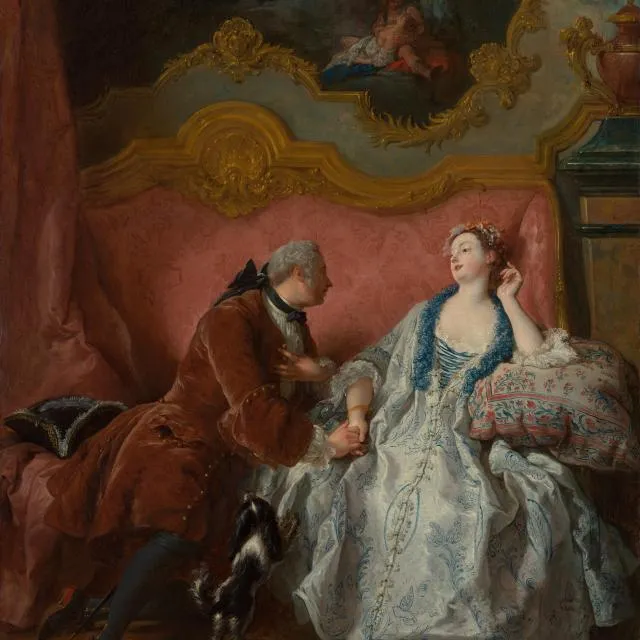
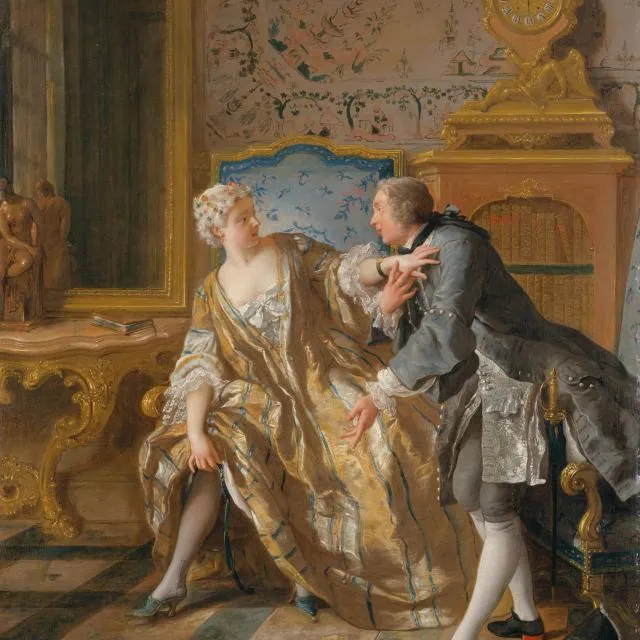
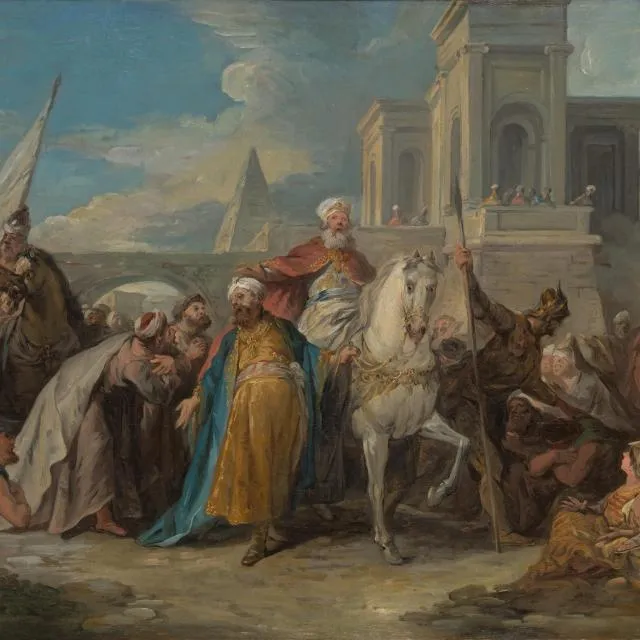
Jean François de Troy (27 January 1679, Paris – 26 January 1752, Rome) was a French Rococo easel and fresco painter, draughtsman and tapestry designer. One of France's leading history painters in his time, he was equally successful with his decorative paintings, genre scenes and portraits.
More by Jean Francois de Troy
Comments (0)
No comments yet. Be the first to share your thoughts.