

Water-Lilies
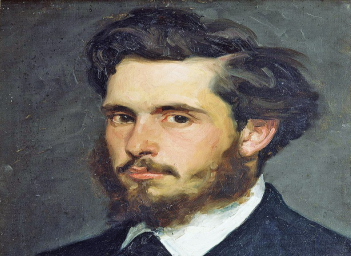
after 1916 · Oil on canvas
Dimensions 200.7 x 426.7 cm
Collection: National Gallery, London
In the years before he painted this canvas Monet experienced some tragic events that had led to a relatively fallow period in his artistic output. His wife Alice died in 1911 and his son Jean in 1914, not long after he himself was diagnosed with cataracts that affected his vision. But in the summer of 1914, on the brink of the First World War, he began to paint again, refusing to join the ranks of people fleeing from Paris and Giverny. Apparently feeling it was his patriotic duty to continue working, he concentrated on his water garden – a subject that was to preoccupy him until his death 12 years later.It seems that Monet had long had it in mind to paint an entire decorative scheme consisting of a continuous panorama of water and flowers in a circular room, but he did not begin to put his plan into practice until 1916, when he had a new studio built at his home in Giverny in order to work on the huge canvases, each of them more than two metres high. These monumental paintings, which show close-up views of the water, have long sweeps of canvas dominated by a single colour.Monet worked concurrently on many of them for several years. From an early stage he envisaged presenting them to the French nation, and he was encouraged in this by his friend Georges Clemenceau, who was Prime Minister of France from 1917 to 1920. In 1918, the day after the Armistice was signed, the painter promised a group of the paintings to the French nation as a particularly personal war memorial that honoured victory and peace and offered an immersive experience that enabled the viewer to forget the outside world. He originally intended 12 canvases to be hung in the Hôtel Biron in Paris, which the French government planned to open as the Musėe Rodin, but later agreed that they would be housed at the Orangerie. Twenty-two of his water-lily canvases were installed there in 1927, the year after his death, in two specially designed oval rooms. The rest of the large-scale water-lily canvases, of which this is one, remained in Giverny until after the Second World War.The canvases on show in the Orangerie tend to have recognisable details of trees and foliage which act as compositional anchors and help locate the viewer in the scene. However, this painting lacks any of these; distance and perspective are abolished and a limitless expanse of water occupies our entire field of vision. The water lily pads seem to play a secondary role, floating outwards towards the edges, leaving a space in the centre. It is not clear whether this shows the reflections of willows, sky or cloud. The huge pale picture surface is alive and shimmering with trails of green, ochre, violet, yellow, sky blue and pink.When the painting went on display at the National Gallery in 1963, one commentator noted ‘It is a great area of drifting, nebulous colour with which it is very difficult to establish any consistent relationship. The only proper reaction would be to dive into it and drown.’
505 collected·884 zoomed·1 comments·2 boards
This artwork is in 2 boards
About this artwork
Water-Lilies (after 1916) by Claude Monet, oil on canvas, from the National Gallery, London collection.
About Claude Monet
(November 1840 – 5 December 1926) Oscar-Claude Monet was a French painter, a founder of French Impressionist painting and the most consistent and prolific practitioner of the movement's philosophy of expressing one's perceptions before nature, especially as applied to plein air landscape painting.
More by Claude Monet
Comments (0)
No comments yet. Be the first to share your thoughts.