

Water-Lilies, Setting Sun

about 1907 · Oil on canvas
Dimensions 73 x 92.7 cm
Collection: National Gallery, London
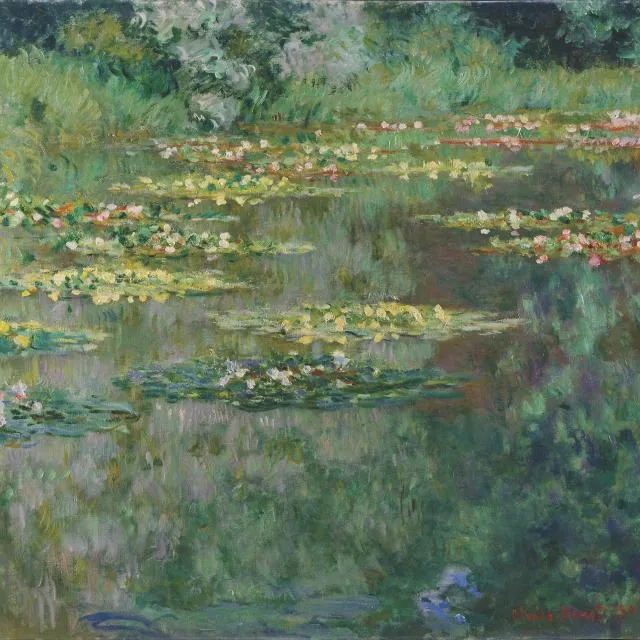
During the final two decades of his life Monet devoted himself to painting the water garden he had created at his home in Giverny, producing around 250 innovative canvases. Around 200 of these represent just the water-lilies floating on the surface of the water, while the remainder show the Japanese bridge at the northern edge of the pond, the weeping willow trees, wisteria, irises, agapanthus and day lilies on its banks.From 1902 to 1908 Monet concentrated on an extended series of views of the water-lily pond that marked a radical departure in his work. He gradually did away with the banks of the pond and the traditional horizon line and abandoned the depiction of the Japanese bridge and trees (which can be seen in earlier paintings such as The Water-Lily Pond) in order to concentrate on the subtle modulations of light as it transformed the water and the reflections of foliage and clouds. The exercise was challenging and at times frustrating, and Monet even destroyed some of the canvases because he was dissatisfied with them. But in May 1909 he exhibited 48 paintings at Durand-Ruel’s gallery in Paris with the title ‘Water lilies: Series of Water Landscapes.’ The critical response was overwhelmingly positive, and by the end of the year 19 of the pictures had been sold. One commentator wrote that ‘Monet has reached the final degree of abstraction and imagination allied to the real that his art of the landscapist allows.’In this painting we are looking down on the surface of the pond. We see reflections in the water, but not the sky and trees that are being reflected. The only hint to help situate us is the clump of plants in the bottom left corner, which indicates the approximate position of the bank. These plants may have been added after the main body of the painting was completed in about 1907, as a photograph taken in Monet’s studio at around that date shows the picture without them. The leaves are sketched in with quickly applied, almost calligraphic brushstrokes that recall Japanese brush painting. Pink and yellow light from the setting sun shimmers on the still surface of the water in which the water lilies float. Monet conveys the flatness of the water surface while at the same time indicating its depth. There is an intriguing interplay between the horizontal lily pads and the dark vertical reflections of the weeping willows.Another person who saw the exhibition at Durand-Ruel’s was Marcel Proust, who was starting his monumental 12-part novel In Search of Lost Time (A la Recherche du Temps Perdu). His description of the waterlilies on the river Vivonne in the first volume, Swann’s Way, is based on Monet’s pictures: ‘…the heavy shade of the trees gave the water a background which was ordinarily dark green, although sometimes, when we were coming home on a calm evening after a stormy afternoon, I have seen in its depths a clear, crude blue that was almost violet, suggesting a floor of Japanese cloisonné. Here and there, on the surface, floated, blushing like a strawberry, the scarlet heart of a lily set in a ring of white petals.’Monet kept this painting in his studio until 1923, when he may have reworked it.
409 collected·713 zoomed·3 comments·1 boards
This artwork is in 1 board
About this artwork
Water-Lilies, Setting Sun (about 1907) by Claude Monet, oil on canvas, from the National Gallery, London collection.
About Claude Monet
(November 1840 – 5 December 1926) Oscar-Claude Monet was a French painter, a founder of French Impressionist painting and the most consistent and prolific practitioner of the movement's philosophy of expressing one's perceptions before nature, especially as applied to plein air landscape painting.
More by Claude Monet
Comments (0)
No comments yet. Be the first to share your thoughts.