

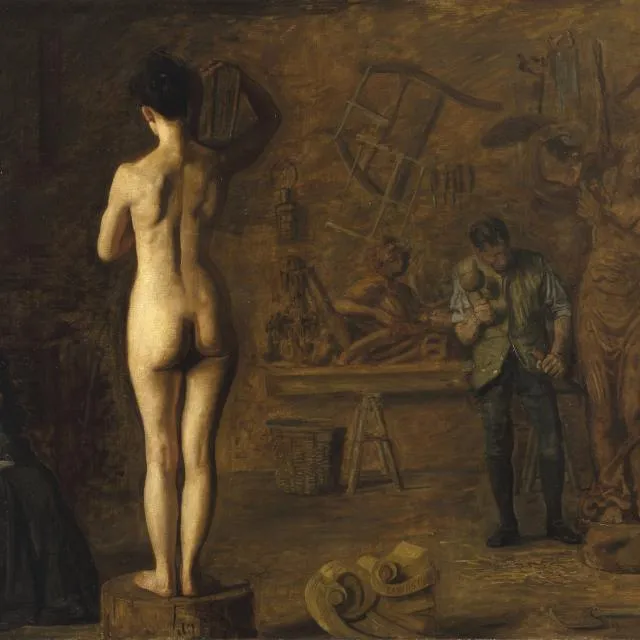
William Rush and His Model

1877 · oil on canvas mounted on masonite
Dimensions 51.1 × 66.3 cm
Collection: Art Whisperer
William Rush and His Model is the collective name given to several paintings by Thomas Eakins, one set from 1876–77 and the other from 1908. These works depict the American wood sculptor William Rush in 1808, carving his statue Water Nymph and Bittern for a fountain at Philadelphia's first waterworks. The water nymph is an allegorical figure representing the Schuylkill River, which provided the city's drinking water, and on her shoulder is a bittern, a native waterbird related to the heron. Hence, these Eakins works are also known as William Rush Carving His Allegorical Figure of the Schuylkill River. Philadelphia's first waterworks was located at Centre Square, now the site of Philadelphia City Hall. Steam engines drew drinking water from the Schuylkill River and pumped it up to tanks in the engine house tower, from which it was distributed by gravity through underground mains to the city. Rush, a carver of ship figureheads, was commissioned in 1808 to carve an allegorical statue to be the centerpiece of an ornamental fountain. His pine statue was painted white to imitate marble, and its water jet gushed from the mouth of the bittern held atop the nymph's shoulder. Art historian Elizabeth Milroy notes that the nymph's pose recalls the Venus de' Medici, a copy of which was owned by a Philadelphia painter. Local legend tells that the daughter of a Watering Committee member posed as Rush's model. When the Centre Square waterworks was demolished in 1829, the statue was relocated to a fountain at the nearby Fairmount Waterworks. Following more than 60 years of exposure to water and the elements, Nymph and Bittern was stripped of its white paint in 1872, and a bronze copy was cast. The copy became the centerpiece of a new fountain at Fairmount, and the rotting original was placed in storage. Eakins's interest in William Rush originated from a desire to restore Rush's name to prominence in the history of American art. Eakins taught at the Pennsylvania Academy of the Fine Arts, of which Rush had been a founder. Eakins was a strong believer in teaching human anatomy, and insisted that his students study from nude models. Since it is unlikely that Rush had employed a nude model for his sculpture of a draped water nymph, the painting may be viewed as Eakins's demonstration of the importance of studying anatomy from nudes. Eakins was able to study both versions of the statue, and his notes document the deteriorated condition of the wooden original. Only its head survives, in the collection of the Pennsylvania Academy of the Fine Arts. The 1872 bronze copy is in the collection of the Philadelphia Museum of Art. As part of his process of creating the painting, Eakins carved wax studies of the nymph, her head, Rush's head, the nude model, and the other Rush sculptures depicted. The finished version of William Rush and His Model has the model slightly rotated, and the chaperone to the model's right, facing Rush. In the foreground, between Rush and the model, stands a chair conspicuously displaying the model's clothes. Rush’s life-sized figure of George Washington (1815), and his Allegorical Figure of The Waterworks (1825)—a reclining female figure manipulating a waterwheel—are visible in the background. Although the painting is historically inaccurate—Rush carved Water Nymph and Bittern in 1808, and the other statues years later—Eakins's intent seems to have been to present a survey of the sculptor’s whole career. The painting was first exhibited in January 1878 at the Boston Art Club, and later that year at the Society of American Artists in New York. It immediately sparked controversy with one New York reviewer writing, "What ruins the picture is much less the want of beauty in the model ... than the presence in the foreground of the clothes of that young woman, cast carelessly over a chair. This gives the shock which makes one think about the nudity—and at once the picture becomes improper."
111 collected·307 zoomed·0 comments·1 boards
This artwork is in 1 board
About this artwork
William Rush and His Model (1877) by Thomas Eakins, oil on canvas mounted on masonite, from the Art Whisperer collection.
About Thomas Eakins
Thomas Cowperthwait Eakins (July 25, 1844 – June 25, 1916) was an American realist painter, photographer,[1] sculptor, and fine arts educator. He is widely acknowledged to be one of the most important artists in American art history.
More by Thomas Eakins
Comments (0)
No comments yet. Be the first to share your thoughts.