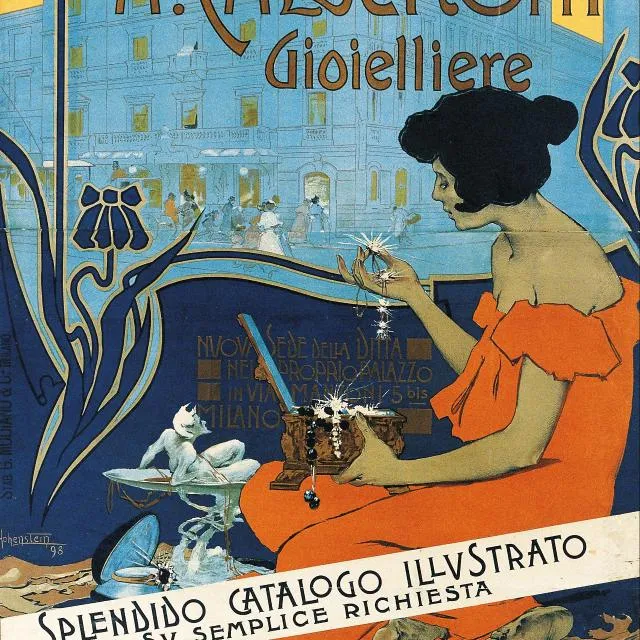
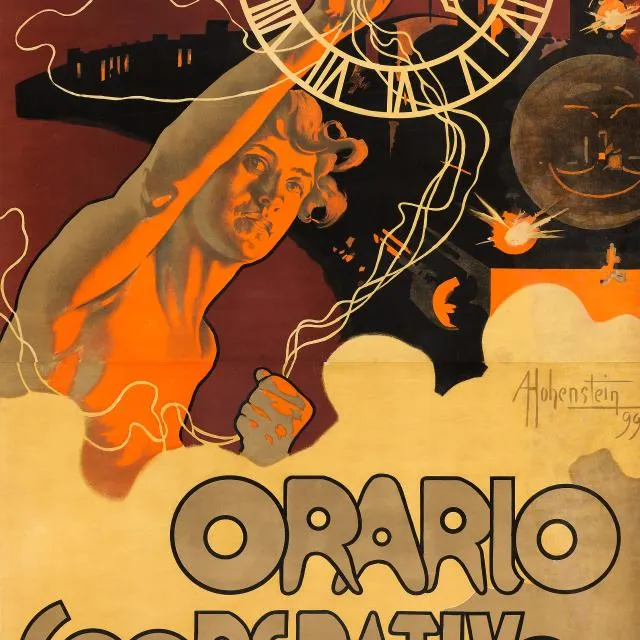
Adolfo Hohenstein (Saint Petersburg, 18 March 1854 – Bonn, 12 April 1928) was a German painter, advertiser, illustrator, set designer and costume designer. He's considered the father of the Italian poster art and an exponent of the Stile Liberty, the Italian Art Nouveau. Together with Leonetto Cappiello, Giovanni Mario Mataloni, Leopoldo Metlicovitz and Marcello Dudovich, he's considered one of the most important Italian poster designers. In 1879, he settles down in Milan, Italy. He becomes a set and costume designer for La Scala and other theatres. There he meets the musical publisher Giulio Ricordi, and in 1889 begins to work for the Ricordi Graphical Workshops, where he shortly becomes the artistic director in charge of the graphical part. He'll create the posters for La Bohème and Tosca, as well as publicity for Campari, Buitoni and Corriere della Sera, numerous postcards, covers for scores and booklets. His work will continue to cover the theatrical dimension: scenarios and wardrobes for several works. In the first years of the 1900s, after marrying Katharina Plaskuda, a widow, he travels more and more frequently between Italy and Germany till 1906, year in which, after winning the competition for the graphical symbol and the poster for the "Esposizione per il Traforo del Sempione", he leaves Milan for Bonn and Düsseldorf definitively. He will settle in Bonn in 1918. The German years see him engaged mostly as a painter and involved in the decoration of numerous buildings, among them one of the first in constructed reinforced concrete in Renania (1911). He is associated with the Düsseldorf school of painting. Adolfo Hohenstein died in Bonn 12 April 1928.