"Born in Barcelona on August 24, 1851, into a family from Sitges (his godfather was the notary Felip Font i Falp), son of Salvador Masó i Matalí and Josepa Falp i Llopis. He was baptized with the names of Felip Bartomeu and Salvador.
As a young man he went to Madrid, where he studied - it seems unfinished in Architecture and Law. From 1872 to 1885 he lived in Paris and was a disciple of the painter Léon Bonnat, a representative of official academicism. However, during those same years, he spent the summer seasons in the manor house of Sitges, located in Carrer de Sant Bartomeu (here everyone knew him by the nickname of Pope, due to his extreme elegance in dress).
Married to a Russian princess (1889), he later resided in San Remo, Monte Carlo and Lourdes, always surrounded by a large entourage of acolytes and leading a lavish life. at the outbreak of World War I, he enlisted in the French army and worked in blood hospitals for a couple of years. In 1916 he visited Sitges for the last time.
Specializing in the painting of history and customs, between 1876 and 1878 he made two large canvases about the life of the discoverer of America: Columbus and his son contemplating the globe and Columbus and his son sleeping, which were presented in two national exhibitions in Madrid and the first of which was acquired by the government of the Republic of Chile. Otherwise, in 1885 he won a silver medal at the Antwerp International Certification with the painting Birds of Paradise.
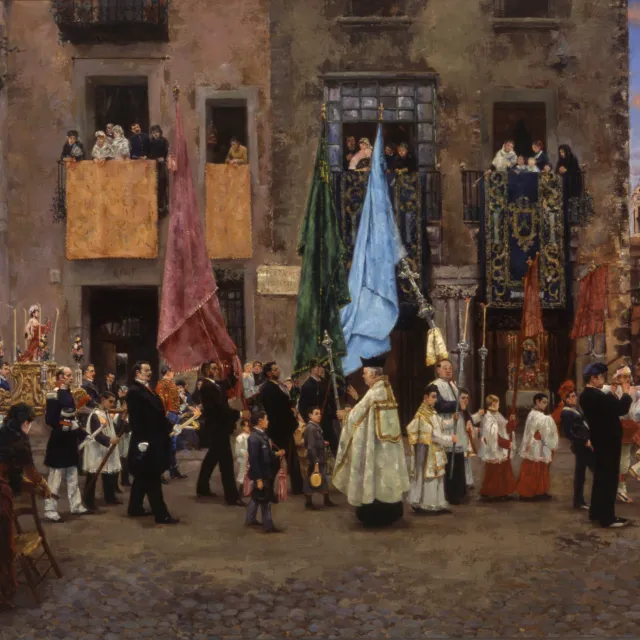
However, his best known work is The Procession of St. Bartholomew (1884, Maricel Museum), presented at the Paris Salon in 1884 - where Masó participated several times - and awarded at the Vienna Exhibition of 1887. The painting, In addition to its artistic value, it has an indisputable historical interest, as it features different figures from Sitges at the time, such as Monsignor Fèlix Clarà -dressed in a raincoat- and some of the musicians who made up the local band. The work is one of the most emblematic pieces of the Art de la Vila Collection and is a founding painting of the Sitges Luminista School.
Masó took part in the 1892 Sitges Fine Arts Exhibition, organized by Santiago Rusiñol and considered the First Modernist Festival, and designed the summer room of the Casino Prado Suburense.
In addition to the works in the Maricel Museum in Sitges, his works preserved in Catalonia include Baile flamenco, Festa de Sant Bertomeu and Alfons el Magnànim preserved in the Víctor Balaguer Museum Library in Vilanova i la Geltrú; Costume scene at the Empordà Museum in Figueres, etc., as well as those belonging to the National Art Museum of Catalonia (MNAC). The work of Felip Masó is also preserved in Madrid.
He died on June 28, 1929 in the French city of Pau. At the beginning of 1948, when Julio Martínez Ávila was mayor of Sitges, a street in the town was named after him."