

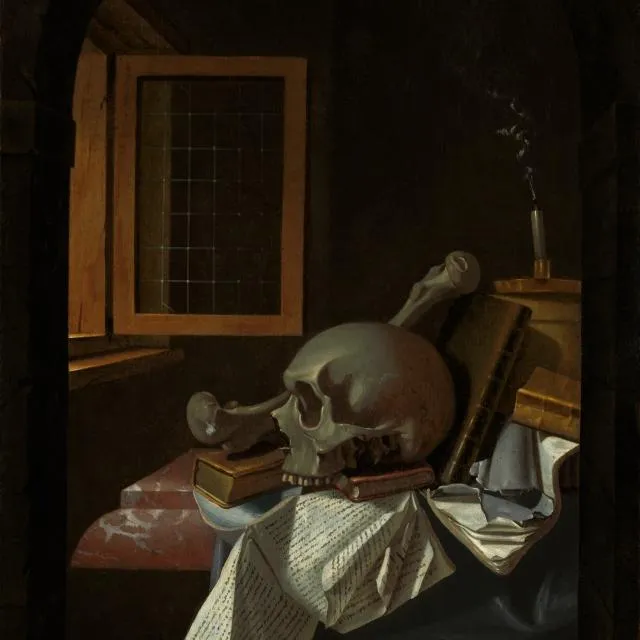

Very little is known about the life of the still-life painter François van Daellen. He was active in The Hague, joining the Guild of Saint Luke in 1636 as a student of the portraitist Joachim Ottensz Houckgeest (c. 1585–after 1644). Documents indicate that the still-life painter Abraham van Beyeren (1620/1621–1690), who also worked in The Hague, repaid a debt to Van Daellen in 1651. That little else is known about Van Daellen’s life is made more complicated by the fact that his existing oeuvre is not large—about seven paintings—and is relatively uniform. Everyone one of his extant paintings is an intimate vanitas still life that depicts extinguished candles and skulls arranged with books or musical instruments on marble tabletops. Painters from Leiden, among them Jacques de Gheyn II (Dutch, 1565 - 1629), Jan Davidsz de Heem (Dutch, 1606 - 1684), and Hendrick van Steenwijk the Younger (Flemish, c. 1580 - 1649) similarly juxtaposed literary achievements with reminders of the fleeting nature of human life, which suggests that Van Daellen had some connection to this artistic tradition. Although Van Daellen repeated almost identical combinations of items in all his paintings, he created a unique architectural environment for each one, sometimes setting his arrangements within stone niches or placing them before classicizing columns and courtyards. Two such works, a pair of vanitas arrangements set within stone niches, have been in the Uffizi collections since 1686, suggesting that Van Daellen’s works were regarded highly enough in the 17th century to attract the attention of Grand Duke Cosimo III de’ Medici.