Maria Oakey Dewing (October 27, 1845 – December 13, 1927) was an American painter known for her depiction of flowers. Her work was inspired by John La Farge and her love of gardening. She also made figure drawings and was a founding member of the Art Students League of New York. Dewing won bronze medals for two of her works at world expositions. She was married to the artist Thomas Dewing.
Maria Richards Oakey was born in New York City, the fifth child of William Francis Oakey and Sally Sullivan Oakey, who had ten children together. William was an importer, and was also interested in the arts, Sally was a cultured woman and writer who came from a wealthy family from Boston. Her younger brother, Alexander F. Oakey, was an architect with, like his sister, an interest in textiles. He wrote The Art of Life and Life of Art in 1884.
She decided at age seventeen to paint. In 1881 Maria Oakey married Thomas Dewing, whose career was less well established. After that, she was disappointed in her career. As the wife of one of the most prominent figure painters of the day, she felt unable to compete with her husband. At the end of her life, Dewing, expressed doubt in her accomplishments and regret for what she had given up.
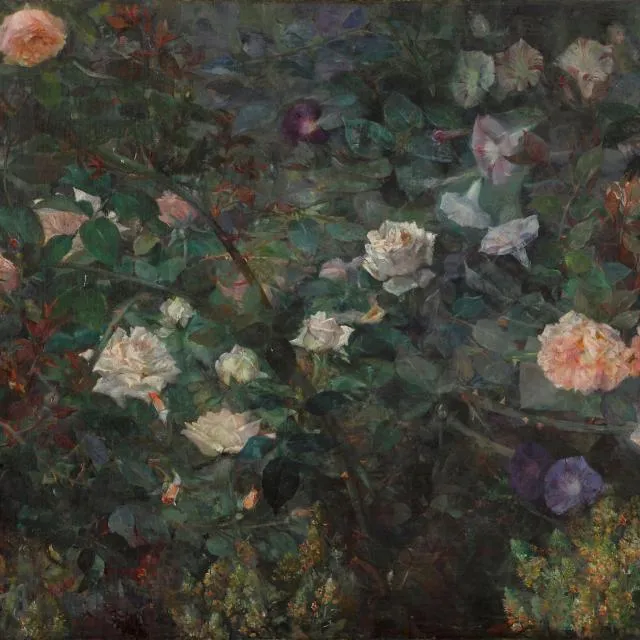
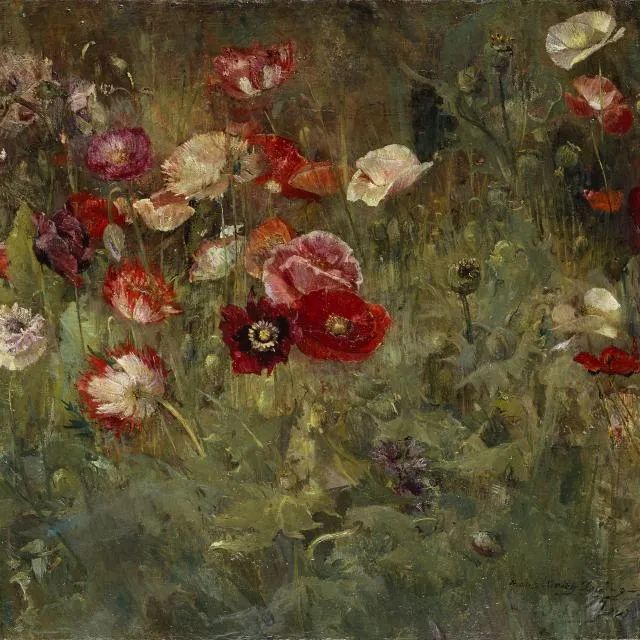
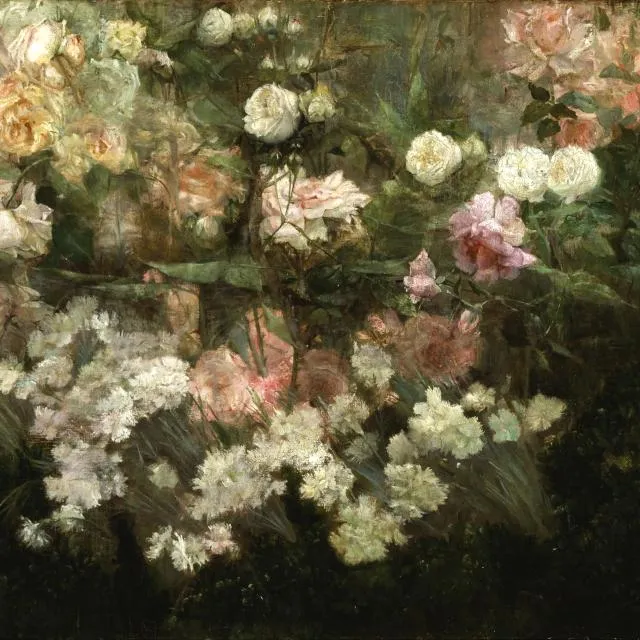
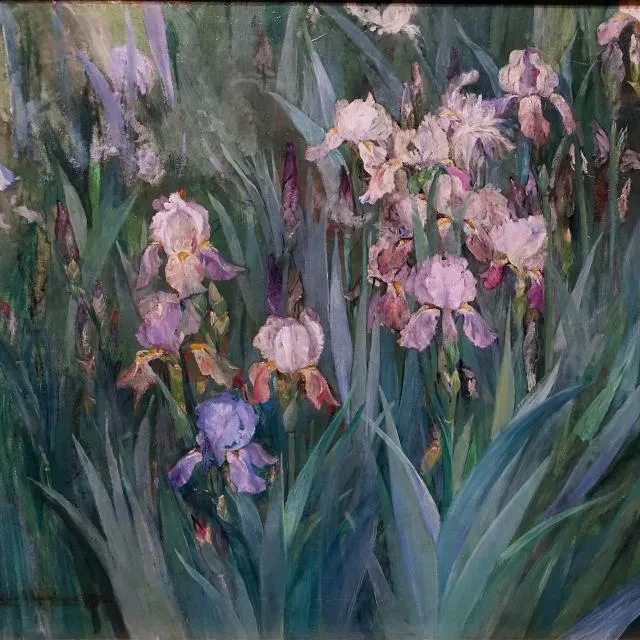
Maria and her husband spent the summers from 1885 to 1905 at the Cornish Art Colony in New Hampshire. There both of the Dewings were avid gardeners, an activity that Maria believed was important to paint nature and inspired her floral paintings. She said, "The flower offers a removed beauty that exists only for beauty, more abstract than it can be in a human being, even more exquisite." Garden in May made in 1895, Bed of Poppies made in 1909 and Iris at Dawn are among her most well-known paintings. In 1921 art critic Edwin Bye said her flower paintings were "absolutely unique" and William H. Gerdts said in 1942 that her "flower paintings combine a poetic sensibility derived from her teacher, John La Farge, with a thorough knowledge of botany nourished and enhanced by the cultivation of her own garden." It is also possible that she changed in order to focus her artistic effort in a different direction.
Dewing created embroidered applique pieces that were like tapestries in the early 1880s.[4] In 1886 Dewing and her husband worked together on the painting Hymen, which was signed by both of them, and she also painted floral portions of other paintings for him, but without her signature.
Dewing exhibited her work at the 1893 World's Columbian Exposition in Chicago, Illinois and at the 1901 Pan-American Exposition in Buffalo, New York, where she won bronze medals. In 1907 a solo exhibition of 22 of her flower and figure paintings was held at The Pennsylvania Academy of the Fine Arts. She began making figure paintings again later in life.
Her patrons during her career included Charles Lang Freer, Whitelaw Reid and John Gellatly. In her lifetime, her works were compared to French painters Antoine Vollon, Henri Fantin-Latour and John La Farge.
Wistful that as a wife of a successful figure painter she had not realized her full potential, Dewing said in the later years of her career, "I have hardly touched any achievement... I dreamed of groups and figures in big landscapes and I still see them."
Dewing was an early convert to Modernism, and in an article published in Art and Progress in 1915 she wrote: “The flower offers a removed beauty that exists only for beauty, more abstract than it can be in the human being, even more exquisite. One may begin with the human figure at the logical and realistic, but in painting the flower one must even begin at the exquisite and distinguished".