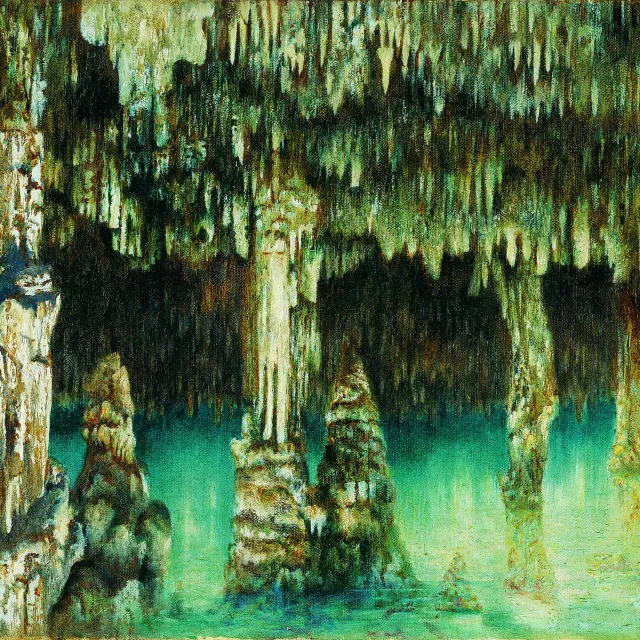
"(Montherm� 1867 � Stavelot, Belgium 1935)
French-born, Belgian symbolist painter. After studying in Brussels, Degouve came into contact with an artists� colony in the village of Machelen, north of Brussels. In the 1890s, he frequented Belgium�s literary figures, particularly the poets of the �Jeune Belgique� and �mile Verhaeren. He married Verhaeren�s sister-in-law, Juliette Massin, in 1894; she, too, was a painter. From 1895 onwards, the couple travelled throughout Europe, first to Italy and then to Majorca (1899-1902), Austria, the south of France, Switzerland and Germany. During the First World War, they took refuge in the Netherlands. Degouve returned to Belgium in 1919 and, in 1922, settled permanently in Stavelot, in the Belgian Ardennes, where he died in 1935.
Degouve was born into a cultured family and dreamt of being a musician. However, in order to express his vision of the world, he became a painter. Degouve was practically self-taught and began painting by copying works by Memling, D�rer and Jan Steen at the museums in Brussels and attending classes at the fine art academy in Ixelles, around 1883. However, his friends, the Dutchman, Jan Toorop and the Belgian, Henry de Groux, whom he met in Machelen, were the people who had a decisive influence on his work. He lived a bohemian life with them until 1891, and, like them, began painting scenes from everyday life representing marginalised or poverty-stricken individuals. The only surviving example of these is Paysage bruxellois (Brussels landscape). In 1890, Degouve exhibited for the first time at the Exposition g�n�rale des Beaux-Arts in Brussels (portrait of Monsieur Henry de Groux), at the Paris Salon and the Burlington Gallery in London. In 1891, Degouve moved into a hut in the countryside in Jette Saint-Pierre, on the outskirts of Brussels, and his landscapes began to acquire a symbolist hue. The landscape is empty and gloomy, and the artist�s gaze primitivist and devoid of all convention. Furthermore, invisible forces seem to emanate from the masterpieces of this period, Le canal (The Canal - 1894) and La maison aveugle (The blind house - 1892) that can only be revealed by a mystical artist. Degouve began to earn recognition during this period with several exhibitions that aroused the critics interest, the first one at the Ghent Salon (1892), followed by the last Salon des XX (1893), the first Salon de la Libre Esth�tique (1894) in Brussels, the exhibition of the Nederlandsche Etsclub in Amsterdam, exhibitions in Louvain and Ostend, at the Salon du Champ-de-Mars in Paris and the Continental Gallery in London, all of them in 1894. The works Degouve painted in Italy in 1895 are nearly all nocturnal scenes. Un canal a Venecia (A canal in Venice), Crepuscle sobre el llac de Como (Twilight over Lake Como) and Parc de Mil� (Park in Milan), which were exhibited at the Libre Esth�tique in 1896 and 1897, reveal changes that would determine his entire output until he left for Majorca in 1899. They echo the evolution of the nocturne as a landscape tradition in the 1890s when Whistler became known in Belgium, and also reveal parallels with the poetry of Verhaeren, early Maeterlinck and Georges Rodenbach, who contributed to creating a landscape of the imagination dominated by the spectral light of the moon (Laoureux 2012: 32). The blue-monochrome atmosphere of Degouve�s symbolist nights, Le Cygne noir (The black swan - 1895), La For�t (The forest - 1896), Effet de nuit (Nocturnal effect -1896), also crosses over with the musical composition of the nocturne, which was popularised at the time by composers such as Debussy, Faur� and Vincent d�Indy. There is a correspondence between the musical chromaticism and the infinite tonal modulations of a single primary colour, such as blue. The union between colour and landscape created with the luminous powder of the pastel �one of Degouve�s favourite materials� transforms the painted image into a state of mind. The picture becomes transcendent; it is a fragment of a whole where �the mysterious song of the infinite�, as Maeterlink put it, dwells.
Majorca marked a shift from nocturnal to daytime scenes for Degouve, from the mysterious moonlight to the brilliant light of the sun and the Mediterranean sky. Nevertheless, the artist remained true to the symbolist and musical concept of the landscape, and drew inspiration from Majorca�s unspoilt landscape. InMajorca, Degouve first met Joaquim Mir and then made the acquaintance of Santiago Rusi�ol. The three of them, together with the Majorcan painter Antoni Gelabert, invented a style of landscape painting that sought to convey the idea of the cosmic vibrations they felt and the pantheistic feeling they experienced there. Degouve and Mir painted the northern coast of the island, with a particular predilection for Cala Sant Vicen�. Throughout 1902, the Franco-Belgian painter showed his Majorcan paintings at the Cercle Mallorqu�, in Palma, at the Sala Par�s in Barcelona, at Bing�s Maison de l�Art Nouveau in Paris and took part in the Libre Esth�tique in Brussels. These exhibitions were highly controversial, but they earned Degouve�s international renown. Back from Majorca, the Degouves settled in Brussels. The years 1906 to 1912 could be referred to as a �religious period� with the presence of Catholic themes in his paintings. Nevertheless, the landscape still predominated. Degouve joined the society of luminist painters �Vie et Lumi�re� and returned to the landscapes of Brabant which he had painted early in his career, constantly searching for direct contact with nature and simplicity, and eschewing all academicism. Degouve was to become the great painter of snowy, isolated, wild and primitive landscapes with the emphasis on simplicity, solitude and sobriety (La Solitude, Solitude - 1910; Plaine enneig�e, Snowy plain - 1911-1912). In 1914, with the outbreak of war, Degouve emigrated to the Netherlands, a neutral country, and continued to paint snowy, solitary landscapes with their isolated houses. Shortly after his return to Belgium, Degouve�s mother and his wife, Juliette Massin, died and Degouve withdrew to the small historic town of Stavelot, in the Belgian Ardennes, where he shut himself away and continued to paint the snowy fields, but this time from a broader, more panoramic viewpoint. In Brabant, the Netherlands, and the Ardennes, direct contact with nature was the trigger for his creative impulse. Degouve found the essence of his art in the calm and solitude of the landscape (Wijgergangs 2012 : 82).
Rusi�ol and Degouve met in Palma de Mallorca. Their acquaintance was short-lived, three months at the most, from late October 1901, when Rusi�ol arrived on the island, to early January 1902, when Degouve left. They met because they were living in El Terreno and had friends in common, particularly the painter Gaspar Terrassa. The correspondence between Terrassa and Degouve (Trenc 1996 : 74) bears this out. Rusi�ol not only defended Degouve�s painting when he had his exhibition at the Cercle Mallorqu�, but he was one of the few people to buy one of his paintings, Coves de Manacor (Caves of Manacor). He kept it all his life and it is part of the Cau Ferrat collection. Degouve painted everywhere on the island, depicting almond trees in blossom, olive trees, landscapes on the Pollen�a coast, the Cala de Sant Vicen�, sweeping panoramas, such as Puig Major, and close-ups of the flora, such as Els nopals (The prickly pear trees) and Les oliveres (The olive trees). A wide diversity of themes, with one in particular that tied in with his early blue symbolist landscapes: the Caves of Drach. Degouve became friendly with the priest and photographer Fernando Moragu�s who was one of the first people to photograph the Caves of Drach lit up with flares. These photographs provided Degouve with the source material for his paintings of the caves. The mysterious, mythical, underground, dark world of the caves was bound to attract Degouve. The landscape style is lyrical and musical, with the repetition of vertical lines and shapes and the use of a harmonious, yet arbitrary, range of colours, based on white, greenish grey and turquoise. The other surviving painting of the caves is similar in size (48 � 60 cm), and is part of a private Belgian collection. It features the same vertical forms and harmonic blues, and bears the title � which is sure to have been given by Degouve himself � Grotte du Dracht, further emphasising the phantasmagorical atmosphere of this haunted-looking space.
By Eliseu Trenc Ballester - Museus de Sitges, 2020"