

A Bacchanalian Revel before a Term

1632-3 · Oil on canvas
Dimensions 98 x 142.8 cm
Collection: National Gallery, London
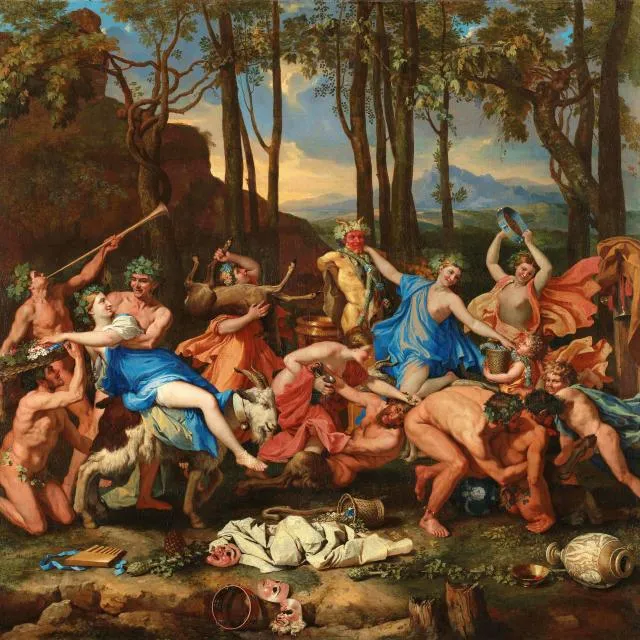
At this wild party, men and women dance around a term (a carved bust of a bearded and horned man). This is traditionally identified as Pan, god of woods and fields, flocks and herds. The Greek word pan means ‘all’, conveying his power over the earthly world and the other gods. During the Renaissance, Pan came to personify lust.In this painting, however, we cannot see Pan’s usual attributes: a shepherd’s crook and musical pipes (they are shown in Poussin’s The Triumph of Pan). Their absence supports the idea that the statue could be Priapus, god of gardens and fertility, who wears floral garlands and exposes his genitalia.These revellers are often seen in classical, pastoral scenes depicting the rites of Bacchus, the god of wine. The grapes and dancing suggest that this is a Bacchic festival, like those held during ancient Roman times to encourage a successful harvest. In art and literature, partygoers enjoy excessive drinking and fulfil their sexual desires, suggested here by the empty vessels and exposed skin.The female dancer on the left with outflung hair squeezes juice from a bunch of grapes into a small dish held by a chubby child. Poussin has cleverly mirrored the linked arms of the dancers in the overlapping tree trunks behind them. On the right, a woman has fallen to the ground and stretches out her hand for help as she is drawn into the embrace of a satyr (a mythological figure known for lustful behaviour). The women could be nymphs or maenads, the wild female followers of Bacchus who were often identified by tambourines and loose draperies. The boldly coloured fabrics worn by the dancers contrast with the women’s porcelain complexions and the ruddy skin of the men and satyr.Poussin studied every aspect of the classical past, and he aimed to recreate that world for his educated, aristocratic patrons. The muscular bodies and crisp drapery folds recall ancient sculptures. Despite the frantic activity, the dancers have been carefully posed in a frieze-like composition, like the figures on ancient stone coffins, known as sarcophagi.The painting was made in around 1632, and the figures have a more solid appearance than those in some of Poussin’s earlier pictures of Bacchic subjects, such as Nymph with Satyrs, painted six years earlier. Poussin also used this group of dancers in reverse in an earlier picture, The Adoration of the Golden Calf. The landscape here was inspired by Poussin’s knowledge of sixteenth-century Venetian paintings by Titian and Giovanni Bellini in Roman collections.
66 collected·63 zoomed·0 comments
About this artwork
A Bacchanalian Revel before a Term (1632-3) by Nicolas Poussin, oil on canvas, from the National Gallery, London collection.
About Nicolas Poussin
Nicolas Poussin (June 1594 – 19 November 1665) was the leading painter of the classical French Baroque style, although he spent most of his working life in Rome. Most of his works were on religious and mythological subjects painted for a small group of Italian and French collectors.
More by Nicolas Poussin
Comments (0)
No comments yet. Be the first to share your thoughts.