

A Distant View of Dordrecht, with a Milkmaid and Four Cows, and Other Figures ('The Large Dort')

about 1650 · Oil on canvas
Dimensions 157.5 x 197 cm
Collection: National Gallery, London
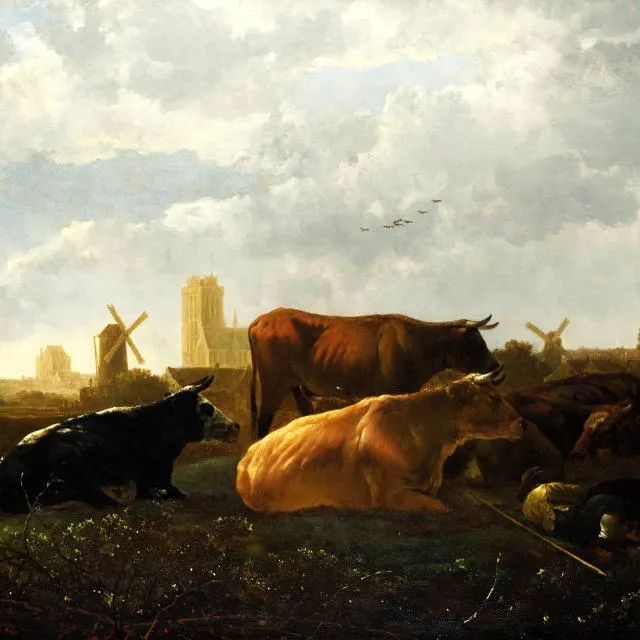
Cows often feature in pastoral landscapes, especially in seventeenth-century Dutch painting. But it is rare for them to be given quite such heroic status as the four monumental beasts which dominate the foreground here. They relegate the shepherd to the hill and the milkmaid, who funnels the results of her labour into a brass flask, to the sidelines. But for the artist and his contemporaries cows were extremely highly valued, and Cuyp was famous for his ability to paint such scenes of bovine bliss. He could make his cattle seem real: flesh out their bulk, make their heavy, horned heads hang with convincing languor, use the light to pick out the ripples on their flanks.This painting is not only an excellent example of his skill, it is also one of the largest he ever made. We don’t know who commissioned it, but most of his customers were private buyers. If this was the case here, it must have been bought by someone whose house had rooms big enough to display it to effect. Cuyp had half a dozen such clients in his home town of Dordrecht, then one of the richest cities in the Netherlands. We can see the key landmarks of Dort (as it was known) in the distance. The imposing bulk of the Grote Kerk (‘Great Church’) dominates the hazy horizon. To the left is the high profile of the Vuilpoort watergate, while the suburbs seem to spill right out as far as the cottage in the middle of the picture.As well as their impressive town houses, some Dordrecht families also had a country residence and held land outside the city where dairy farming was expanding. It may be that this picture represents an idealised view from such an estate. Cuyp himself had acquired lands through marriage, but they were to the west of Dordrecht and we can tell from the orientation of the church that the viewpoint here is from the south-east. This painting isn’t about grand houses, but it is concerned both with the interdependence between town and country and the importance of cattle to the local economy and the Dutch way of life.Cows were a national success story. The seventeenth century had seen improvements in breeding stock, better feeding practice and the reclamation of flooded land – low-lying pasture was much better for cattle than sheep. Cheese and butter were not only national staples, they were now key exports. In short, cattle represented wealth, peaceful prosperity and plenty.We sense that happy state in this painting. The cows seem to have a presence in the landscape as permanent and solid as the church and windmills. Peasant and beast work side by side. Even the sheep dog, petted by a small child, stands quietly watching the flowing milk while the afternoon light floods in from the south west, suffusing the scene with a warm glow – a fashionable lighting effect which had recently come to Holland from Italy. To knit it all together, Cuyp reinforces this harmonious sense of peace and order with a subtle sequence of pictorial planes, from the immediate darkening foreground of weeds and brambles to the light-dappled cows, the shadowy cottages and windmills, then Dordrecht itself, bathed in sunshine. As well as deepening the perspective they form an intricate weave of light and dark. And then, beyond the city the overall mood is set by a luminous low-country sky, clouds fringed with silver, which takes up half of the canvas and glows in the evening light.This painting is similar to another by Cuyp, A Distant View of Dordrecht, with a Sleeping Herdsman and Five Cows.
57 collected·36 zoomed·0 comments
About this artwork
A Distant View of Dordrecht, with a Milkmaid and Four Cows, and Other Figures ('The Large Dort') (about 1650) by Aelbert Cuyp, oil on canvas, from the National Gallery, London collection.
About Aelbert Cuyp
Aelbert Jacobsz Cuyp (20 October 1620 – 15 November 1691) was one of the leading Dutch Golden Age painters, producing mainly landscapes.
More by Aelbert Cuyp
Comments (0)
No comments yet. Be the first to share your thoughts.