

The Maas at Dordrecht in a Storm

about 1645-50 · Oil on oak
Dimensions 49.8 x 74.4 cm
Collection: National Gallery, London
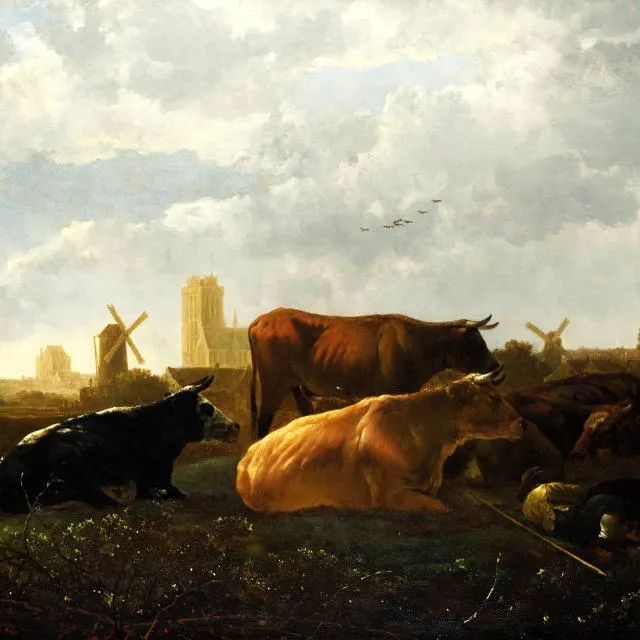
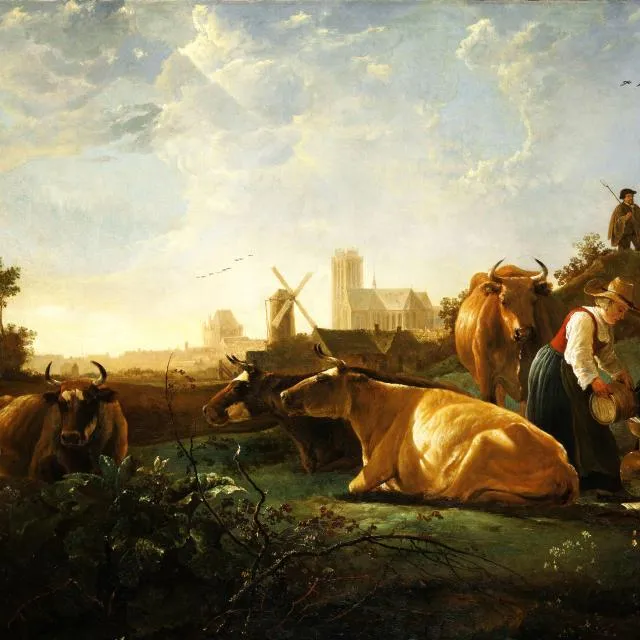
Aelbert Cuyp is best known for landscapes which evoke a strong sense of peace, plenty and prosperity. He often painted this view across the water to his home town of Dordrecht, which is defined by the large bulk of the Grote Kerk (Great Church). But normally in Cuyp’s paintings the scene is a calm one – the water is mirror-still and sails hang limp from the mast.This picture, which is probably an early work, is very different. It is defined by the lightning which flashes across the sky above the town. Instead of a sense of timelessness, it captures an instant – the moment when the gleaming rooftops and the church tower in the background have been illuminated by the sudden blaze of light, while rain pours from a leaden sky. In the foreground, the clouds seem to be clearing and a burst of sunlight catches the spray thrown back over the bow of the boat nearest us. The churning waves are capped with foam and the sail is blown taught against the rigging. Oarsmen in a small boat heave against the choppy sea.While freezing this moment of turmoil and violence, Cuyp nevertheless evokes a strong sense of the force of the storm. The horizon is set very low in the picture and emphasises the great dynamic sweep of sky with a series of strong diagonals: the lines of cloud, the clusters of birds, the shape of the lightning bolt and the angle of the ship’s mast and spas. The diagonals are countered by Cuyp’s energetic brush strokes – broad and swirling for the deep grey clouds, short and choppy for the sea. In the midst of this drama, there is a quiet stoicism. While nature rages around them, the sailors keep a low profile. Rather than wrestling with ropes they seem calm and controlled. If there is heroism here, it is the quiet heroism of endurance in the face of adversity. They are riding out the storm rather than battling against it.The three boats which are struggling against the squall are know as damloopers (‘dam runners’) because they could be hauled over dams and dykes. They were slow, sturdy trading vessels with a shallow draft, built for Holland’s inland waters. Instead of a deep keel, they had leeboards on each side which were lowered individually to stabilise the boat. This is a very useful design in shallow waters, but makes for slower progress when tacking against the wind – as the boats are doing here.Cuyp painted at least one other scene of a lightning flash at around the same time as this picture (Foundation E.G. Bührle Collection, Zurich). But it is very different, depicting a view of Dordrecht across a landscape grazed by cattle.
96 collected·110 zoomed·0 comments
About this artwork
The Maas at Dordrecht in a Storm (about 1645-50) by Aelbert Cuyp, oil on oak, from the National Gallery, London collection.
About Aelbert Cuyp
Aelbert Jacobsz Cuyp (20 October 1620 – 15 November 1691) was one of the leading Dutch Golden Age painters, producing mainly landscapes.
More by Aelbert Cuyp
Comments (0)
No comments yet. Be the first to share your thoughts.