

A Horseman with a Cowherd and Two Boys in a Meadow, and Seven Cows

probably about 1655-60 · Oil on canvas
Dimensions 80 x 106 cm
Collection: National Gallery, London
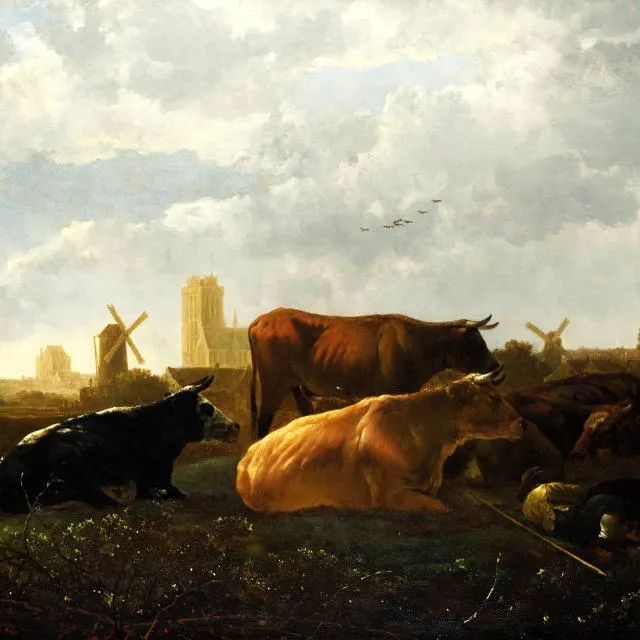
Aelbert Cuyp did paint some stormy scenes, but the vast majority of his landscapes are, like this one, an evocation of rural tranquillity, the countryside bathed in the warm glow of a summer afternoon. We can feel it’s warm: the cowherd on the left has fallen asleep on the bank in the foreground, and the black and white dog next to him has a distinctly dozy air about it. The cattle too seem drowsy. Cuyp made a preliminary drawing for the sleeping boy on a signed sheet of studies (Rijksprentenkabinet, Amsterdam).We‘re looking at a landscape in the Low Countries, probably the flatlands between Nijmegen and Cleves in the eastern part of the Netherlands, which Cuyp had visited in the early 1650s. But the golden light, and that implied heat, is more reminiscent of southern Europe than the north. It was a combination which became fashionable in Holland during the seventeenth century, when Dutch artists who had trained and worked in Italy returned home to ply their trade. Cuyp never visited Italy, but he was certainly influenced by his contemporaries who had, such as Jan Both. Cuyp made this lighting effect a trademark of his paintings.With the warm glow also comes a sense of harmony. Man and beast are living peacefully together, the animals dutifully subservient to their masters. The cowherd and horseman also seem to chat easily, even though one – the man riding the horse – is probably of a significantly higher social status. He might be the cattle farmer checking on his animals, or a passing gentleman.Either way, our viewpoint from behind these figures draws us into the picture in two subtle ways. First, it invites us to follow their gaze over the landscape, out along the diagonal line established by the angle of the standing horse, the clouds and the two flocks of birds – a line which seems to emanate from the distant spire of the church. Secondly, we are left intrigued as to the subject of their discussion. Perhaps they are talking about something to the left of that diagonal, something just out of our sight. Or perhaps, like us, they are simply admiring the view.The cows, of course, are oblivious to all this – but they are important too. At the time they were highly valued as a key economic success story. They grazed happily on the damp reclaimed lowlands, and continuing improvements in breeding stock and feeding practice were increasing their productivity. Cheese and butter were not only national staples, but had become important exports. In short, cattle represented a reliable source of wealth and peaceful prosperity – and Cuyp was famous for his ability to depict them convincingly, often using positions and profiles that he would repeat and perfect in different paintings. For example, the arrangement of the heads of the two cows standing together side-on in this picture is a near mirror image of two heads in Cuyp’s A Distant View of Dordrecht, with a Milkmaid and Four Cows, and Other Figures (’The Large Dort'). The outline of the cow standing head-on on the right is also used in both paintings, though varied slightly.
57 collected·34 zoomed·0 comments
About this artwork
A Horseman with a Cowherd and Two Boys in a Meadow, and Seven Cows (probably about 1655-60) by Aelbert Cuyp, oil on canvas, from the National Gallery, London collection.
About Aelbert Cuyp
Aelbert Jacobsz Cuyp (20 October 1620 – 15 November 1691) was one of the leading Dutch Golden Age painters, producing mainly landscapes.
More by Aelbert Cuyp
Comments (0)
No comments yet. Be the first to share your thoughts.