

A Man with a Pink

about 1495 · Oil and egg on poplar
Dimensions 49.5 x 38.5 cm
Collection: National Gallery, London
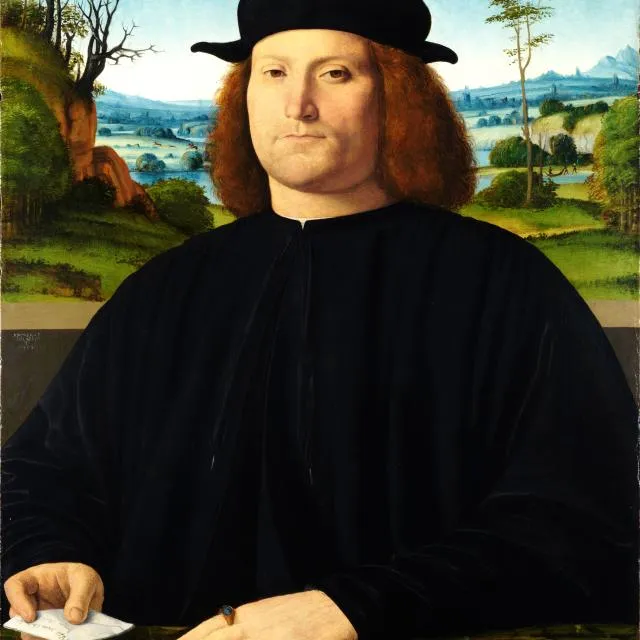
The accessories worn by the man in this portrait reveal not only his age but also his rank and the city in which he lived: the tunic, cap and stole – the strip of black fabric across his chest – indicate that he was a member of the Venetian togati. The term refers to this Roman style of dress which was the uniform of Venetian citizens or patricians (the two highest social orders in Venice) over the age of 25. The strip of grey in the man’s fringe and the prominence of the veins on his left hand suggest that he is probably a little older than this. The colour of his tunic is also significant: Venetian men could only wear red tunics if they belonged to the city’s councils and it is possible that this man was a magistrate.It may seem unusual for a man of such high social rank with such a serious role in society to choose to be painted holding a pink – a type of carnation. Renaissance artists often included objects, flowers or even animals to communicate meaning. These could derive from local, secular or religious customs and would have been easily understood by viewers at the time. Pinks featured in marriage rituals: on her wedding day, a bride would hide a pink in her clothing and the groom would have to search her to find it. By holding the flower here, the man may be proclaiming his success in this endeavour. With his other hand, he clutches his stole in a way that shows off the blue and gold ring on his thumb. These clues suggest that the man ordered the painting to commemorate his marriage.This man’s hands – what he holds and wears – are key to understanding the painting. The use of the innovative three-quarter pose, where the sitter is turned from profile towards the viewer, made it possible for Solario to depict the man’s hands. Artists, like Solario, working in and around Venice were the first to adopt this pose which originated in Northern European portraiture. Netherlandish artists like Memling were also the first to include hands in bust-length portraits, and to paint their clients as though they were sitting in an open landscape.These settings made the portrait more beautiful and allowed the painter more scope to show off his skill. Solario has used a variety of techniques to give the impression of the vast countryside in the distance: the two trees that frame the man’s face mark out the centre ground; a river weaves through the fields behind the man’s right shoulder leading the eye towards the mountain range beyond. The bluish tone of the mountains tricks the eye into thinking they are miles behind the sitter for, as Leonardo realised, distance changes the way that colours appear so that far-off mountain ranges seem blue, rather than green. Solario, who was from Milan, may have learnt this technique, called aerial perspective, from works made by Leonardo for that city such as, for example The Virgin of the Rocks.
53 collected·46 zoomed·0 comments
About this artwork
A Man with a Pink (about 1495) by Andrea Solario, oil and egg on poplar, from the National Gallery, London collection.
More by Andrea Solario
Comments (0)
No comments yet. Be the first to share your thoughts.