

Giovanni Cristoforo Longoni

1505 · Oil on poplar
Dimensions 79 x 60.5 cm
Collection: National Gallery, London
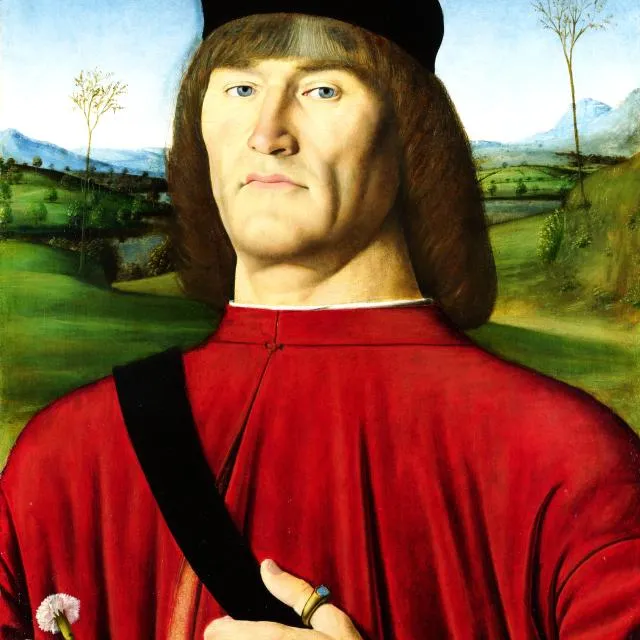
In his right hand, this gentleman holds a letter addressed to him: Nobili Joanni Christophoro Longono amigo (‘Noble Giovanni Cristoforo Longoni, friend’). We can assume this is his own name and that the letter was included as a subtle way of identifying him. His black mantle and cap are a sign of his social status: these were worn by men of the middle and upper classes in many Italian cities in the late fifteenth and early sixteenth centuries. The position of his left hand on the marble parapet in front of him draws attention to his rings, which may indicate his wealth or official status. He is shown something between a frontal and a three-quarter pose, which emphasises the breadth of his torso; his gaze is confident, perhaps leaning towards arrogant.The format of the portrait, with its landscape background with a river running through it was known as ‘alla fiammingha’, that is, ‘Flemish style’. It was popularised in Italy by the works of southern Netherlandish painter, Hans Memling. The inclusion of the sitter’s hands – which allowed the inclusion of personal, identifying objects like the letter – was also an innovation that came from northern Europe. Both elements are found in A Man with a Pink.We know little of Longoni apart from that he was living in Milan in the late 1490s. Solario was from Milan but he spent time working in Venice, where he painted A Man with a Pink. On his return to Milan after 1495 his work began to more closely reflect the innovations of Leonardo da Vinci, who had spent several years working in the city. The sombre and somewhat gloomy landscape background with its blue-grey tones reflects the mysterious landscapes that Leonardo painted in the background of his portraits and religious images, such as Virgin of the Rocks. The way in which Solario has painted the sitter’s face also shows that he has studied Leonardo’s technique. The transitions between light and shade are very subtle, creating a slightly blurred or smoky effect called sfumato, which was one of Leonardo’s innovations.Renaissance portraiture had a profound purpose: to commemorate an individual’s appearance as well as their character. They were thought to stand in for a sitter’s presence and, after death, their soul. The inscription in Latin on the parapet translates as ‘You know not what sort of person you were or will be; devote much time to an earnest effort to see what sort of person you are’, suggesting the portrait itself captures Longoni’s image at this moment as well endeavouring to examine his mind and personality.
41 collected·9 zoomed·0 comments
About this artwork
Giovanni Cristoforo Longoni (1505) by Andrea Solario, oil on poplar, from the National Gallery, London collection.
More by Andrea Solario
Comments (0)
No comments yet. Be the first to share your thoughts.