

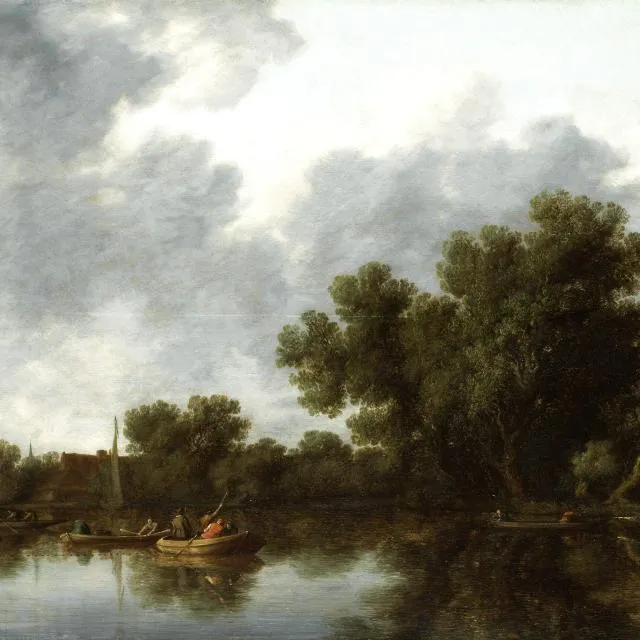
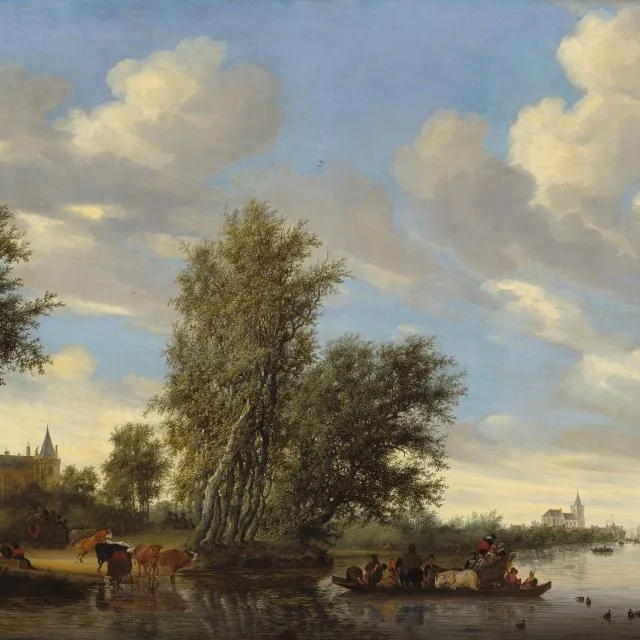
A River with Fishermen drawing a Net

1630-5 · Oil on oak
Dimensions 46.3 x 62.8 cm
Collection: National Gallery, London
This is a picture of calm. A single branch points up out of water, leading our eyes across the painting towards the small boats almost hidden in shadows and reflections cast by the grey alder trees on the river bank.The water is flat, without a ripple. The reflections are perfect. No wind stirs the sails, no flags lift in a breeze. The men in the boat are crouched and still, apart from one who stands upright facing a leafless tree ahead of him – almost like two sentinels with an invisible line between them.These vessels are kaags, shallow-bottomed working boats for use mostly on rivers and canals. But Salomon van Ruysdael makes them stately and serene, their tall masts almost seeming to pierce the clouds, with a rhythmic line of trees and sails reaching out on a diagonal into the distance. Close to us, the only moving things are two birds that swoop low over the water. Further out, where the river appears to divide, the sail of a small boat seems to fill a little in the breeze and a family of ducks ventures across the water.There were a handful of reasons to make such a painting. First was the idyll itself – a purely decorative and restorative picture hung on the walls of a busy Dutch household. But the black dots making a semi-circle on the still water are cork floats, defining the edges of a large fishing net. The men in the nearest boat aren't idling away their time. They are fishermen, and fishing was one of the main industries that gave the Dutch Republic its wealth. These are ordinary working men, shown realistically, thought worthy of a picture because they were part of the pride that the Dutch had in their building of a new nation: the taming of rivers, the digging and reinforcing of canals and dams, the creation of a new land from the sea by hard labour. Dutch lives and livelihoods were built on water and they wished to celebrate it in all its forms.Salomon van Ruysdael was one of a family of painters, including his nephew Jacob van Ruisdael, who specialised in land and seascapes. Although living in Haarlem, it appears that Salomon travelled widely in the Netherlands as he produced views of many other towns and cities. He left no drawings or sketches, so must have painted from memory or from the many prints available made by other artists.The technique of showing distance by portraying a spit of land cutting across the canvas on the diagonal and diminishing in size is particularly his, but Salomon shared his taste for painting in soft muted greys, greens and browns with his fellow marine landscape artist and colleague, Jan van Goyen.
51 collected·28 zoomed·0 comments·1 boards
This artwork is in 1 board
About this artwork
A River with Fishermen drawing a Net (1630-5) by Salomon van Ruysdael, oil on oak, from the National Gallery, London collection.
About Salomon van Ruysdael
Salomon van Ruysdael (c. 1602, Naarden – buried November 3, 1670, Haarlem) was a Dutch Golden Age landscape painter. He was the uncle of Jacob van Ruisdael.
More by Salomon van Ruysdael
Comments (0)
No comments yet. Be the first to share your thoughts.