

A View of Rhenen seen from the West

1648 · Oil on wood
Dimensions 30.5 x 41.3 cm
Collection: National Gallery, London
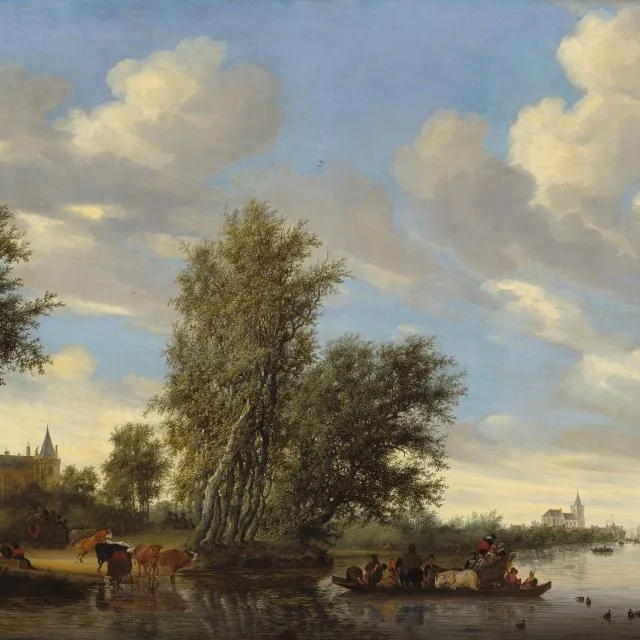
Dawn is breaking over the town of Rhenen, but already the cows are alert, drinking in the river, and boats are moving upstream. The sweep of the clouds, the outward curve of the sails and the ripples on the water suggest a slight breeze. The Dutch flag lifts slightly on the boat closest to us. Salomon van Ruysdael has used a limited palette of muted, earthy colours here to convey the almost luminous quality of early morning light over a wide, flat landscape with an expanse of water.The fishermen on the boat are in silhouette, but we sense that they are facing away from us. The cows are clearer but still in the shadows, except one that lifts its head to low at the boat as it passes. The shadow is cast by the mass of grey cloud overhead, while the single white cloud peeping through is mirrored by the shape of the glossy white cow below. A little further upstream a splash of sunlight glows on another group of cows, with a reflection of the single white animal suggested by a mere couple of dots of silvery paint in the water. Close at hand, everything seems still, but further ahead, the wind picks up. Boats keel over more steeply, moving in unison at speed. A forest of minute grey sails beat across the river near the town, perhaps assuring us that the town is busy and full of life while not disturbing our quiet place on the river bank.Seventeenth-century Dutch landscape artists were not always concerned with the accuracy of the buildings they showed; the harmony of their compositions and the conveying of atmosphere were more important. Often, a distant town was little more than a blur of paint with perhaps one recognisable building looming through the mist so that the view is identifiable, as in Jan van Goyen’s Fishermen Hauling a Net. But in this picture, van Ruysdael has revealed the little town in a clear, crisp band of light. Although they aren’t necessarily accurately placed, details on the tiny buildings can be clearly seen – windows, roof gables, windmill sails. We see the turrets spaced out along the town walls, the distant spire of the Cunerakerk and, a little closer, on the water’s edge, the jumbled buildings of the Koningshuis with its impressive three-tiered tower.The Koningshuis was the palace in which King Frederik V of Bohemia and his British wife Elizabeth Stuart, known as the Winter Queen, sought refuge after they were deposed. The whole of Europe was exhausted from war at the time, and in 1648, the year that the picture was painted, the Dutch won independence from the Spanish after some 80 years of conflict. A picture like this one would have been appreciated its skilfully depicted light and its beautifully balanced composition, but perhaps also for its tranquillity and sense of continuity – the return of peace and prosperity after the storms of war.
66 collected·61 zoomed·0 comments
About this artwork
A View of Rhenen seen from the West (1648) by Salomon van Ruysdael, oil on wood, from the National Gallery, London collection.
About Salomon van Ruysdael
Salomon van Ruysdael (c. 1602, Naarden – buried November 3, 1670, Haarlem) was a Dutch Golden Age landscape painter. He was the uncle of Jacob van Ruisdael.
More by Salomon van Ruysdael
Comments (0)
No comments yet. Be the first to share your thoughts.