

A Young Man holding a Ring

perhaps about 1450 · Oil on oak
Dimensions 17.8 x 12.4 cm
Collection: National Gallery, London
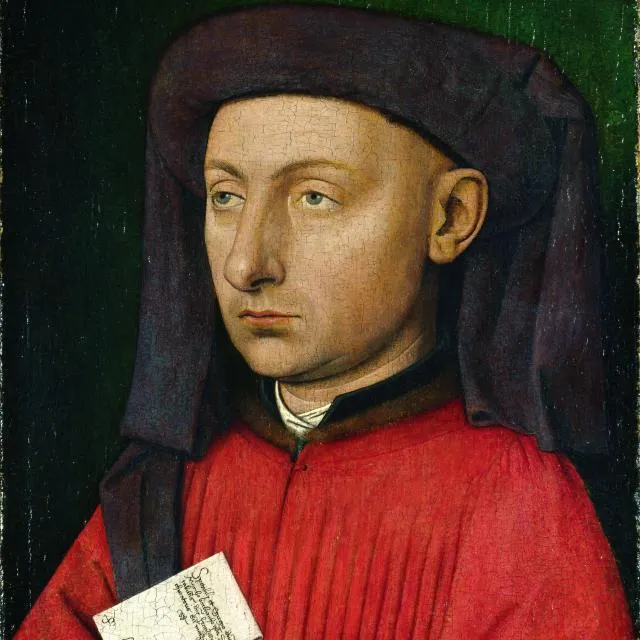
We don‘t know the identity of the young man in this small portrait, but his clothes are those of a wealthy individual. He wears a dark grey doublet with a red laced collar and chaperon, a fashionable fifteenth-century headdress worn by several of van Eyck’s sitters – see Portrait of a Man (Self Portrait?), for example. Here, the short patte or hood hangs down at the back, while the long, scarf-like cornette seems to have been wound up around his head. The fur of his cuffs and collar is spotted, which is unusual in mid-fifteenth-century Netherlandish painting; it might be lynx. The laced collar of his doublet is perhaps a German rather than Netherlandish fashion.The gold ring he holds is set with a green and a red cabochon – polished rather than cut – stone. The form of the ring, with its double stones, is uncommon: might it have been a wedding ring? Or was the sitter perhaps a goldsmith, advertising his wares? Behind him is a blue and white striped background patterned with rain clouds. There are words in between the clouds: har las uber gan (’Lord, let it pass over'). This is presumably the sitter’s motto – though not unique to him – asking God to let trouble pass away. The words are a mix of Dutch and High German and suggest a link with The Hague, where both were both spoken and melded into a practical language in the late fourteenth century.Painters went through several stages to make a finished portrait, and a drawing survives (Kupferstichkabinettink, Berlin) that seems to be a preliminary study for this painting, allowing us to see how the artist adapted the original sketch on van Eyck’s principles. Van Eyck’s portraits are often subtle caricatures, with bodies and faces distorted for maximum effect. Here, the artist has narrowed the man’s shoulders to make the head larger and more prominent, and enlarged the nose to emphasise this easily recognisable feature, as van Eyck frequently did. The next stage would be to sketch a design of the picture on to the ground before starting to paint. We can now sometimes see these designs using infrared radiation. Artists did not always follow the underdrawing exactly, but made changes while they were painting. An infrared reflectogram of this painting shows us that the man’s chaperon was initially larger and its patte longer. The position of the hands was also changed: there are lines in the lower right corner where a shape, perhaps the upraised index finger of his left hand was sketched but not painted, and the thumb on his right hand has been shortened and turned around.The painting is in very good condition. The narrow strip of bare wood around the edges was covered by the frame, which has been lost. The painting was evidently painted in its frame, as was sometimes the practice in the fifteenth-century Netherlands (like with Campin’s A Man and A Woman). After the portrait was finished the frame was painted, probably marbled in red, white and black as traces of these colours can be found around the edges of the painted surface. The back of the panel is also marbled in vermilion, red lake and black. Painting the back not only helped to prevent the panel warping or cracking, but was also decorative. Pictures were not always hung on walls in the later Middle Ages, as is normal today, and the backs were sometimes painted too as they might also be seen.
57 collected·58 zoomed·0 comments
About this artwork
A Young Man holding a Ring (perhaps about 1450) by Follower of Jan van Eyck, oil on oak, from the National Gallery, London collection.
More by Follower of Jan van Eyck
Comments (0)
No comments yet. Be the first to share your thoughts.