

Marco Barbarigo
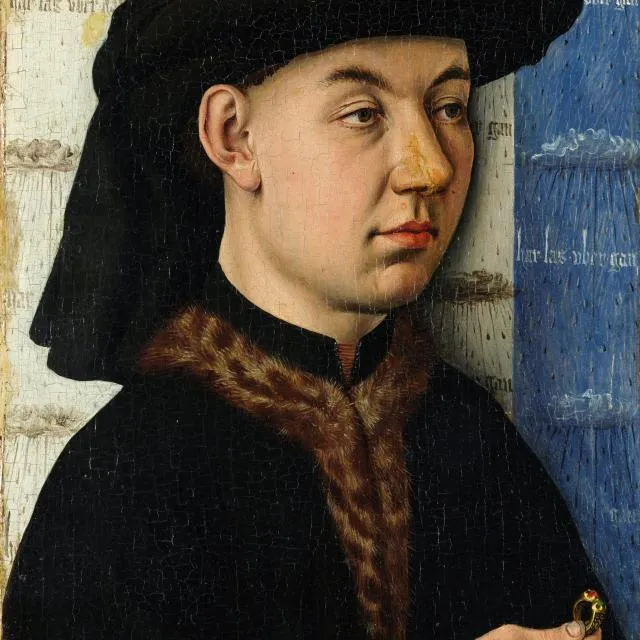
about 1449-50 · Oil on oak
Dimensions 24.2 x 16 cm
Collection: National Gallery, London
This serious-looking young man is Marco Barbarigo, known as ‘Marco the Rich’, Venetian consul in London in 1449 and Doge of Venice in 1485. Born in 1413 into a family of Venetian merchants, he ran the family business in London in the mid-1440s.Barbarigo wears a dark purple chaperon, a fashionable fifteenth-century headdress for men that was made up of a padded ring; his dark brown hair is just visible at his left temple. The short patte or cape rests on his left shoulder and the long, scarf-like cornette hangs down his right side. His bright red houpelande – a long-sleeved robe worn by both men and women in the later Middle Ages – is trimmed with brown fur at the neck. Under it we can see the collar of his doublet and the white of his shirt. His clothes are rather old-fashioned for a date in the late 1440s, but Barbarigo was known to have had conservative tastes, at least in hats.This portrait was apparently painted while he was in London: he holds a letter, written in Latin, addressed to ‘the eminent and distinguished lord Marco Barbarigo, son of the late eminent lord Francesco, procurator of Saint Mark’s’. The address at the bottom, ‘Londonis’, is partly hidden by his fingers; the letters ‘f’ and ‘n’ perhaps stand for fratri nostri (‘our brother’). Marco’s father Francesco died in August 1448, and Marco himself was made Venetian consul in London in February 1449. This appointment usually lasted a year, after which he may have returned to Venice to settle his father’s affairs and marry (his first son was born around 1450).The quality of the painting suggests that it was done by a follower of Jan van Eyck who was working in London in 1449/50. We don't know much about painters working in London at the time, but this one was very familiar with the artist’s principles; he had probably been trained in Flanders. The bold colour scheme and strong lighting against a dark background are typical of van Eyck, as are the distorted proportions: the head is much too large in proportion to the body, and the face too large for the head. The painter has enlarged the features, especially the nose, which is shown in exaggerated profile. Perhaps Barbarigo, on the point of leaving London, commissioned a portrait from an artist working in the latest Netherlandish style to take home as a souvenir, possibly for his brothers. The painting was in Venice in the eighteenth century.The narrow strip of bare wood around the edges was once covered by the frame, now lost. The portrait was painted in its frame, as was sometimes the practice in the fifteenth-century Netherlands (as in Campin’s A Man and A Woman). The frame was perhaps painted before the portrait: there is a pale orange layer underneath the green background around the edges. The back of the panel was probably marbled in red, black and green, but is very damaged. Paintings were not always hung on walls in the late Middle Ages, as is usual now, and so the backs were sometimes decorated as they could also be seen.
47 collected·24 zoomed·0 comments·1 boards
This artwork is in 1 board
About this artwork
Marco Barbarigo (about 1449-50) by Follower of Jan van Eyck, oil on oak, from the National Gallery, London collection.
More by Follower of Jan van Eyck
Comments (0)
No comments yet. Be the first to share your thoughts.