

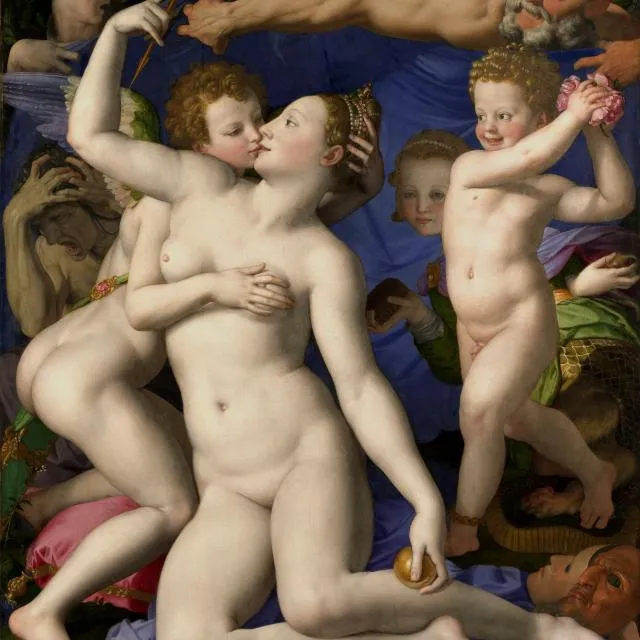
An Allegory with Venus and Cupid

about 1545 · Oil on wood
Dimensions 146.1 x 116.2 cm
Collection: National Gallery, London
This is one of Bronzino’s most complex and enigmatic paintings. Its intended meaning is not entirely certain. It is likely to be the painting mentioned in Vasari’s ‘Life of Bronzino’ of 1568: ‘He made a picture of singular beauty, which was sent to King Francis in France; in which was a nude Venus with Cupid kissing her, and on one side Pleasure and Play with other Loves; and on the other, Fraud, Jealousy, and other passions of love.’The erotic yet erudite subject matter of the painting was well suited to the tastes of King Francis I of France, who was notoriously lecherous. It was probably sent to him as a gift from Cosimo I de‘ Medici, ruler of Florence, who employed Bronzino as a court painter. However, there appears to be no record of the painting ever having been in the French royal collection.The picture contains a tangle of moral messages, presented in a sexually explicit image. Venus, goddess of love, steals an arrow from her son Cupid’s quiver as she kisses him on the lips. Bronzino may have recalled a painting by his teacher Pontormo showing Venus robbing Cupid of his arrow (Uffizi, Florence), which was based on a drawing by Michelangelo. Venus holds the golden apple which Paris presented to her as the most beautiful of all goddesses, and her traditional attribute of a pair of doves rest on the ground. Cupid squats with his bare buttocks provocatively thrust out and fondles Venus’ breast, squeezing her nipple as he returns her kiss, while attempting to steal her crown. The masks at Venus‘ feet suggest that she and Cupid exploit lust to mask deception.The smiling little boy with the anklet of bells is foolish Pleasure, who is about to shower the pair with rose petals. He doesn’t seem to notice the thorn piercing his right foot – Pleasure is frequently followed by Pain. Fraud or Deceit, the pretty girl behind Pleasure, offers Cupid a honeycomb. However, her concealed serpent’s body suggests that her offer of sweetness literally has a sting in its tail. The mantle pinned with a brooch to her shoulder is of cangiante colours that resemble shot silk – from one angle it appears pink, from another pale blue – as changeable and deceptive as she is.In the background is winged Father Time, identified by his hourglass. It is not easy to make out what he is doing. He holds a blue cloth with which he attempts either to conceal or reveal this series of deceits. He glares towards another figure in the background whose head appears to have no back or contents and who may represent Oblivion, also holding the cloth. Time may be attempting to stop Oblivion from concealing Venus and Cupid’s actions.The figure clutching their head behind Cupid has been variously identified as Suffering, Jealously and Syphilis, displaying some of the symptoms of the disease. However, such an overt reference to syphilis would have been inappropriate in a painting for the French king – the illness was known at the time as ‘the French disease’ because it was believed to have been brought to Italy by French troops. The painting’s message may have been about Beauty curbing Passion to protect us from Jealousy, Fraud and Folly, and enabling Time to combat the Oblivion that Passion entails. Equally it may be about the painful consequences of unchaste love, presided over by pleasure and deceit.If the painting was a diplomatic gift, then it is also possible that it has a political meaning. A famous drawing depicting the adultery of Mars and Venus (now in the Louvre, Paris), which Rosso Fiorentino sent to the French king in 1530, is thought to celebrate the king giving up his war-like ambitions in Italy. Bronzino’s Allegory perhaps had a similar intention. There are indications that he may have had to make it quickly as there are, for him, an unusually large number of instances where he made alterations to outlines and changed his mind during painting. The figure tearing their hair was originally lower down, and Venus‘ arm was bent further back caressing Cupid’s curls.These types of complex, multilayered themes are found in poetry of the period, and Bronzino, like Michelangelo, was an accomplished poet as well as a painter. He wrote conventional love lyrics derived from the poetry of Petrarch as well as more bawdy poems. Unravelling the painting’s meaning would have been part of its appeal – a pleasure to both the eye and the intellect – a duality frequently referred to in Bronzino’s poetry.The obscure imagery and highly artificial design and finish of the painting are characteristic of the type of highly sophisticated and self-consciously stylised art produced in European courts and urban centres at the time. Reacting against the ideals of harmony, proportion and naturalism of High Renaissance art, Mannerist art emphasised intellectual sophistication, unnatural elegance, artifice and instability. Bronzino and his teacher Pontormo embraced this artistic development, and Bronzino’s highly finished artificial and intellectual works – especially the Allegory – epitomise this erudite, courtly type of art.The Allegory has an almost enamel-like surface – the painter’s brushstrokes have been blended away to conceal the means by which the painting was made. Bright white artificial lighting defines marble-like limbs that are clearly outlined and unambiguously drawn. Every detail, animate or inanimate, is subjected to glaring scrutiny in this unflinching light, creating a sense of dramatically heightened artificiality. The painting has the structure and quality of a relief sculpture, with multiple figures, little depth and no real background, giving it a claustrophobic feeling. With its clear jewel-like colour and the abundant use of ultramarine blue, made from the semi-precious stone lapis lazuli, the Allegory has the appearance of a luxury object – as flawless, cold and hard as the golden ball in Venus’ hand.
75 collected·117 zoomed·0 comments
About this artwork
An Allegory with Venus and Cupid (about 1545) by Bronzino, oil on wood, from the National Gallery, London collection.
About Bronzino
Agnolo di Cosimo; November 17, 1503 – November 23, 1572), usually known as Bronzino (Italian: Il Bronzino or Agnolo Bronzino, was an Italian Mannerist painter from Florence. His sobriquet, Bronzino, may refer to his relatively dark skin or reddish hair.
More by Bronzino
Comments (0)
No comments yet. Be the first to share your thoughts.