

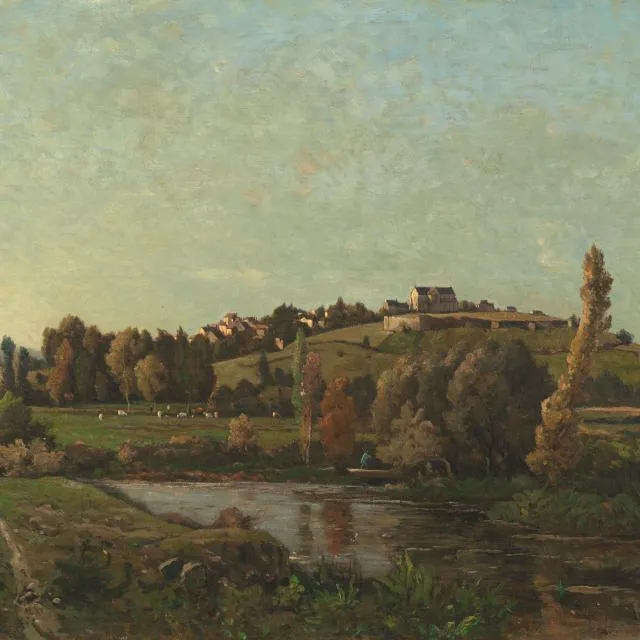
Autumn Evening

1894 · Oil on canvas
Dimensions 116.8 x 160 cm
Collection: National Gallery, London
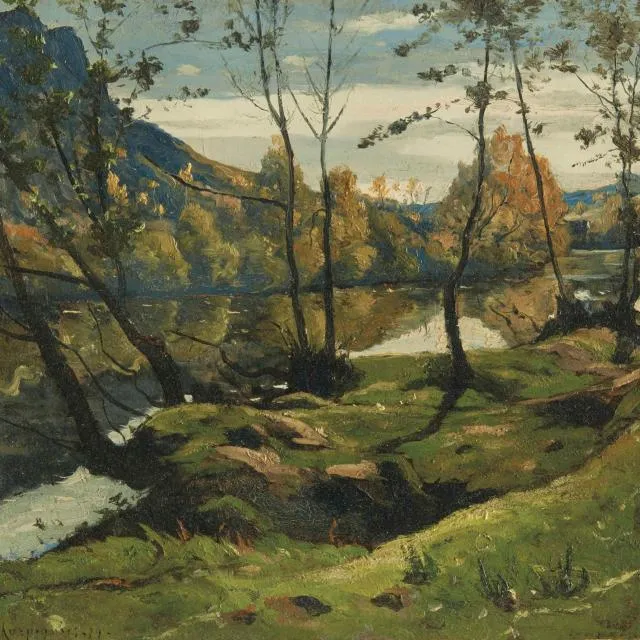
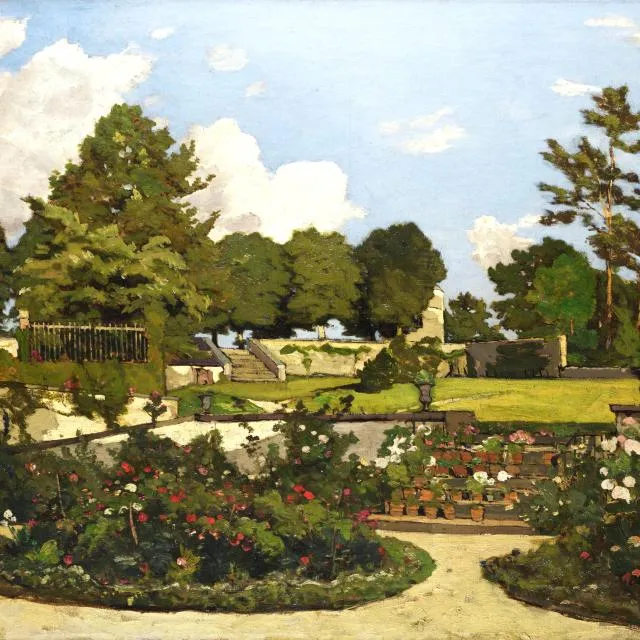
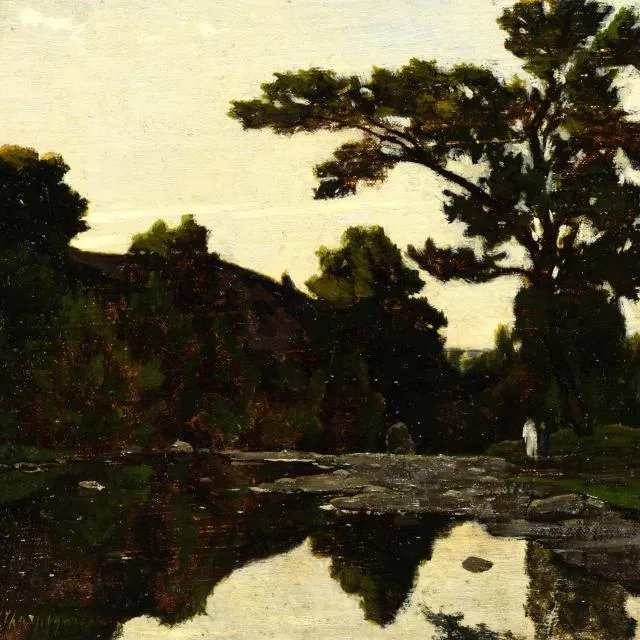
The sombre colours and dying glow of the evening light in this rustic landscape evoke autumn, the inevitable passage of time and a certain melancholy. Leaves on the cluster of poplar trees are crisp and beginning to turn brown. On the scrubby grass beneath the trees, a few dabs of paint suggest late blooming flowers or perhaps leaves already fallen. A dip in the rough terrain reveals the breadth of a lake, its water rippling and splashing under the distant, grey hills.We don’t know where the scene is set. It’s most likely to be from Harpignies’ imagination, but based on his knowledge of and affection for the countryside of the Yonne, the area south of Paris that he visited often and where he lived in his retirement. Throughout his life, Harpignies painted countless landscapes and was very successful. A visit to Rome at the start of his career had introduced him to the work of the great seventeenth-century landscape artist Claude, who was a lasting influence. Time spent with Barbizon painters such as Jean François Millet made him aware of their new realism, painting gritty subjects of relentless manual labour or working animals in an often grim landscape. Harpignies wanted realism, but not in their way – ‘No! No! It’s Rome that marked me above all’, he wrote.He shared this view of landscape with his great friend Corot – painting what he saw around him but not in the grim, realist way. He chose the more gentle, classic way of the earlier masters, though without their use of the mythical figures of Greece or Rome. Like Corot, he used subtle contrasting colours to enliven his pictures – the subtle red in the sky here lifts the heavy greens and browns of the foreground. In Cows in a Marshy Landscape, Corot has used colour contrast in this way, but he also included a figure and animals to give life. Harpignies rarely put figures into his landscapes, and almost never animals; when he did, they usually had a technical purpose. The tiny figure of the woman on the right here is much too small in proportion to the trees. She is there solely to animate the scene through colour, painted in expertly judged dots and dabs of red, pink and brilliant white. The single figure in The Painter’s Garden at St Privé has the same effect.By the 1890s, when Harpignies was beginning to age, pictures such as this one were considered to be old-fashioned, but his technical skill and confidence was undiminished. The crumbling earth and tufts of grass are painted with heavy impasto, much in the way that younger Impressionist artists like Monet were doing. But still the luminous sky and the elegance of the trees links Harpignies with the classical artists of Rome, making him a bridge between the seventeenth-century masters and his contemporaries.
299 collected·381 zoomed·1 comments·1 boards
This artwork is in 1 board
About this artwork
Autumn Evening (1894) by Henri-Joseph Harpignies, oil on canvas, from the National Gallery, London collection.
About Henri-Joseph Harpignies
Henri-Joseph Harpignies (French pronunciation: [ɑ̃ʁi ʒɔzɛf aʁpiɲi]; June 28, 1819 – August 28, 1916) was a French landscape painter of the Barbizon school.
More by Henri-Joseph Harpignies
Comments (0)
No comments yet. Be the first to share your thoughts.