

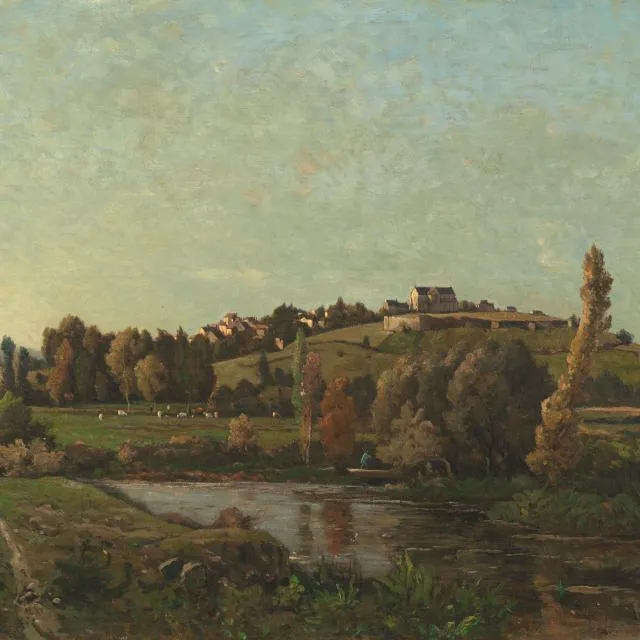
River and Hills

about 1850-60 · Oil on canvas
Dimensions 27.3 x 44.5 cm
Collection: National Gallery, London
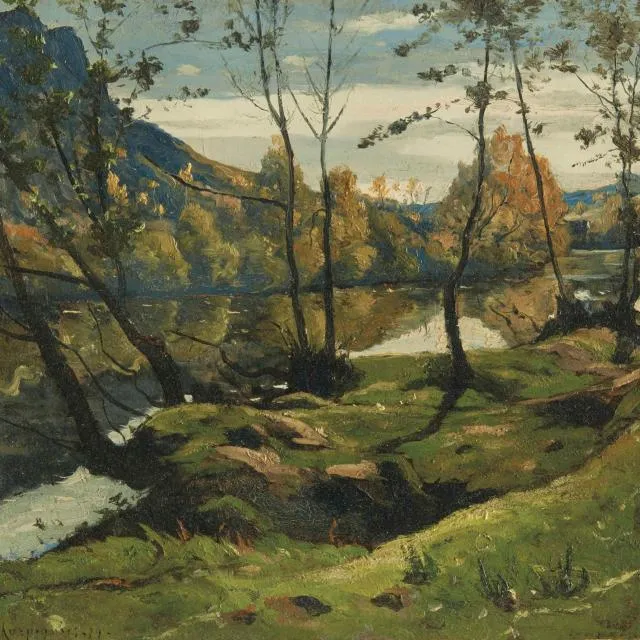
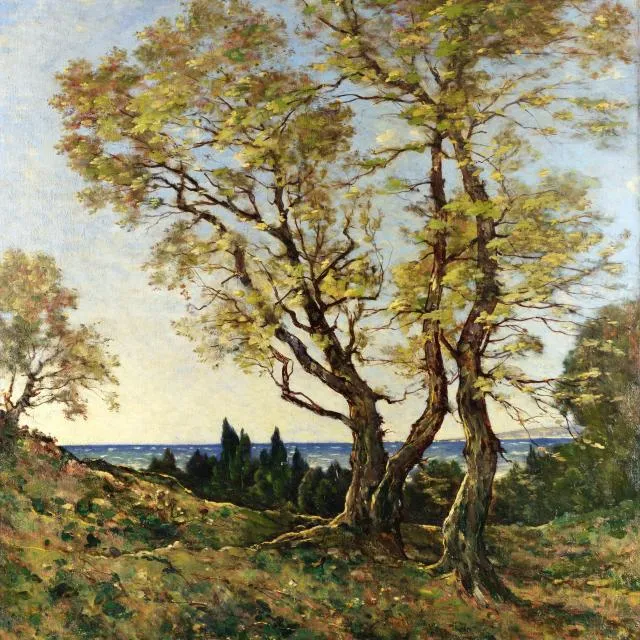
In 1850, early in his career, Henri-Joseph Harpignies went to Italy, visiting Rome and Naples until 1852. While there, he explored the Campagna, the countryside around the city, where his passion for landscape painting began. He wrote several times that he loved Rome so much he wished never to return to France, and – as he repeatedly referred to his love for the city – perhaps in his mind he never did. The style of the picture is that of his work in the 1850s, but the precise date is unknown. The scene is possibly imaginary, but it certainly recalls the Campagna in its craggy beauty and arresting contrast in light.A man stands on the winding path beneath the dark, forbidding cliffs. He gazes out across the river, his white cap, coat and backpack lifting the bleakness of the cliffs behind him. High above him, the sun catches a strange construction on the cliff top then reaches across to the far hillside, bathing it in luminous warmth. On the far bank of the river, poplar trees grow in grey, gravelly soil, their reflections perfect in the still water.Patches of canvas visible under thin paint create texture, giving the suggestion of broken clouds in the clear light of the sky; these are reflected in the water by curved flicks of the brush in blue, white and purple. The trunks of the poplars are painted with quite pronounced impasto and one is lightly outlined in black. Harpignies used this technique throughout his career (see Olive Trees at Menton, painted in his retirement), long after he abandoned the heavy, rough strokes with which he has depicted the cliffs, the teeth-like rocks and the red soil of the hill. This early style suggests that he might have developed into an Impressionist painter, but a return to Rome in 1863 changed his direction.Between his visits to Rome, Harpignies had stayed for a while in Barbizon with artists like Jean François Millet, but he had never quite adopted their version of modernism – gritty, often disturbing, subjects, like poverty-stricken men and women involved in crushing labour. Nor did he align himself with the Impressionists and their heavy impasto and scenes of the city, often considered by critics and the public as in questionable taste. On his second visit to Rome, Harpignies met Jean-Baptiste-Camille Corot and became his friend and follower. The two men chose to follow the path of the seventeenth-century classical artists Claude and Poussin, using their smoother, more delicate technique and with people and nature in harmony.
83 collected·119 zoomed·1 comments·1 boards
This artwork is in 1 board
About this artwork
River and Hills (about 1850-60) by Henri-Joseph Harpignies, oil on canvas, from the National Gallery, London collection.
About Henri-Joseph Harpignies
Henri-Joseph Harpignies (French pronunciation: [ɑ̃ʁi ʒɔzɛf aʁpiɲi]; June 28, 1819 – August 28, 1916) was a French landscape painter of the Barbizon school.
More by Henri-Joseph Harpignies
Comments (0)
No comments yet. Be the first to share your thoughts.