

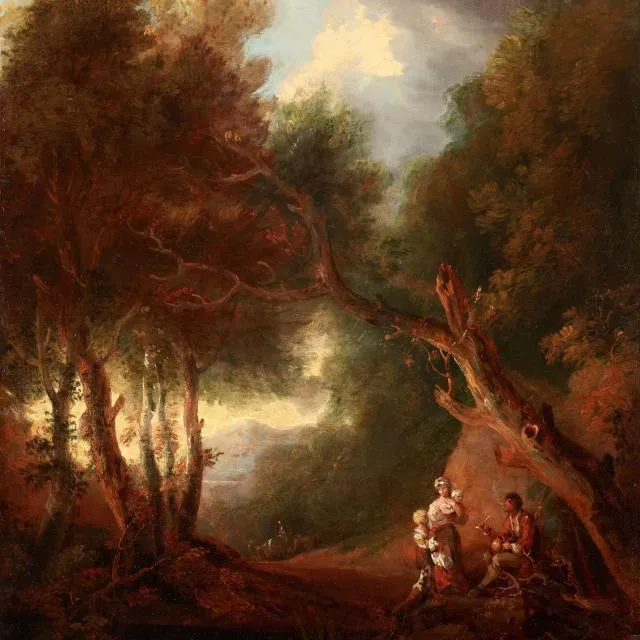
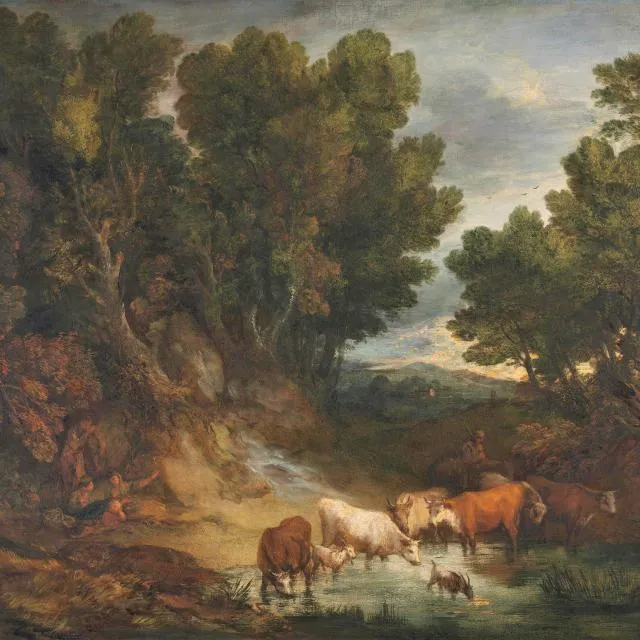
Cornard Wood, near Sudbury, Suffolk

1748 · Oil on canvas
Dimensions 122 x 155 cm
Collection: National Gallery, London
Cornard Wood is on the outskirts of the village of Great Cornard, two miles from Sudbury, where Gainsborough was born. The view is taken from Abbas Hall, on a hillside above Great Cornard, looking south and slightly west to the village of Great Henny. The church of St Mary’s Great Henny appears in the background, our eyes led to it by the path winding through the wood. In reality, Great Henny is further away than it appears in Gainsborough’s painting, and its tower is slightly different.The wood was common land, not private property, and villagers had ancient rights to gather wood, graze donkeys and horses, dig marl for manure and sand for building materials, take the path to Great Henny, or just go for a stroll there. In Gainsborough’s painting we see many of these activities: two donkeys stand on a hillock; a man, accompanied by a seated lady, rests from digging; another man cuts and ties firewood while travellers journey on foot and horseback towards Great Henny. The trees and common on the left are dappled with sunshine, whereas the two spring-fed ponds on the right are bathed in shade. The Prussian blue pigment in the sky has faded to grey.Gainsborough began teaching himself to draw and paint by studying and copying landscapes by Dutch artists, particularly Wynants and Ruisdael. Dutch landscapes appealed to those who preferred pictures of recognisable reality rather than the ideal classical landscapes of artists such as Claude and Poussin. Gainsborough could have seen Dutch paintings in East Anglian collections and probably knew others through engravings. The countryside of East Anglia, with its river meadows, ponds and windmills, shares much in common with that of the Netherlands. Gainsborough may have recognised that he could paint and sell pictures of his native landscape to those who appreciated Dutch art. However, Cornard Wood has a dreamy quality that sets it apart from the very realistic ‘little Dutch landscapes’ Gainsborough studied in his youth.In a letter dated 11 March 1788, Gainsborough wrote that Cornard Wood was ‘actually painted at Sudbury, in the year 1748’, while he was still learning his craft, and that its sale enabled his father to send him to London. He said that the painting’s ’schoolboy stile‘ secretly pleased him because it showed the strength of his lifelong commitment to landscape painting. He confessed that ’though there is very little idea of composition in the picture, the touch and closeness to nature [...] are equal to any of my later productions.‘ Gainsborough revealed that in the intervening 40 years, Cornard Wood had passed through the hands of 20 picture dealers and he had even bought the painting back once himself for 19 guineas.Cornard Wood belonged for some years to the painter John Constable’s uncle, David Pike Watts. Constable was born within ten miles of Gainsborough’s birthplace, and was an admirer of his landscapes. It may have been Constable who recognised the scene as near Cornard and came up with the picture’s title. When Constable was painting near Woodbridge in Suffolk in 1800, he wrote: ’tis a most delightful country for a landscape painter, I fancy I see Gainsborough in every hedge and hollow tree.'
101 collected·130 zoomed·0 comments
About this artwork
Cornard Wood, near Sudbury, Suffolk (1748) by Thomas Gainsborough, oil on canvas, from the National Gallery, London collection.
About Thomas Gainsborough
homas Gainsborough RA FRSA (14 May 1727 (baptised) – 2 August 1788) was an English portrait and landscape painter, draughtsman, and printmaker.
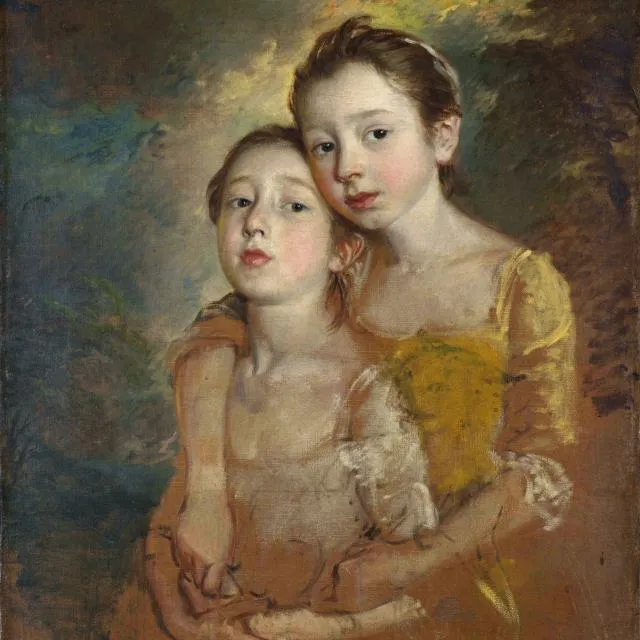
More by Thomas Gainsborough
Comments (0)
No comments yet. Be the first to share your thoughts.