

Fox Hill, Upper Norwood

1870 · Oil on canvas
Dimensions 35.3 x 45.7 cm
Collection: National Gallery, London
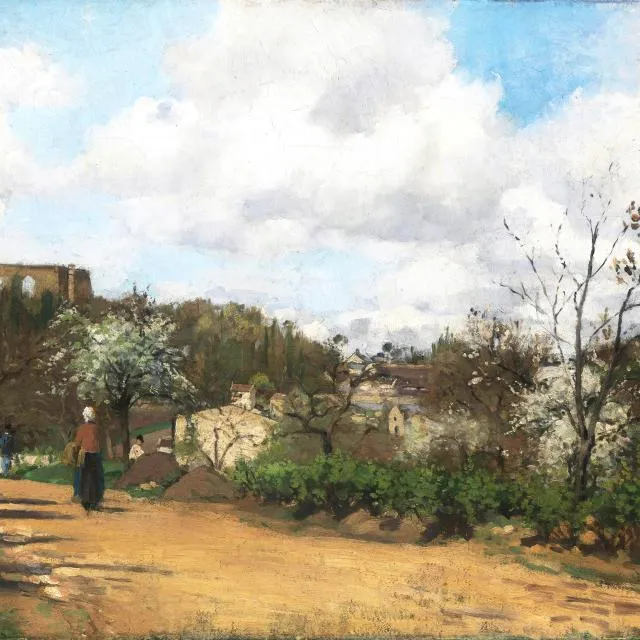
This is one of 12 surviving pictures that Camille Pissarro painted while in self-imposed exile in London from late 1870 to mid-1871 during the Franco-Prussian war. When the Prussians invaded Paris in September 1870 and commandeered his house in Louveciennes, to the west of the city, Pissarro and his family moved to London, where his mother and brother were already living.They arrived in early December 1870 and settled briefly in the south London village known then as Lower Norwood, before moving to Upper Norwood (the two parts merged 15 years later). This area of south London was undergoing significant change, as villages and the surrounding countryside were absorbed into the spreading suburbs. All the paintings show places within walking distance of Pissarro’s lodgings, but reveal different aspects of the city. Another painting in the National Gallery’s collection The Avenue, Sydenham, shows an elegant residential street, while Lordship Lane Station, Dulwich (Courtauld Institute, London) focuses on the city’s technological modernisation, specifically the railway.The winter of 1870–1 was particularly cold, enabling Pissarro to continue painting the type of winter landscapes he had produced in France in the winter of 1868–9. Fox Hill, Upper Norwood is perhaps the first picture he painted in London. One of the more rural scenes of the group, it is particularly close to landscapes he had been painting at Louveciennes, especially his views of the Versailles Road, which he painted in different weather conditions between 1869 and 1870. As in the Versailles Road pictures, we see a simple road flanked by houses, chimney smoke merging with the clouds. Three people – two women and a man in a top hat with a walking stick – pass each other, their sombre clothing matching the shrubbery and bare trees.The picture has the appearance of having been painted quickly on site, with Pissarro’s easel placed in the centre of the gently winding road as he looked up and westward towards Fox Hill. However, it was completed in several stages. Having first sketched out the basic outlines of the composition, Pissarro worked rapidly and energetically using a wet-in-wet technique to blend the colours and block out specific areas, such as the foliage. Some details – including the man – were only added once the initial paint layers had dried. Although Pissarro used a broad array of colours, there is a strong tonal contrast between the darker houses and foliage in the lower half of the picture and the bright sky of the upper half. In places, Pissarro used touches of vivid colour, which also bind the composition together. For example, the russet red in the women’s clothing is echoed in the rooftop of the house facing us, and the pale blue of the shadows on the snow echoes the blue sky.It is possible to identify the site today – the road at Fox Hill retains its slight bend – but Pissarro was perhaps more interested in the atmospheric effects of light and weather than in precise topography. Indeed, this painting may have been exhibited with the title Effet de neige (Snow Effect), rather than a title indicating a specific location, in March 1871 at the New Bond Street gallery of art dealer Paul Durand-Ruel. He was an important champion of the Impressionists, who Pissarro first met on this visit to London.
74 collected·68 zoomed·1 comments
About this artwork
Fox Hill, Upper Norwood (1870) by Camille Pissarro, oil on canvas, from the National Gallery, London collection.
About Camille Pissarro
Camille Pissarro (/pɪˈsɑːroʊ/ piss-AR-oh, French: [kamij pisaʁo]; 10 July 1830 – 13 November 1903) was a Danish-French Impressionist and Neo-Impressionist painter born on the island of St Thomas (now in the US Virgin Islands, but then in the Danish West Indies).
More by Camille Pissarro
Comments (0)
No comments yet. Be the first to share your thoughts.