

La Maison du Pendu
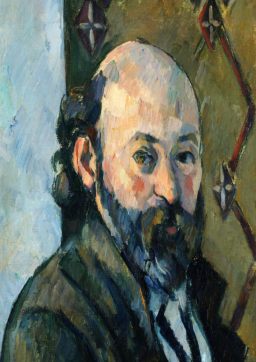
1873 · Oil on canvas
Dimensions 55.5 × 66.3 cm
Collection: Doria Collection
This was one of three paintings that Cézanne presented at the first and seminal impressionist exhibit in the studios of Nadar in 1874 where it was remarked as one of the most radical items. Count Armand Doria left the exhibit perplexed with his son, saying "Well, we don't get any of it. There is something of the first order in there, I must have something by this painter". He turned back and became the first buyer of a work by Cézanne with La Maison du Pendu, to the great despair of Victor Chocquet, another collector, who begged him to let him have the painting, eventually convincing Doria to make an exchange with "Neige fondante à Fontainebleau". While critics of the time were confused by the painting, it is regarded as a turning point in Cézanne's career and one of his major achievements. The composition is complex with ascending and descending paths, vertical trees, oblique branches, curves, numerous and crowded planes expanding into a distant horizon, etc. Strongly influenced by Pissarro, Cézanne discarded the darker colors he had used in earlier paintings and chose a bright palette with typically impressionist fragmented touches. He chose a simple, mundane subject with no character, cold tonalities and a stark vegetation giving a strong feeling of loneliness. The heavy and grainy layers give the scene a distinct pasty sensation. After Chocquet, this artwork belonged to Count Isaac de Camondo, another major art collector, who bequeathed it to the Louvre. It is now exhibited in the Musée d'Orsay in Paris. Ce tableau est l'un des trois (avec Une Moderne Olympia et une étude de paysage) présentés par Cézanne en 1874 à la première exposition des peintres impressionistes dans l'atelier de Nadar, où il est remarqué pour sa radicalité. Le Comte Armand Doria, quittant l'exposition perplexe avec son fils aurait dit "Décidément nous n’y entendons rien. Il y a des choses de premier ordre là-dedans. Il faut que j’aie quelque chose de ce peintre-là. » et retournant sur ses pas devint le premier acquéreur d'une peinture de Cézanne avec la Maison du Pendu, au grand désespoir de Victor Chocquet, un autre collectionneur, qui à force de le supplier de la lui céder finit par obtenir un échange avec "Neige fondante à Fontainebleau". Les critiques étaient déroutés par le tableau, depuis considéré comme une étape importante dans la carrière de Cézanne et un de ses chefs-d'oeuvre. La composition est complexe autour d'un point central, avec une route descendant vers le centre du tableaux, une autre montant, des arbres verticaux, des branches obliques, des lignes courbes, de nombreux plans très rapprochés etc. Cézanne, influencé par Pissarro, y délaisse la palette sombre de sa jeunesse et adopte des couleurs claires ainsi que la touche fragmentée des impressionistes. Le sujet est banal, loin des scène historiques ou dramatiques, avec des tons froids, des rues déserte et une végétation austère qui renforcent un sentiment de solitude. La couche picturale, lourde avec un grain épais, donne une impression pâteuse à l'ensemble. Après Chocquet, cette toile rejoint la collection elle aussi prestigieuse du Comte Isaac de Camondo qui la lègue au Louvres. Elle est à présent exposée au Musée d'Orsay.
36 collected·74 zoomed·0 comments·1 boards
This artwork is in 1 board
About this artwork
La Maison du Pendu (1873) by Paul Cezanne, oil on canvas, from the Doria Collection.
About Paul Cezanne
(19 January 1839 - 22 October 1906) Paul Cezanne was a French painter. He was born in Aix-en-Provence, in the south of France, and died of pneumonia there. The artistic career of Paul Cézanne lasted more than forty years, from roughly 1860 to 1906.
More by Paul Cezanne
Comments (0)
No comments yet. Be the first to share your thoughts.