

Louis-Auguste Schwiter
1826-30 · Oil on canvas
Dimensions 217.8 x 143.5 cm
Collection: National Gallery, London
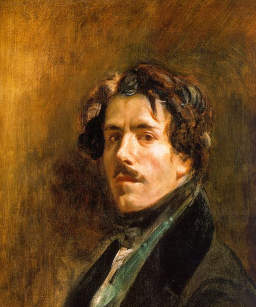
Louis-Auguste Schwiter (1805–1899) was an artist who exhibited regularly at the Paris Salon from 1831. He later inherited the title of baron. His friendship with Delacroix, seven years his senior and under whom he may have trained, lasted until Delacroix’s death in 1863. Significantly for this painting, both shared an enthusiasm for England and they may have travelled together to London in 1825, the year before Delacroix began work on the portrait.French interest in English culture and history was at its peak in the 1820s and 1830s – a fine example of this is Paul Delaroche’s The Execution of Lady Jane Grey. The cultivation of English style is evident both in Schwiter’s clothes and in Delacroix’s emulation of contemporary English portraiture. British artists often exhibited at the Paris Salon and Delacroix would also have seen examples while visiting London. Delacroix especially admired the portraitist, Sir Thomas Lawrence (1769–1830). He wrote enthusiastically in his Journal of portraits Lawrence had exhibited at the Salon of 1824, and met him in England the following year.For this portrait, Delacroix adopted Lawrence’s preference for presenting elegantly dressed figures within a parkland setting. He also sought to recreate what he saw as Lawrence’s ability to capture ‘the most delicate shade of melancholy or of gaiety.’ Although not an overtly melancholic portrait, the sombre evening sky, setting sun and dark landscape – partly painted by the landscape painter Paul Huet (1803–1869) – contribute to the effect of approaching dusk. Schwiter himself is depicted as a pensive and somewhat guarded young man who appraises us as much as we do him. Holding his top hat, with its flash of bright red lining, he wears a simple but fashionable black frock coat, which sets off his cream gloves and brilliant white cravat. Pale, elegant, and slim, he is a distinctly modern figure with a hint of the dandy about him.Delacroix was also an enthusiastic admirer of the English poet, Lord Byron (1788–1824), whose poems provided subjects for many of his paintings and prints. In his Journal of 1824 he extensively praised Byron’s ability to express the sense of isolation that can accompany genius. Delacroix’s identification with ‘the poet who lives in isolation’ is perhaps projected onto Schwiter. As they shared similar physical features, the painting may in part be viewed as a self portrait.As his first full-length portrait, this painting was an important step for Delacroix. But despite his ambitions for it, the painting was rejected for the Salon of 1827. The reason for this is not known, but dissatisfaction with the perspective of the balustrade may be the explanation; Delacroix later reworked this section. The painting was eventually bought by Edgar Degas (1834–1917) in 1895 for his own private collection, a few years after Schwiter’s death.
64 collected·84 zoomed·1 comments
About this artwork
Louis-Auguste Schwiter (1826-30) by Eugene Delacroix, oil on canvas, from the National Gallery, London collection.
About Eugene Delacroix
( 26 April 1798 – 13 August 1863) Ferdinand Victor Eugène Delacroix was a French Romantic artist regarded from the outset of his career as the leader of the French Romantic school.
More by Eugene Delacroix
Comments (0)
No comments yet. Be the first to share your thoughts.