

Philip IV of Spain in Brown and Silver
about 1631-2 · Oil on canvas
Dimensions 195 x 110 cm
Collection: National Gallery, London
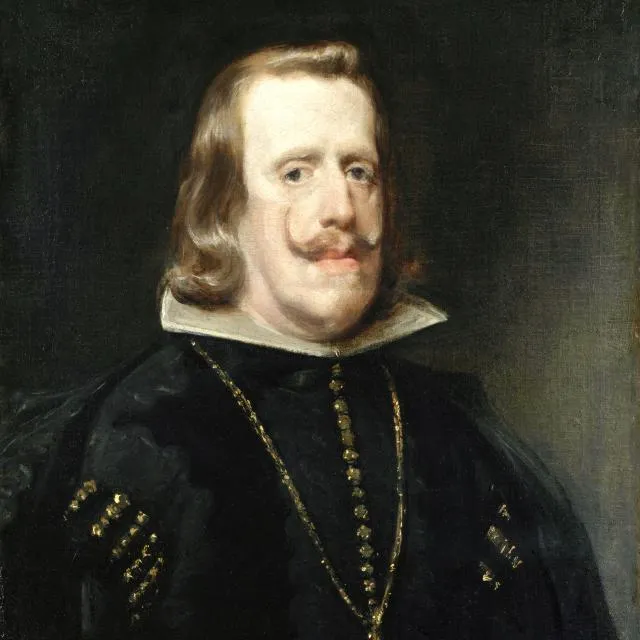
Philip IV, King of Spain, was normally shown in fairly sombre clothing, so the unusual splendour of his costume here suggests that this work was made to celebrate something particular. Philip stands beside a plain wooden table covered in a red velvet cloth, matching the draped curtain behind him. His expression is impassive but assertive, and his luxurious clothing conveys his power.Philip’s sleeveless jacket and breeches are made from purplish-brown fabric (now faded to brown) woven with silver motifs, and further embellished with silver appliqués and buttons; silver lace adorns the edge of his cloak. The white sleeves, shimmering with silver, are probably made of silk. His hat, on the table beside him, is decorated with delicate feathers. He wears the badge of the Order of the Golden Fleece (a prestigious chivalric order) on a gold chain and rests one hand on the hilt of his sword.The King holds a petition signed by Velázquez, identifying his position as ‘Painter to Your Majesty’ and presumably declaring his allegiance to the monarch. Velázquez rarely signed his works, only those he considered important. He became court painter through his skill as a portraitist, and painted Philip IV and his family over four decades. Although the King would not have posed for every painting, this portrait was apparently done from life and the head served as a prototype for other half- and full-length portraits of the King, both by Velázquez and by his workshop. It was probably painted shortly after the artist returned from Italy in early 1631, as it shows a significant change in the King’s appearance compared to portraits from the 1620s – notably his facial hair, styled into a curly moustache and beard.In 1629 Philip’s son and heir, Baltasar Carlos, was born and the Cortes of Castile were invited to pledge an oath of allegiance to the crown prince. This was one of the most important ceremonies of Philip’s reign and took place in the church of San Jerónimo in Madrid in 1632. A contemporary account of the King’s costume during this event suggests it was similar to the one we see here; Velázquez was perhaps commissioned to commemorate the occasion.Velázquez experimented with his painting technique in this portrait: the daubs and squiggles of paint might appear haphazard close up, but from a distance they conjure a brilliant impression of light and texture. The surface effects in this picture are especially dazzling because it is one of Velázquez’s best-preserved works.During the mid-seventeenth century this portrait was recorded in the Escorial Library, housed within the Monastery of San Lorenzo near Madrid, and it may indeed have been commissioned with that location in mind. The painting was part of a group of four portraits that included the King’s predecessors – Charles V, Philip II and Philip III – thus establishing Philip’s place in the Habsburg dynasty.The National Gallery’s collection also includes the bust-length Philip IV of Spain by Velázquez, while Philip IV hunting Wild Boar shows the King and his courtiers taking part in a rural hunt.
91 collected·179 zoomed·0 comments
About this artwork
Philip IV of Spain in Brown and Silver (about 1631-2) by Diego Velazquez, oil on canvas, from the National Gallery, London collection.
About Diego Velazquez
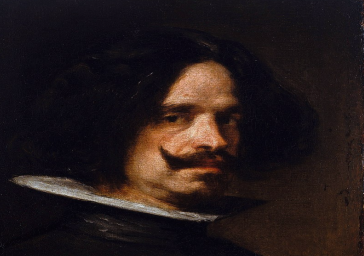
(baptized June 6, 1599 – August 6, 1660) Diego Rodríguez de Silva y Velázquez was a Spanish painter, the leading artist in the court of King Philip IV, and one of the most important painters of the Spanish Golden Age. He was an individualistic artist of the contemporary Baroque period.
More by Diego Velazquez
Comments (0)
No comments yet. Be the first to share your thoughts.