

The Immaculate Conception

1618-19 · Oil on canvas
Dimensions 135 x 101.6 cm
Collection: National Gallery, London
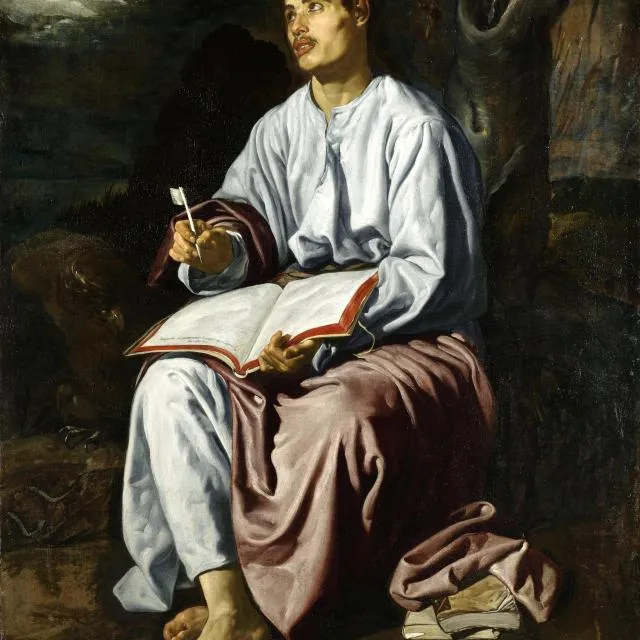
A young woman floats above a landscape, a translucent moon under her feet and a crown of 12 stars on her head. A yellow glow surrounds her. This imagery is based on the New Testament Book of Revelation, in which Saint John the Evangelist records his vision of the Woman of the Apocalypse ‘clothed with the sun’. She bears a male child and is threatened by a dragon – the devil.In Catholicism, this woman represents the Virgin Mary, the mother of Jesus Christ. Here, her hands are clasped in prayer and she looks down in humility to show her protection over humanity. The garden, fountain, temple and ship at the bottom are all symbols normally associated with her purity, and were included in a litany (or prayer) dedicated to the Virgin.This is an early example of the representation of the Immaculate Conception in Spanish art. The belief that the Virgin was herself conceived without sin dates back to at least the Early Middle Ages. In 1617, just before this picture was painted, Pope Paul V issued a decree that enforced this doctrine.An important Spanish treatise on painting, the Arte de la Pintura (1649) by Velázquez’s teacher Francisco Pacheco, gives detailed recommendations on how to depict religious scenes such as this one. It was published 30 years after this picture was painted, but its concepts would have been familiar to Velázquez from his time in Pacheco’s studio. Pacheco wrote that the Virgin should be shown ‘in the flower of her youth, 12 or 13 years old, as a beautiful young girl, with fine and serious eyes, a most perfect nose and mouth and pink cheeks, wearing her mat golden hair loose’.The youthful, naturalistic Virgin here seems to be based on an actual girl. But she also has a solid sculptural appearance, especially in the deeply carved folds of her drapery. Velázquez was probably trained in the art of painting wooden sculpture, and this may have improved his ability to convey form in such a lifelike, three-dimensional way. The Virgin’s blue mantle originally swept across the lower part of her legs, in front of her tunic; this is clearly visible in X-ray images. Velázquez painted this out, perhaps to make the form of her legs beneath the drapery clearer and to enhance her sculptural appearance. The pink tunic would originally have been more intensely red, but its colour has faded.With its companion painting, Saint John on the Island of Patmos, this is one of Velázquez’s earliest known works. In that picture, he shows Saint John looking up towards his vision of the Woman of the Apocalypse, and we are encouraged to look towards this painting for an intimate and close-up view of the Virgin.There are several paintings on this subject in our collection, including others by artists working in Seville during the seventeenth century, such as Juan de Valdés Leal’s The Immaculate conception with Two Donors, and The Immaculate Conception of the Virgin by Bartolomé Esteban Murillo and his studio.
110 collected·153 zoomed·0 comments
About this artwork
The Immaculate Conception (1618-19) by Diego Velazquez, oil on canvas, from the National Gallery, London collection.
About Diego Velazquez
(baptized June 6, 1599 – August 6, 1660) Diego Rodríguez de Silva y Velázquez was a Spanish painter, the leading artist in the court of King Philip IV, and one of the most important painters of the Spanish Golden Age. He was an individualistic artist of the contemporary Baroque period.
More by Diego Velazquez




Comments (0)
No comments yet. Be the first to share your thoughts.