

Portrait of a Boy

probably about 1475-98 · Tempera and oil on wood
Dimensions 22.9 x 19.7 cm
Collection: National Gallery, London
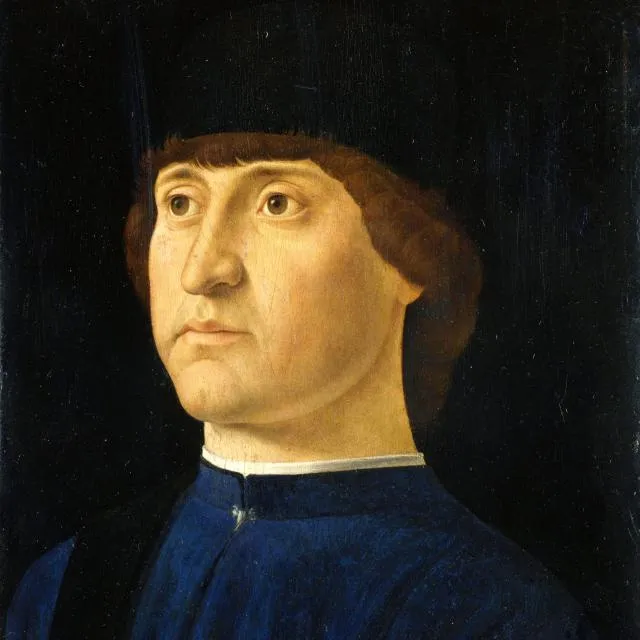
This small, exquisite portrait of a young boy is a very rare example of the work of the Venetian painter and manuscript illuminator known as Jacometto. The boy’s smooth, creamy skin is painted with such fine and densely placed brushstrokes that the paint looks like enamel. His cheeks are flushed almost neon pink, his prominent pouting lips a more subtle shade of rose; both emphasise the vitality of youth. His eyes are clear and his gaze sincere. His shiny strawberry blonde waves are combed to perfection.Although we don‘t know who this boy was, Jacometto’s image is a portrait of youth and beauty. The tradition of creating idealised portraits was well established by the time Jacometto made this picture; Renaissance thinkers theorised that outward appearance was the mirror of the soul. The main reason that portraits were commissioned was to commemorate someone for posterity and so it was not just their face but also their character and soul that were thought to be present in the image. The scale of this portrait and its reverse, which is decorated to resemble marble, suggest that it was intended to be carried with its owner as a keepsake (like a photograph) rather than hung permanently on a wall. Several other portraits attributed to Jacometto, including his Portrait of a Man, have painted reverses.Portraiture was an important type of painting in Venice and its citizens were keen patrons and collectors of portraits. Venice was a Republic ruled by an elected leader – the doge – rather than a dukedom like many Italian states. Venetian painters portrayed middle-class citizens as well as leaders, perhaps explaining why there are so many surviving portraits of unidentified sitters. It also explains why many of them were dressed in the same plain, unostentatious outfits as this young man. Venetians valued the philosophy of a collective identity and being painted wearing the outfit of the citizens, without any personalised embellishment, reinforced this sense of unity.Jacometto has adopted a format for portraits that was popularised in the city by the Sicilian painter Antonello da Messina. If you look at Antonello’s Portrait of a Man you’ll see that both share the plain dark background and a close-up view, showing only the head and shoulders. In both the sitter’s body is angled slightly to his right, facing into a strong light, so the face is seen in a three-quarter view and partially shadowed on the left-hand side.Antonello arrived in Venice in 1475 and his portrait style, strongly influenced by examples from the Southern Netherlands, soon became hugely popular. It is not difficult to see why local artists like Jacometto quickly borrowed the elements of his successful formula. The only difference is that here the boy does not look at us, as many of Antonello’s sitters do. Instead, he looks into the distance; he does not engage with viewers directly. The direct gaze of Antonello’s portraits was not universally adopted – Giovanni Bellini, for example, always showed his sitters looking beyond the picture surface, never catching the viewer’s eye.
57 collected·42 zoomed·0 comments·2 boards
This artwork is in 2 boards
About this artwork
Portrait of a Boy (probably about 1475-98) by Jacometto, tempera and oil on wood, from the National Gallery, London collection.
About Jacometto
Jacometto Veneziano (active 1472–1497), was an Italian painter and illuminator. The information we have about Veneziano is mainly based on the records of the diarist and art collector Marcantonio Michiel.
More by Jacometto
Comments (0)
No comments yet. Be the first to share your thoughts.