

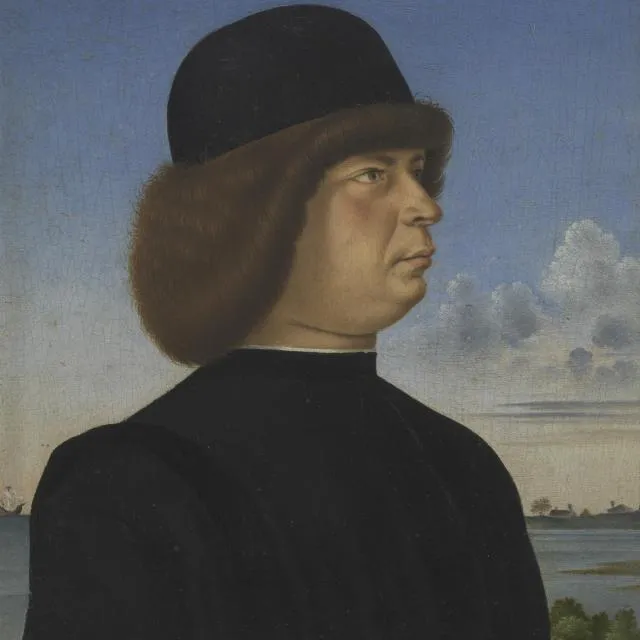
Portrait of a Man

probably about 1475-98 · Tempera and oil on wood
Dimensions 26 x 19 cm
Collection: National Gallery, London
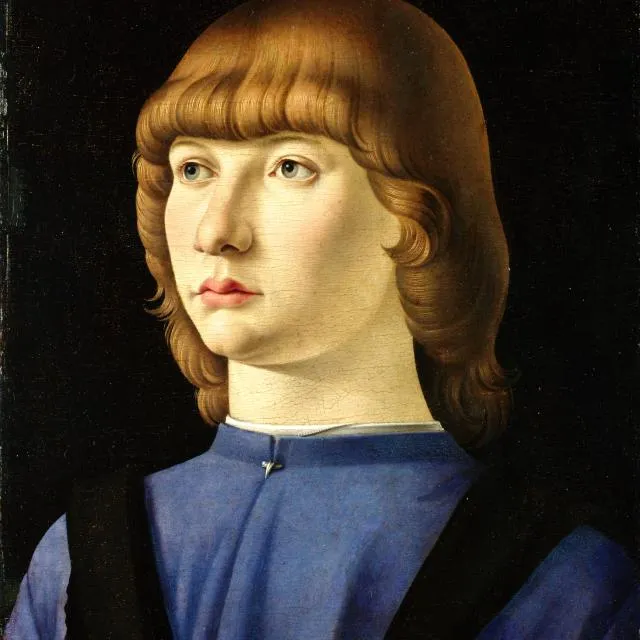
Not many portraits by the Venetian painter and miniaturist Jacometto survive, but the National Gallery has two: this one, and Portrait of a Boy. The man is dressed in the normal outfit of a Venetian citizen or patrician, which included a black cap and stole (the strip of fabric across his chest).Blue was worn by members of confraternities, but this is as close as we can get to understanding his identity. Apart from a fleshy chin, the man’s face lacks definition – his cheek bones are low and his jaw is soft. His most distinctive features are his small beady eyes and his long thin nose.This painting, along with the Portrait of a Boy, reflects the portrait style popularised in Venice by the Sicilian artist Antonello da Messina: a dark background, three-quarter view and the effect of strong lighting from a single source to the sitter’s right. The light effect is more subtle here and the contours appear softer than those in Antonello’s portraits. The picture more closely reflects the work of Jacometto’s other contemporary in Venice, Giovanni Bellini.Two fronds of laurel bound together with a ribbon are painted in gold on the painting’s reverse, on a dark background. Between them is an inscription, from the Roman poet Horace’s Odes, in Latin: FELICES TER ET AMPLIVS/QVOS/IRRVPTA TENET COPVLA (‘Thrice happy and more are those bound together ’). A Renaissance patron would've known that laurel symbolised eternity, and the rest of Horace’s ode relates to romantic jealousy: he encourages the woman to whom the poem is addressed to seek happiness in a peaceful, faithful and enduring relationship. The message here seems to be that marriage is hugely desirable; it seems likely, then, that this portrait was commissioned to celebrate an engagement or marriage. Another panel, representing the man’s wife, may have been ordered at the same time.Several portraits attributed to Jacometto include painted reverses. These include a pair – probably commissioned to celebrate a marriage – at the Metropolitan Museum of Art, New York. They are of a man called Alvise Contarini and a woman, most likely his wife. The reverse of his image shows a deer chained to a painted stone background and includes the Latin word aiei, meaning forever; it alludes to the importance of sexual faithfulness within marriage.Painted reverses were a popular way of adding meaning to the portrait and often included heraldic devices or symbols and mottos. The idea came from Netherlandish paintings – at the Courtauld Gallery in London there’s an example of a Netherlandish portrait of man with a sprig of holly and a Latin motto, which dates to the 1430s.
49 collected·36 zoomed·0 comments
About this artwork
Portrait of a Man (probably about 1475-98) by Jacometto, tempera and oil on wood, from the National Gallery, London collection.
About Jacometto
Jacometto Veneziano (active 1472–1497), was an Italian painter and illuminator. The information we have about Veneziano is mainly based on the records of the diarist and art collector Marcantonio Michiel.
More by Jacometto
Comments (0)
No comments yet. Be the first to share your thoughts.