

Saint John the Baptist

about 1480 · Oil on oak
Dimensions 57.5 x 17.3 cm
Collection: National Gallery, London
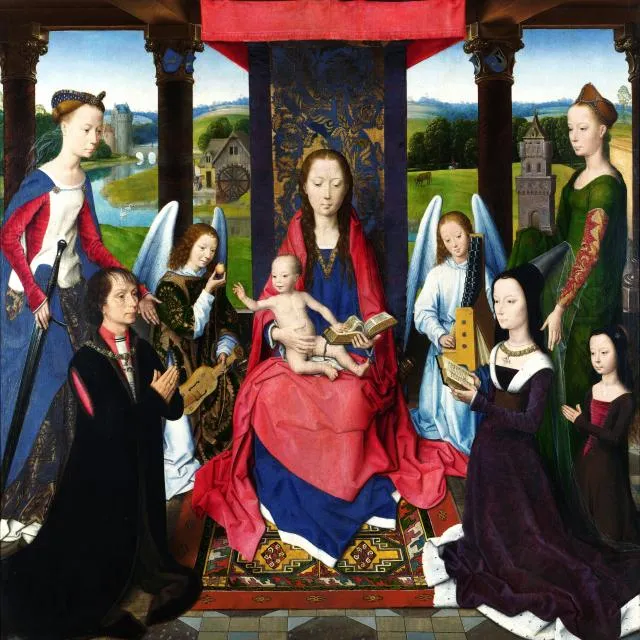
Saint John the Baptist, dressed in a hair shirt and a purple mantle, holds his attribute of a lamb. According to the Gospels, the saint lived as a hermit in the desert, wearing clothes of camel hair and eating locusts and honey, and was the first to recognise Christ as the Messiah. When he baptised Christ in the river Jordan he proclaimed, ‘Behold the Lamb of God’ (John 1: 36), which explains his gesturing with his right hand to the lamb in his left.This refined painting was originally the left wing of a small triptych by Hans Memling, the central panel of which showed the Virgin and Child, and the right-hand wing Saint Lawrence. Memling frequently recycled ideas and he reused many of his workshop patterns in this triptych. Similar Baptists appear on the left wing of The Virgin and Child with Saints and Donors (The Donne Triptych), in the centre panel of the Triptych of the Two Saints John (Memling Museum, Bruges) of 1479 and in the Small Triptych of Saint John the Baptist (Kunsthistoriches Museum, Vienna). The lamb’s head is so similar to that of the animal in Saint John the Baptist (Alte Pinakothek, Münich) that both may depend on the same drawing.On the reverse of the panel four cranes stand in a dark landscape lit by the sun, which is probably rising. One at the front holds a stone in his upraised claw. According to legend, at night flocks of cranes would post a single bird as sentry. To prevent itself falling asleep, this bird would hold a stone in its foot: if it dropped the stone it would wake up immediately. Because of this legend, cranes in medieval art became a symbol of vigilance. The fox on the upper right side may represent the dangers from which the sentinel crane is protecting the others. The vigilant crane was the emblem of the bishop and astrologer Benedetto Pagagnotti, the first owner of the triptych, whose coat of arms hangs on a tree behind.Technical analysis of the painting shows underdrawing for the figure, the lamb and the landscape, quite freely executed.
58 collected·47 zoomed·1 comments
About this artwork
Saint John the Baptist (about 1480) by Hans Memling, oil on oak, from the National Gallery, London collection.
About Hans Memling
Hans Memling (also spelled Memlinc; c. 1430 – 11 August 1494) was a German painter who moved to Flanders and worked in the tradition of Early Netherlandish painting. He was born in the Middle Rhine region, and probably spent his childhood in Mainz.
More by Hans Memling
Comments (0)
No comments yet. Be the first to share your thoughts.