

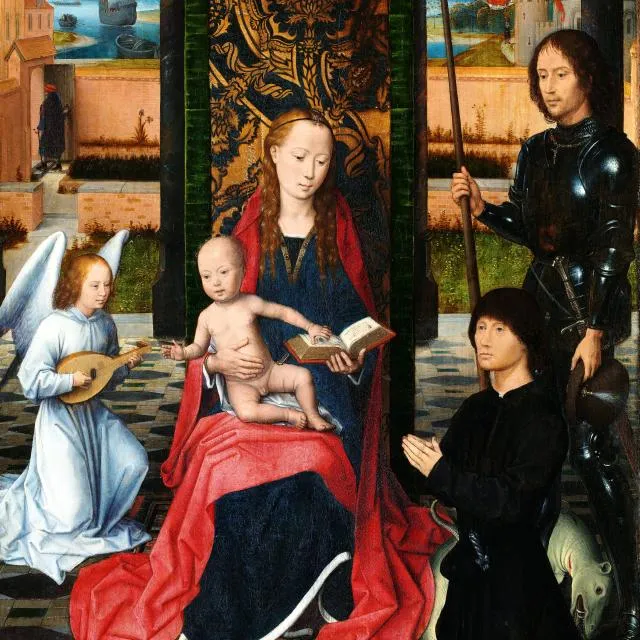
The Virgin and Child with Saints and Donors (The Donne Triptych)

about 1478 · Oil on oak
Dimensions 71 x 70.3 cm
Collection: National Gallery, London
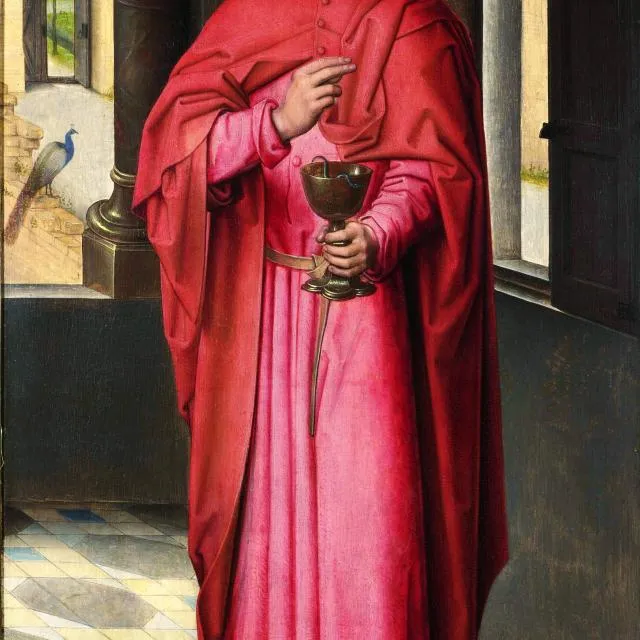
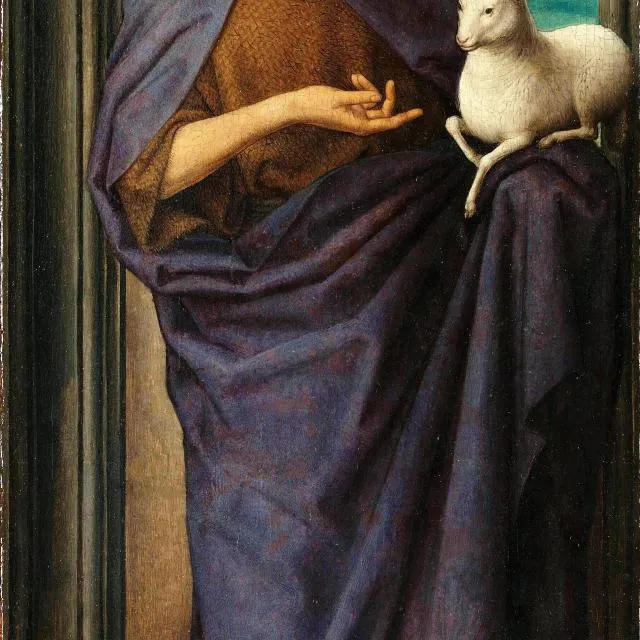
This is the central panel of a small triptych (a painting in three parts) probably commissioned by the welshman Sir John Donne of Kidwelly in the late 1470s. The wings are also in the National Gallery’s collection: Saint John the Baptist and Saint John the Evangelist.The Virgin and Christ Child are seated beneath a canopy and in front of a cloth of honour, with an Anatolian carpet at the Virgin’s feet. On the left, an angel dressed in a dalmatic and holding a viol offers an apple to Christ. On the right, a second angel dressed in an alb plays a portative organ. In the foreground kneel the donors: Sir John Donne, his wife Elizabeth Hastings and one of their daughters, identifiable from the coats of arms on the capitals of the columns behind the angels. Their patron saints, Saint Catherine of Alexandria and Saint Barbara, present them to the Virgin and Child. Saint Catherine, who wears the ‘robe royale’ of a princess, stands on the wheel on which she was tortured. In her right hand she holds the sword with which she was executed, its blade also decorated with wheels. Saint Barbara holds her emblem, the tower in which she was kept prisoner. Both were widely revered in the British Isles and the Low Countries: Catherine was the protectress of the dying, Barbara of those in danger of sudden death.The figures are in a sort of loggia (an open-sided gallery or room) with richly coloured marble columns. The loggia gives way to a landscape where there is a castle, a bridge and a watermill. A man carrying a pole crosses the bridge, while the miller or his servant unloads a sack from a donkey’s back. On the right, a cow grazes and a fashionably dressed horseman rides off on a white horse. The waterwheel behind Saint Catherine may allude to the wheel of her martyrdom, but similar waterwheels occur in other paintings by Memling where the saint is not present.Memling was a good businessman and ran an efficient workshop. He presumably produced a fairly detailed preliminary design based on the Triptych of the Two Saints John (Memling Museum, Bruges) by recycling and recombining workshop patterns. Technical analysis reveals rather sketchy and untidy underdrawing with few major alterations, so the underdrawing probably follows the approved design accurately. Memling’s skill and economy of effort are also seen in the execution. He used tracings for the patterned cloth behind the Virgin, and the translucent gauze at Lady Donne’s neck was achieved not through white paint but by leaving the ground unpainted. It is the lack of white highlights that makes the distinction between skin and fabric.The main changes are in the donors‘ heads. Sir John’s nose was enlarged, and rapid, hatched brushstrokes indicate shadows and stubble. His head seems to have been painted rapidly and from life. Memling also altered Lady Donne’s face and headdress. Initially she looked very like the youthful Saint Barbara but in the course of painting she was made – presumably – more realistic, with thinner lips and a sharper nose. It seems that Memling first painted an idealised head but changed it either when he met Lady Donne or was supplied with better information by her husband.The apple which the angel offers to the Christ Child appears in many of Memling’s paintings, including a triptych of which two panels in the National Gallery’s collection were the wings. It refers to the Fall: Christ is the ’Second Adam' and Redeemer.
51 collected·55 zoomed·0 comments
About this artwork
The Virgin and Child with Saints and Donors (The Donne Triptych) (about 1478) by Hans Memling, oil on oak, from the National Gallery, London collection.
About Hans Memling
Hans Memling (also spelled Memlinc; c. 1430 – 11 August 1494) was a German painter who moved to Flanders and worked in the tradition of Early Netherlandish painting. He was born in the Middle Rhine region, and probably spent his childhood in Mainz.
More by Hans Memling
Comments (0)
No comments yet. Be the first to share your thoughts.