

Salisbury Cathedral and Leadenhall from the River Avon

1820 · Oil on canvas
Dimensions 52.7 x 77 cm
Collection: National Gallery, London
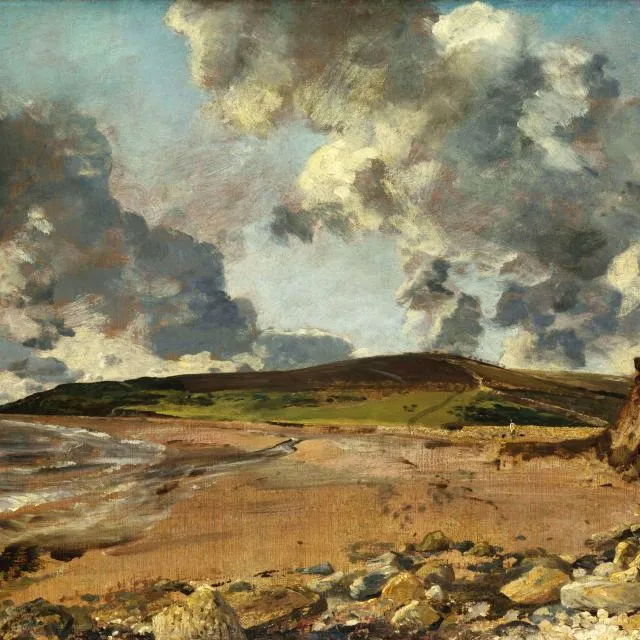
This sketch was painted during Constable’s six-week visit to Salisbury with his wife and two children in the summer of 1820. He had been invited there to paint the Bishop’s portrait and stay in the Bishop’s palace. The Reverend John Fisher had become Bishop of Salisbury in 1807. One of the parishes he oversaw was Langham near East Bergholt in Suffolk, where Constable lived, and Fisher was also Chaplain of the Royal Academy.The Bishop’s nephew, Archdeacon John Fisher, was a canon of Salisbury Cathedral and Constable’s lifelong friend. He had performed the Constables‘ marriage ceremony in 1816 and invited them to stay at Osmington in Devon with him on their honeymoon, where Constable painted Weymouth Bay: Bowleaze Cove and Jordon Hill. Constable wrote to the young Fisher of his ambitions to be a ’natural painter‘ and Fisher bought the first two of Constable’s Stour Valley exhibition paintings, A View on the Stour Near Dedham (Frick Collection, New York) and Stratford Mill in 1819 and 1820.Constable painted Salisbury Cathedral many times from different viewpoints. Some of these pictures were plein-air (painted outdoors) oil sketches like this one, while others were large pictures intended for exhibition. His last visit to Salisbury, for about a month in July 1829, inspired Salisbury Cathedral from the Meadows (private collection).The view in this oil sketch is from the further bank of the River Avon, looking east across the meadows and the backs of houses in the Cathedral Close. The Cathedral’s spired tower is visible among the trees. On the right is Leadenhall, where Constable and his family were staying with the Fishers. The warm buff-coloured ground shows through the paint of the sky, and has been left exposed in many places in the foliage and foreground. The flicks, dots and dashes of thick unblended paint, which make up the figures and reflections on the water, reveal the spontaneity and freshness of Constable’s technique.Twenty or so figures are enjoying the fine summer’s day on the river meadows. Painted swiftly and in the open air, this sketch is on quite a large canvas. Constable would usually have worked outdoors on small pieces of paper or millboard that fitted in his paintbox lid, but at Salisbury he made use of Fisher’s easels and large canvases. Constable’s studio assistant, John Dunthorne, later made a copy of this oil sketch for Fisher.In 1822, the Bishop commissioned Constable to develop another sketch ’in the palace grounds‘ into a large picture, which became one of Constable’s best known works, Salisbury Cathedral from the Bishop’s Grounds (Victoria and Albert Museum, London). The stormy sky and black cloud in Constable’s original version displeased the Bishop, who did not share his nephew’s enthusiasm for Constable’s emotionally expressive landscapes. When the Bishop commissioned a smaller copy, he asked for ’a more serene sky.'The National Gallery’s sketch, Salisbury Cathedral and Leadenhall from the River Avon, remained unsold at Constable’s death and was inherited by his daughter, Isabel.
87 collected·82 zoomed·0 comments
About this artwork
Salisbury Cathedral and Leadenhall from the River Avon (1820) by John Constable, oil on canvas, from the National Gallery, London collection.
About John Constable
John Constable, RA (11 June 1776 – 31 March 1837) was an English landscape painter in the Romantic tradition. Born in Suffolk, he is known principally for his landscape paintings of Dedham Vale, the area surrounding his home – now known as "Constable Country" – which he invested with an intensity of affection.
More by John Constable
Comments (0)
No comments yet. Be the first to share your thoughts.