

Stratford Mill

1820 · Oil on canvas
Dimensions 127 x 182.9 cm
Collection: National Gallery, London
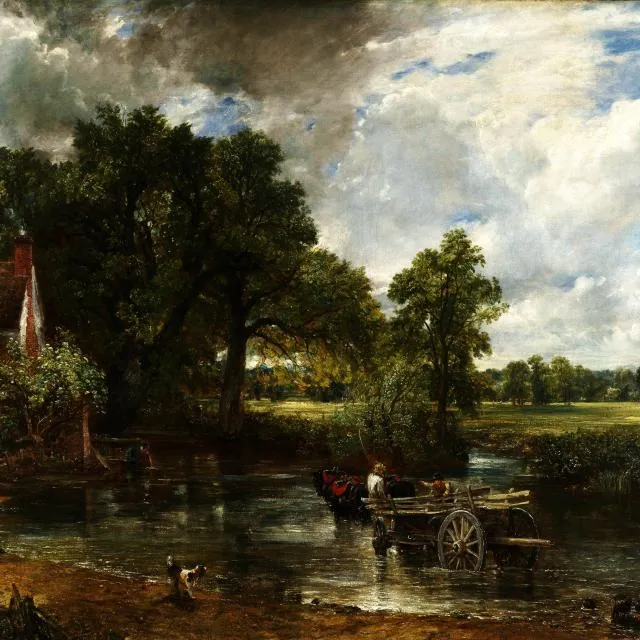
Constable was determined to be recognised by the Royal Academy for his monumental paintings of the Stour landscape that he‘d known since he was a child, elevating the scenery of his native Suffolk to the same status as the classical landscapes of Claude and Poussin he so admired.Stratford Mill was a water-powered paper mill on a little island in the River Stour outside the village of Stratford St Mary, about two miles west of East Bergholt, where Constable was born. This was the second of the six so-called ’six-footers’ – or six-foot-wide paintings – which Constable exhibited at the Royal Academy between the years 1819 and 1825, the third of which was The Hay Wain.Constable shows the paper mill in shadow, while shafts of sunlight play between the trees and on a narrow wooden gate beside the meandering river. A dying willow leans its yellowing leaves over the glassy water and we glimpse a distant sunlit farmhouse. An unladen barge is being moored to the far bank. Near the mill, a girl watches a kneeling boy cast his fishing line into the water, and it looks as though the angler to their left has just got a bite. An uprooted tree trunk lies moldering on the ground, while the dark clouds in the distance suggest showers further off.The composition for Stratford Mill developed from an oil sketch now known as Anglers at Stratford Mill (private collection), made in the summer of 1811. Constable took the sketch with him when he settled in London in 1817. He began thinking about painting a large picture of the scene and returned to details he‘d drawn in Suffolk and Essex during 1813 in his pencil sketchbook.In a small and swiftly painted oil sketch (private collection), Constable roughed in his developing ideas for the composition of a large painting, four times its size. He followed this by making a full-scale preparatory oil sketch (Yale Centre for British Art).Constable’s finished painting of Stratford Mill was selected to hang in the Great Room at the Royal Academy exhibition of 1820, where it received generally good reviews but failed to sell. Constable’s friend, Archdeacon John Fisher, who had bought Constable’s A View on the Stour, ’The White Horse‘ (Frick Collection, New York) from the 1819 Royal Academy exhibition for himself, asked if he could buy Stratford Mill as a gift for his solicitor, John Pern Tinney. Constable agreed to sell the painting for 100 guineas, which Fisher thought too low a price.When the painting was returned by the Royal Academy, Constable continued to work on it. Tinney eventually received Stratford Mill by mid-July 1821 but Fisher reported that in Tinney’s house it looked like ’an emerald in a dish of rubbish‘. To the Tinneys’ annoyance, Constable borrowed the painting back three times, first so he could work on ‘toning it down’, then for inclusion in the British Institution’s exhibition of works by living British artists, then after Tinney’s death, for it to be engraved by David Lucas. Lucas’s mezzotint was eventually published in 1840 after Constable’s death with the title The Young Waltonians, a reference to Izaak Walton’s book about fishing, The Compleat Angler, of 1653.
84 collected·88 zoomed·0 comments
About this artwork
Stratford Mill (1820) by John Constable, oil on canvas, from the National Gallery, London collection.
About John Constable
John Constable, RA (11 June 1776 – 31 March 1837) was an English landscape painter in the Romantic tradition. Born in Suffolk, he is known principally for his landscape paintings of Dedham Vale, the area surrounding his home – now known as "Constable Country" – which he invested with an intensity of affection.
More by John Constable
Comments (0)
No comments yet. Be the first to share your thoughts.