

The Battle of Jemappes

1821 · Oil on canvas
Dimensions 177.2 x 288.3 cm
Collection: National Gallery, London
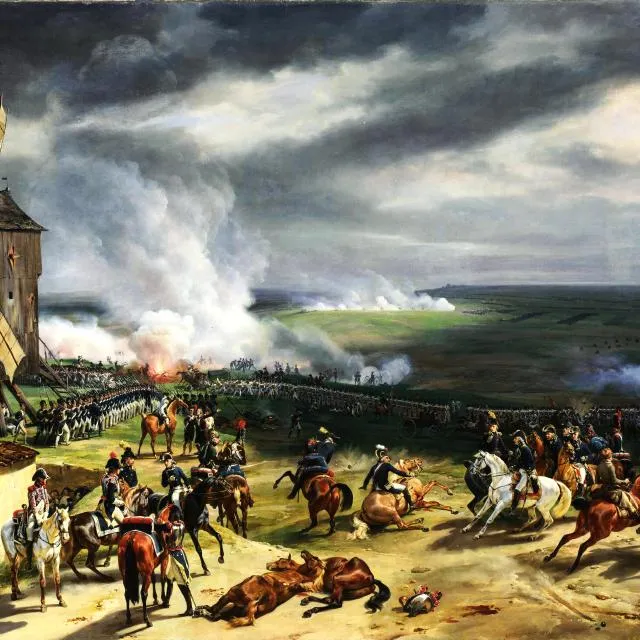
This painting was the first of the four battle scenes to be completed by Vernet for the duc d‘Orléans, having been commissioned in 1819 for 8,000 francs. It shows the Battle at Jemappes, which took place on 6 November 1792. At that time Jemappes was in the Austrian Netherlands but it is now part of the city of Mons in south-western Belgium.The battle occurred during the French Revolutionary Wars, which lasted from 1792 to 1802. The French believed that by occupying the Netherlands they could block an invasion of France by Austria and Prussia. One of the first major battles of the war, Jemappes was a victory for the newly established French Republic and for the French Armée du Nord (Army of the North) that included many inexperienced revolutionary volunteers. Under the command of General Charles-François du Perier Dumouriez, the French defeated the Austrian imperial army. Dumouriez occupied the Austrian Netherlands within a month but lost them at the Battle of Neerwinder in March 1793. They were reconquered the following summer. The duc d’Orléans had joined the Army of the North in April 1792 when France went to war with Austria. He served under Dumouriez and was present at the battles of Jemappes and Neerwinder. After the defeat at Neerwinder, he joined Dumouriez in abandoning the revolutionary cause and coming to terms with the Austrians. He never sided with France’s enemies but instead chose exile in Switzerland.Using alternating bands of light and shadow, Vernet leads our eye across the open landscape, which is partly obscured by smoke and dust, to the village of Cuesmes (its windmill can just be glimpsed through the smoke) and to Mons (identified by its bell tower) on the right. Unlike the three others in the group, this picture does not provide a close overview of the battle, which Vernet places in the distance. Instead, we are shown one episode that the duke himself had described in a five-page handwritten document noting, ‘it is necessary to show an isolated act which is characteristic of French bravery’.In the centre foreground, the French General Drouet, mortally wounded in the legs by a cannonball, is carried away from the battle. His left arm reaches out to wave at General Dumouriez, seated on a white charger, who in turn acknowledges him. Between them, mounted on a brown horse, is a female soldier dressed in blue jacket and white trousers, who turns to look back at Drouet. These looks and gestures of comradely compassion are echoed on the right, where a mounted soldier with braided hair and wearing a white jacket, offers a drink to a civilian as others flee the burning building. Even in battle there can be kindness. Barely visible in the distance, the young duc d‘Orléans, riding a white horse and ’modestly placed in the background‘ according to one commentary, leads the charge which brought about French victory. Subsequently, he was sometimes known as the ’King of Jemappes.‘The painting was not accepted for the Salon of 1822, as it was judged to be anti-royalist. Instead, Vernet included it in his own Salon d’Horace Vernet held at his studio in the same year. In the accompanying brochure, the painting was especially praised for its detail, ’This landscape has an exactitude rarely seen even among landscape artists themselves … everything is positioned as in nature; the same movements are never repeated within the same space.'
72 collected·63 zoomed·0 comments
About this artwork
The Battle of Jemappes (1821) by Horace Vernet, oil on canvas, from the National Gallery, London collection.
About Horace Vernet
Émile Jean-Horace Vernet (30 June 1789 – 17 January 1863) was a French painter of battles, portraits, and Orientalist subjects.
More by Horace Vernet
Comments (0)
No comments yet. Be the first to share your thoughts.