

The Battle of Valmy

1826 · Oil on canvas
Dimensions 174.6 x 287 cm
Collection: National Gallery, London
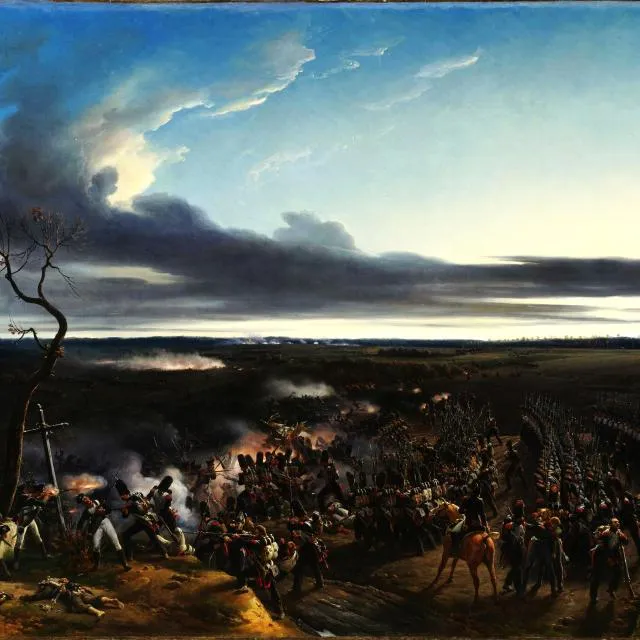
This was the last of the four battle scenes that Vernet painted for the duc d‘Orléans. Completed in April 1826, Vernet received 10,000 francs for it. Along with The Battle of Jemappes, it was one of the battles in which the duke himself had fought. His involvement was so well-known that he acquired the nickname ’Monsieur de Valmy‘.The battle was the French army’s first major victory during the wars that followed the French Revolution of 1789. Not only was Valmy the first chronologically of the four battles painted by Vernet (although painted last), but it was the most historically significant. It was a strategic and psychological victory for the new French government: within two days of victory the newly formed National Assembly abolished the monarchy and proclaimed the First French Republic. Both a vindication for French revolutionary forces and a humiliating defeat for the Prussian army, the unexpected French victory helped ensure the survival of the Revolution, which was to transform Europe. The German writer Goethe, who was at the battle with the Prussian army, tried to console his comrades by saying: ‘Here and today, a new epoch in the history of the world has begun, and you can boast you were present at its birth.’The battle took place on 20 September 1792 as Prussian troops, led by the Duke of Brunswick, marched towards Paris as part of a joint initiative by European monarchies to stop, or at least contain, the Revolution. However, the Prussian advance was halted by Generals François Kellermann and Charles Dumouriez near the village of Valmy in north-eastern France. Over half of the French infantry were regulars from the former Royal Army, as were most of the cavalry and artillery. This core of veterans was reinforced by volunteer battalions, whose patriotic fervour compensated for their lack of training and experience.Vernet organises the composition around a triangle of raised sunlit ground, its edges defined by rows of soldiers. He gives a prominent position to the old windmill around which Kellermann based his command. Two dead horses are placed close to us. Slightly behind them to the left, the duc d’Orléans and his younger brother, the duc de Montpensier, who had also fought at Jemappes, report on the battle to the comte de Rochambeau. Their presence is a reminder of their early commitment to the Revolution.The duc de Montpensier later recounted: ‘All the old soldiers have said they have never experienced such an intense situation; we were also as exposed as the regular soldiers, shells falling around us. General Kellermann was hit by a bullet which took part of his coat and gravely wounded his horse, but he, thank God, was unharmed; we were surrounded by bodies, by the dying wounded, pools of blood, never have I seen such a horrible sight; I believe we lost, both dead and gravely wounded, around 400 to 500 men; this sum is by no means exaggerated; but what touched me to my soul was seeing this motionless infantry watch their comrades fall at any moment amongst them shouting: Long Live the Nation!’Vernet provides both historical authenticity, as we see the battle from Kellermann’s position on the slopes near Valmy, and meteorological accuracy – the almost black clouds are a reminder of the heavy downpour prior to the battle. As in the other pictures in the group, however, the soldiers are not merely their uniforms, but individuals whose gestures and expressions help draw us into the picture.
82 collected·78 zoomed·0 comments
About this artwork
The Battle of Valmy (1826) by Horace Vernet, oil on canvas, from the National Gallery, London collection.
About Horace Vernet
Émile Jean-Horace Vernet (30 June 1789 – 17 January 1863) was a French painter of battles, portraits, and Orientalist subjects.
More by Horace Vernet
Comments (0)
No comments yet. Be the first to share your thoughts.