

The Betrayal of Christ

possibly 1325-8 · Egg tempera on poplar
Dimensions 40.4 x 58.8 cm
Collection: National Gallery, London
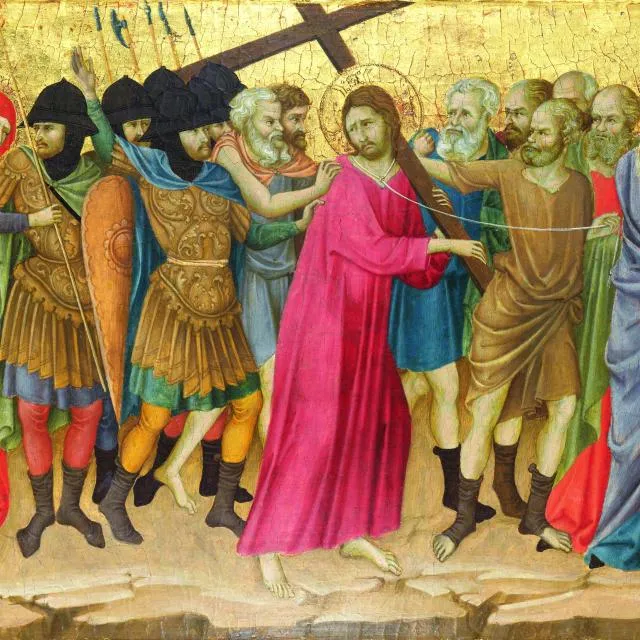
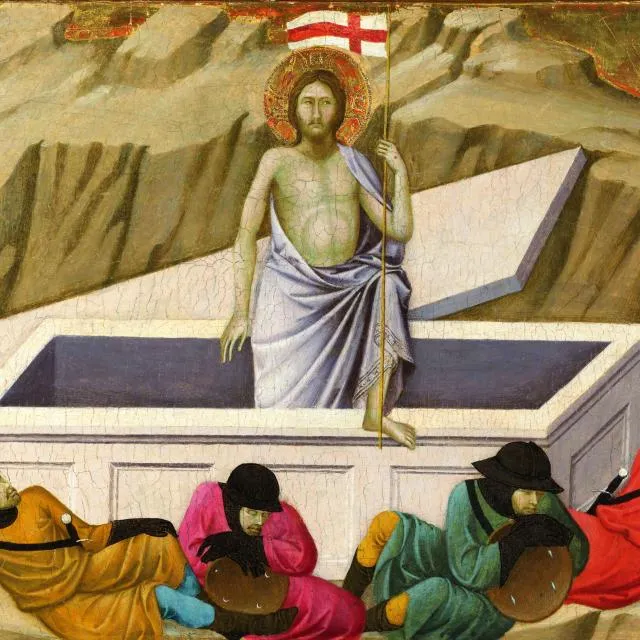
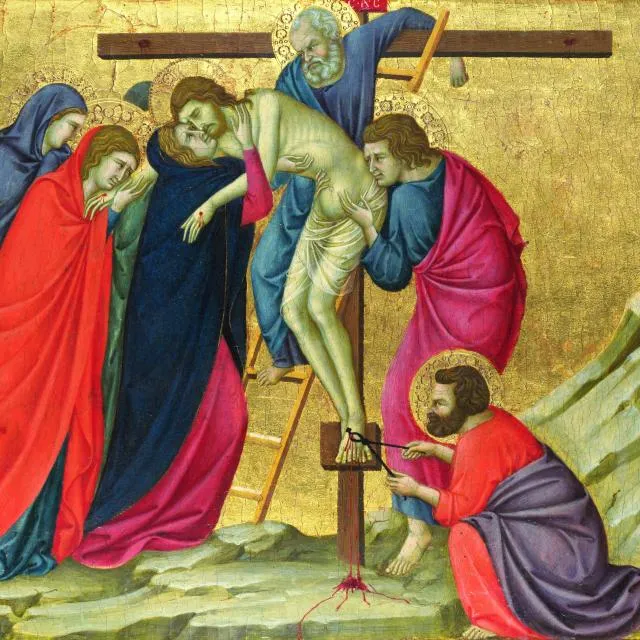
This panel comes from the predella of Ugolino’s altarpiece for the church of Santa Croce in Florence. The predella ran along the bottom of the entire altarpiece and was, as was usual, originally painted on one horizontal panel. It was then cut into individual scenes. There are three other scenes in our collection: The Way to Calvary, The Deposition and The Resurrection.This was the second scene on the predella, positioned between images of the Last Supper (Lehman Collection, Metropolitan Museum of Art, New York) and the Flagellation (Gemäldegalerie, Berlin). It shows the moment, described in the Gospels, when Christ was arrested by Roman soldiers. The soldiers appear on the right-hand side in elaborate armour; their helmets were originally silver but the silver leaf has darkened over time. They carry lanterns and spears – Ugolino has taken this small detail from the Gospel account (John 18: 3) – and are accompanied by chief priests from the Jewish Temple (the bearded men on the left). Before the painting entered our collection, the soldiers‘ eyes were damaged – most probably deliberately.The arrest was organised by Christ’s disciple Judas. We see him in the centre of the scene, kissing Christ on the cheek – a prearranged signal for the authorities: ’The one I shall kiss is the man; seize him and lead him away under guard‘ (Mark 14: 44–45). As this is happening, Christ raises his hand to rebuke Peter, who is assaulting one of the men present. According to the Gospels, Christ told Peter to put his weapon away – he knew that human force was no longer necessary and that he would have to suffer death according to the will of God: ’shall I not drink the cup which the Father has given me?’ (John 18: 11).Christ’s response to Peter’s aggression emphasises his acceptance of his fate and the contrast between his accusers' violence and his own peaceful attitude. The predella as a whole narrated Christ’s torture and death, known as the Passion. This was suitable for the altarpiece, as it focused on Christ’s ultimate conquest of death through the Resurrection.Ugolino has based the design of this image closely on a scene of the same subject by his Sienese contemporary Duccio, who included it in the scenes on the back of his famous altarpiece known as the Maestà. The main difference is that Ugolino has used fewer figures.
53 collected·43 zoomed·0 comments
About this artwork
The Betrayal of Christ (possibly 1325-8) by Ugolino di Nerio, Egg tempera on poplar, from the National Gallery, London collection.
More by Ugolino di Nerio
Comments (0)
No comments yet. Be the first to share your thoughts.