

The Deposition

possibly 1325-8 · Egg tempera on poplar
Dimensions 40.7 x 58.6 cm
Collection: National Gallery, London
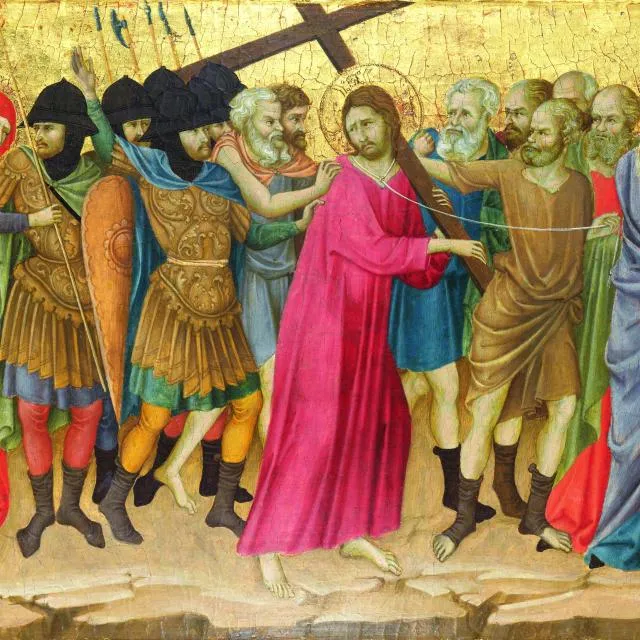
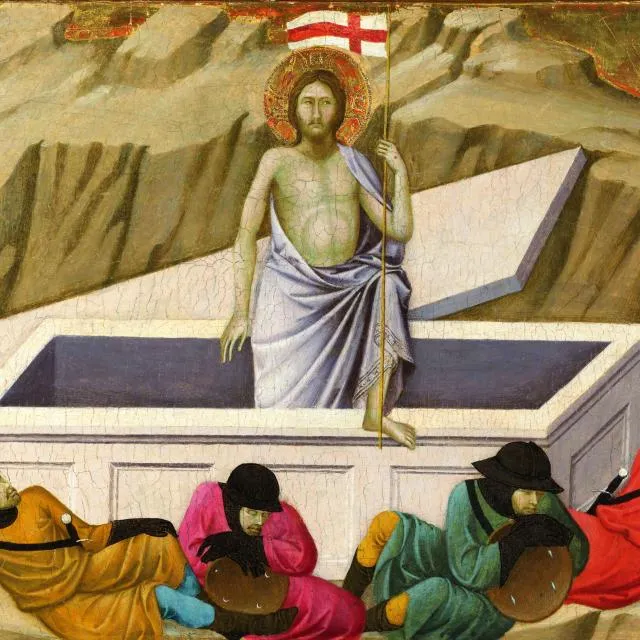
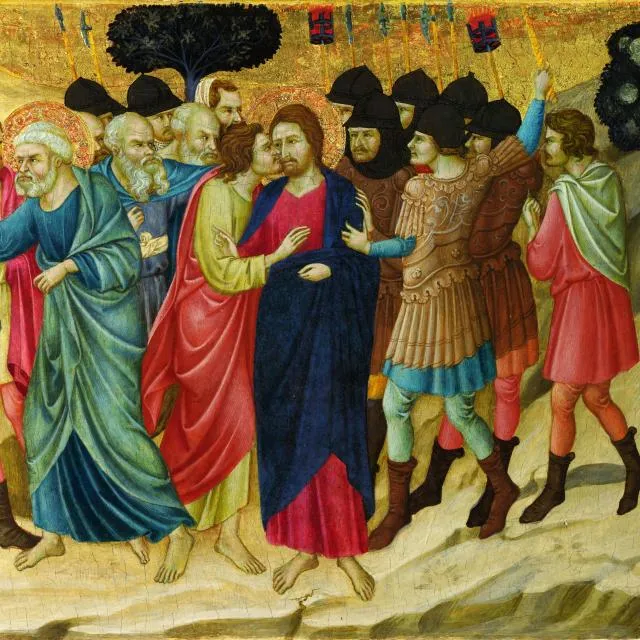
This panel comes from the predella of Ugolino’s altarpiece for the church of Santa Croce in Florence. The predella ran along the bottom of the entire altarpiece and was, as was usual, originally painted on one horizontal panel. It was then cut into individual scenes. There are three others in our collection: The Betrayal of Christ, The Way to Calvary and The Resurrection.The dead Christ is being removed from the Cross, and Saint John the Evangelist clutches him mournfully. One man pulls the nails from his feet; blood from his wounds has pooled on the ground below. This may be Nicodemus, a Pharisee who is mentioned in the Gospel of John as having come to the Cross with spices to anoint Christ’s body. Joseph, a man from the town of Arimathea, appears in both Luke’s and John’s Gospels; according to Luke, he removed the body from the Cross alone. It is likely, then, that the man on the ladder is Joseph of Arimathea.Christ’s limp body collapses as he is gradually freed from the Cross, and he is caught by his mother, the Virgin Mary. She embraces him, placing her face against his in a tender gesture that reminds the viewer of their relationship. The Virgin is accompanied by three other women. Mary Magdalene caresses Christ’s hand, pressing it against her cheek. A woman in green behind is only barely visible. Technical analysis has shown that her head – which can be seen between the haloes of Mary Magdalene and Christ – is painted over the gilded background. This implies that she was added at a late stage of the painting process, over the gilding: usually the artist would reserve a space for the painted figures so as not to waste precious gold leaf. The place where Jesus was crucified was known as Golgotha (‘the place of the skull’). The absence of trees and the arid, craggy rocks seem a fitting landscape for a place with such a bleak name.Here, and in the other predella panels, Ugolino used panels from an altarpiece known as the Maestà, made by his Sienese predecessor Duccio, as a model for the composition – though he includes fewer figures. Here he has omitted two of the women who appear in Duccio’s depiction of this subject.
59 collected·42 zoomed·0 comments
About this artwork
The Deposition (possibly 1325-8) by Ugolino di Nerio, Egg tempera on poplar, from the National Gallery, London collection.
More by Ugolino di Nerio
Comments (0)
No comments yet. Be the first to share your thoughts.