

The Dead Christ with Angels

1514 · Oil on wood
Dimensions 98.1 x 202.5 cm
Collection: National Gallery, London
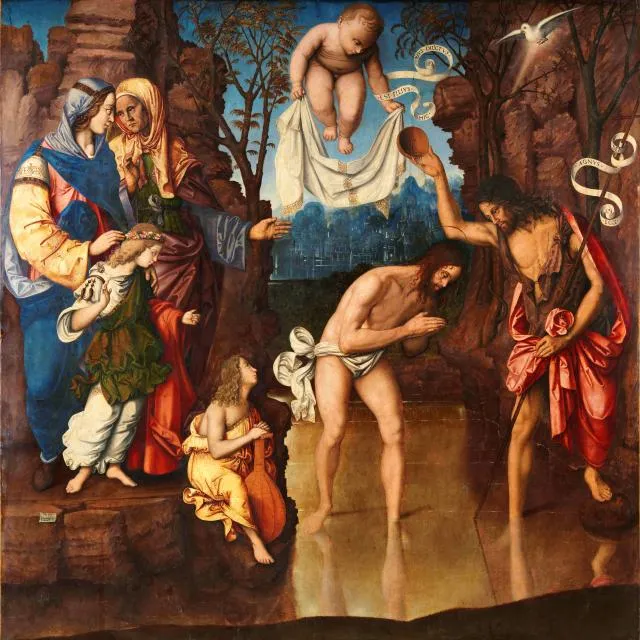
This is the lunette, or upper panel, of the altarpiece painted by Francesco Zaganelli for the chapel of the Visitation in the church of S. Andrea in Vineis, Faenza (the church was rebuilt in the eighteenth century and rededicated as S. Domenico, Faenza).The dead Christ sits on the lid of his stone tomb, supported by two wingless grieving angels who kneel beside him. The angel on the left seems to look down at the wound in Christ’s side; its companion gazes up sorrowfully at Christ’s face. Christ’s legs hang over the front of the tomb, which is made of brown breccia marble. Breccia is a kind of rock composed of broken fragments of minerals or rock naturally cemented together.The lid of the tomb is placed obliquely so that it seems to project into our space, as do Christ’s legs. The sole of his right foot is foreshortened and seen from below. Both soles are marked by the wounds from the nails hammered into Christ’s feet during the Crucifixion (known as the stigmata), and Christ still wears the crown of thorns placed on his head by his tormentors. Zaganelli has represented Christ’s body in our space to emphasise that it is the origin of the Host (consecrated bread) that would be placed on the altar below the painting during the sacrament of the Eucharist. In the lunette, Christ’s tomb itself resembles an altar, and perhaps the distinctive pattern of the breccia marble that Zaganelli has painted matched that of the front of the actual altar originally below the painting.The scene of the dead Christ forms the culmination of the prophecy and episodes depicted in the main panel of the altarpiece below, which represents the Visitation and Christ’s baptism. A scroll inscribed ‘Ecce Agnus Dei’ (‘Behold the Lamb of God’) is attached to the reed cross that Saint John the Baptist holds. This refers to Christ, who was to be sacrificed like a lamb for the salvation of humanity. The Baptist pours water from the river Jordan onto the head of Christ, who clasps his hands in prayer and accepts God’s will.The other Latin inscription, held by the hovering angel with the shroud-like cloth, translates as: ‘This is my beloved Son.’ It represents the word of God. According to the Gospels, after Christ had been baptised, the Holy Ghost descended upon him in the form of a dove and a voice from heaven said: ‘This is my beloved Son, with whom I am well pleased’ (Matthew 3: 17). In the scene of the Visitation, Saint Elizabeth, the mother of John the Baptist, looks at the Virgin Mary and points to the scene of baptism which foretells the future of her unborn son. The crucified Christ rising from the tomb in the lunette above shows the destiny accepted by Christ, the Virgin Mary’s son, at his baptism.
61 collected·38 zoomed·0 comments·1 boards
This artwork is in 1 board
About this artwork
The Dead Christ with Angels (1514) by Francesco Zaganelli, oil on wood, from the National Gallery, London collection.
More by Francesco Zaganelli
Comments (0)
No comments yet. Be the first to share your thoughts.