

The Visitation with the Baptism of Christ

1514 · Oil on wood
Dimensions 200.7 x 190.5 cm
Collection: National Gallery, London
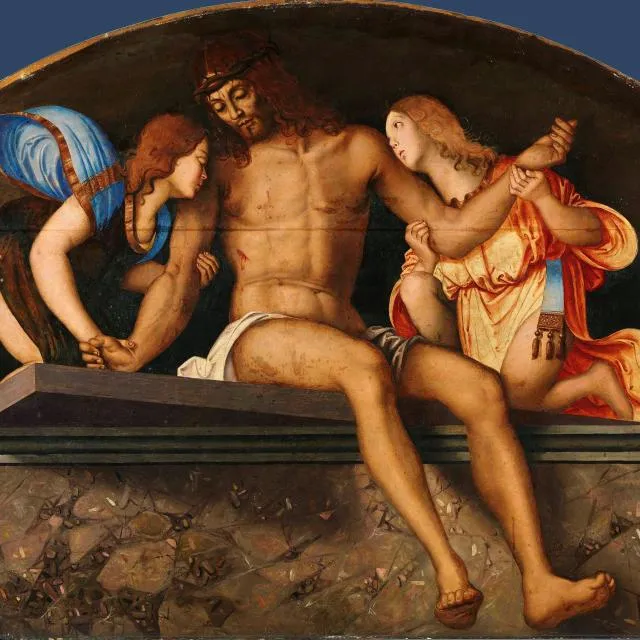
This is the main panel of the altarpiece that Francesco Zaganelli painted for the chapel of the Visitation in the church of S. Andrea in Vineis, Faenza (the church was rebuilt in the eighteenth century and rededicated as S. Domenico).A scroll inscribed ‘Ecce Agnus Dei’ (‘Behold the Lamb of God’) is attached to the reed cross that Saint John the Baptist holds. The inscription refers to Christ, who will be sacrificed like a lamb for the salvation of humanity. The saint pours water from a bowl onto the head of Christ, who clasps his hands in prayer and accepts God’s will.Christ stands in the river Jordan, framed by cliffs and trees. The lights of a distant town are reflected in its still waters, from which the buildings and trees apparently emerge. The unusually wild and rocky setting is found in earlier paintings of Christ’s baptism, such as the fresco by Giotto in the Scrovegni Chapel in Padua. The landscape setting, the complex draperies and facial features also recall the work of German artists such as Patinir, Dürer and Altdorfer.According to the Gospels, after Christ had been baptised the Holy Ghost descended upon him in the form of a dove and a voice from heaven said: ‘This is my beloved Son, with whom I am well pleased’ (Matthew 3: 17). The first part of this sentence is inscribed in Latin on the scroll around the left arm of the infant hovering above Christ. The child may represent the Word Incarnate (the word of God given physical form), as seen in paintings of the Annunciation from the Emilia-Romagna region at this date. He holds an embroidered cloth reminiscent of a shroud – perhaps for Christ to dry himself on, or as a foreshadow of Christ’s Passion and death. The dead Christ with angels is the subject of the lunette, or upper part, of the altarpiece.Although his baptism is the main action of the picture, Christ is placed slightly off-centre. Two women, an angel crowned with flowers and a musician angel occupy the left foreground. The altarpiece was painted for a chapel dedicated to the Visitation, so the two women probably represent the Virgin Mary and Saint Elizabeth. When Mary visited her pregnant cousin Elizabeth, the unborn John the Baptist leapt in Elizabeth’s womb. Here Elizabeth, pointing to the main scene, shows Mary the future encounter of their unborn sons. Combining both episodes in one painting was very rare at this time.The haloes of Christ and the Virgin Mary in the main panel are painted in a distinctive and unusual manner: raised dots of greyish-white paint are superimposed on an ellipse. Similar raised dots are also present on the borders of garments and employed at a few points on the surface of the water. Numerous fingerprints are visible in the paint.
69 collected·89 zoomed·0 comments
About this artwork
The Visitation with the Baptism of Christ (1514) by Francesco Zaganelli, oil on wood, from the National Gallery, London collection.
More by Francesco Zaganelli
Comments (0)
No comments yet. Be the first to share your thoughts.