

The Flaying of Marsyas

1616-18 · Fresco, transferred to canvas and mounted on board
Dimensions 210.2 x 331.4 cm
Collection: National Gallery, London
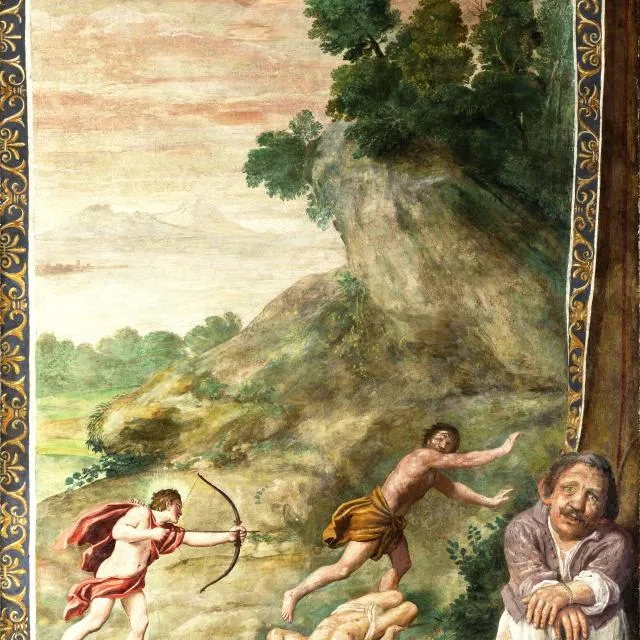
The mythological story of the musical competition between the god Apollo and the satyr Marsyas is told in Ovid’s Metamorphoses (VI, 382ff.). Marsyas challenged Apollo to a music contest, which the god won. To punish him for his presumption, Apollo then skinned Marsyas alive. Here the satyr is tied to a tree while Apollo, in a red cloak and with his lyre on the grass beside him, leans forward to plunge his knife into Marsyas' skin. They are surrounded by a group of fauns, nymphs and other figures.This is one of ten frescoes by Domenichino and assistants depicting stories of Apollo which originally adorned the walls of a room known as the Stanza di Apollo in a garden pavilion in the grounds of the Villa Aldobrandini at Frascati, near Rome. Eight of the frescoes were transferred to canvas and are now in our collection. The decoration of the room glorified the Aldobrandini family and expressed their philosophical and religious ideas. For them, Apollo was not just the classical god of the sun, but also the light of reason. By contrast, Marsyas, whose half-animal nature is seen in his hairy legs, represented the sensual and brutish aspects of human nature, and his grisly death symbolised the triumph of reason over man’s darker passions.This, the only fresco in a horizontal format, was originally positioned over the entrance and so would have been seen last, as the viewer turned to leave the room. Its composition, which is centrally arranged, would have been viewed directly from below and the scene summed up the theme of the entire room. The tapestry border is a modern addition.There are five preparatory drawings for figures in this scene in the Royal Collection at Windsor Castle, and a sixth for the landscape background. One figure was changed in the final painting: the kneeling satyr was originally standing, suggesting that Domenichino may have been actively involved in painting this particular fresco. Of the other scenes in the Stanza, Domenichino was responsible for their design but the actual painting was left largely to assistants.
82 collected·98 zoomed·0 comments
About this artwork
The Flaying of Marsyas (1616-18) by Domenichino and assistants, fresco, transferred to canvas and mounted on board, from the National Gallery, London collection.
More by Domenichino and assistants


Comments (0)
No comments yet. Be the first to share your thoughts.