

The Transformation of Cyparissus

1616-18 · Fresco, transferred to canvas and mounted on board
Dimensions 120 x 88.3 cm
Collection: National Gallery, London
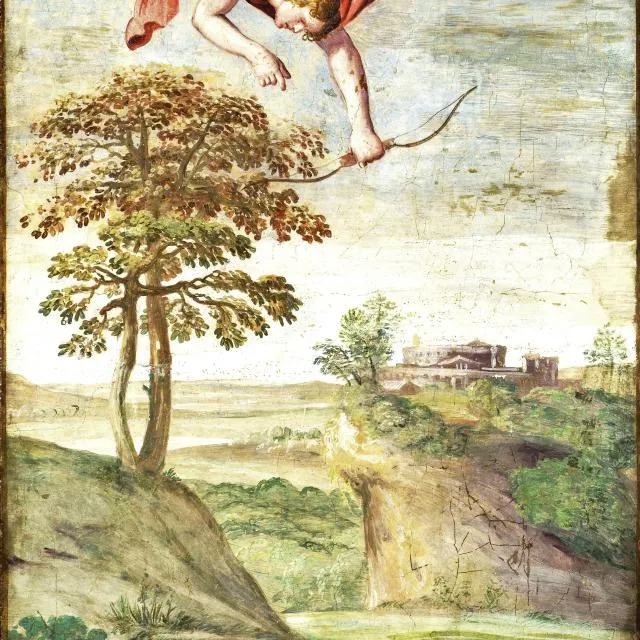
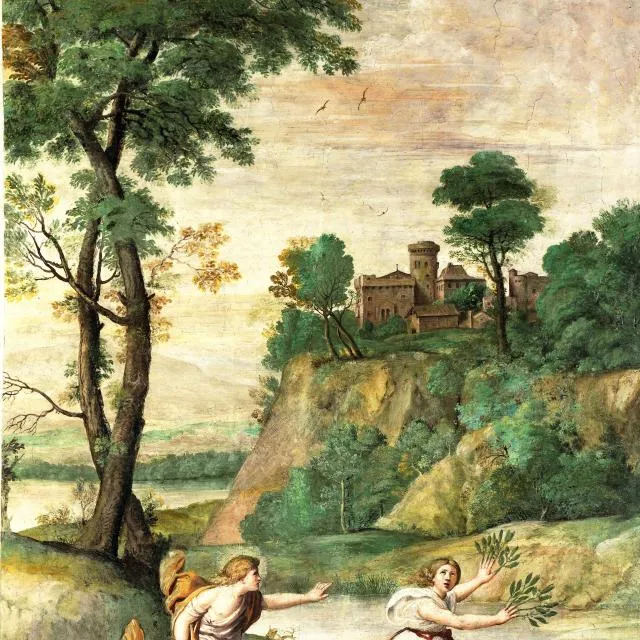
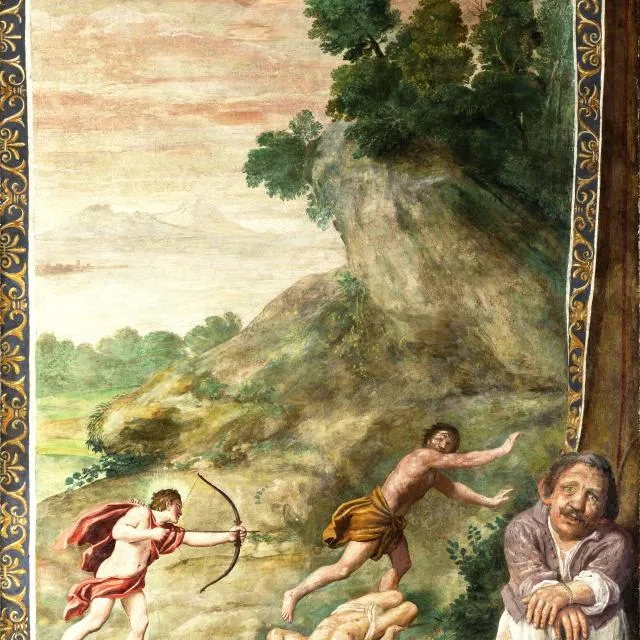
A young man stands next to the body of a stag which he has just shot with an arrow: his bow lies on the ground at his feet. His hands are flung up in horror, and greenery is growing from his fingers and from his head. This is the story of Cyparissus, a favourite of Apollo, who has accidentally killed his own pet stag (Ovid, Metamorphoses (X, 126ff.). He was so distressed that he begged Apollo to be allowed to mourn forever, so Apollo transformed him into a cypress tree, the symbol of mourning.This is one of ten frescoes by Domenichino and assistants which originally adorned the walls of a room known as the Stanza di Apollo in a garden pavilion in the grounds of the Villa Aldobrandini in Frascati, near Rome. Eight of them were transferred to canvas and are now in our collection. All show stories of Apollo, mainly taken from the Roman poet Ovid’s Metamorphoses.This scene was on the left-hand side of the room, next to Apollo pursuing Daphne. The original detachment of this fresco from the wall was not completely successful and the upper, smaller portion containing the figure of Apollo is still in situ at Frascati.Although Domenichino was responsible for the overall design of the frescoes he did not invent the iconography, but based it on a long tradition of illustrated printed editions of Ovid’s famous poem. He may have used Antonio Tempesta’s 1606 edition, although he revised the compositions extensively to make them clearer and more legible, and to adapt their shape from horizontal to vertical to fit the Stanza’s walls.A chalk drawing by Domenichino for the figure of Apollo in this painting is in the Royal Collection at Windsor Castle. Although Domenichino is responsible for the design of this scene, much of the actual painting seems to have been left to assistants.
54 collected·38 zoomed·0 comments
About this artwork
The Transformation of Cyparissus (1616-18) by Domenichino and assistants, fresco, transferred to canvas and mounted on board, from the National Gallery, London collection.
More by Domenichino and assistants
Comments (0)
No comments yet. Be the first to share your thoughts.